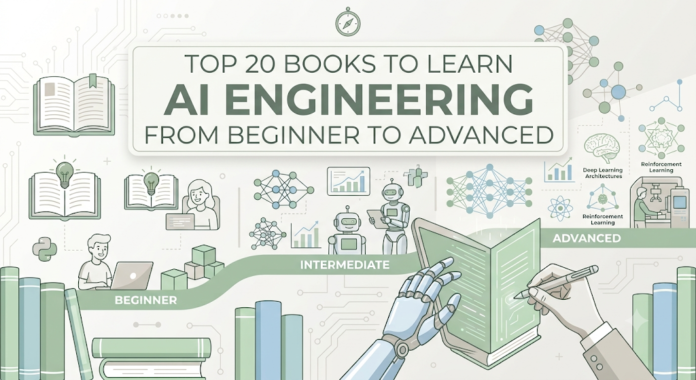
Artificial intelligence has evolved from an academic discipline into one of the fastest-growing engineering fields in the world. Today, AI engineers are expected to understand much more than machine learning algorithms. They must work with data engineering, distributed systems, cloud infrastructure, deep learning, large language models, vector databases, MLOps, retrieval-augmented generation, and production deployment.
With thousands of online courses, YouTube tutorials, and AI newsletters available, many aspiring engineers feel overwhelmed by the sheer volume of learning resources. While short videos can teach individual concepts, books remain one of the best ways to develop deep technical understanding and long-term problem-solving skills.
The right AI engineering books do more than explain algorithms. They teach you how to think like an engineer, understand why systems work, and connect theory with real-world implementation. Whether you are a student, software developer, data scientist, or experienced engineer moving into artificial intelligence, a carefully selected reading list can save hundreds of hours of confusion.
This guide presents twenty of the best AI engineering books, organized into a logical learning path. Instead of simply listing titles, we explain what each book teaches, who should read it, the skills you will gain, and where it fits in your AI engineering journey.
Why Books Still Matter in AI Engineering
Artificial intelligence changes quickly, but the core principles behind successful AI systems evolve much more slowly. Frameworks may change every year, but mathematics, optimization, probability, distributed computing, and system design remain foundational.
Books provide structured learning that random tutorials cannot match.
They help readers understand relationships between concepts instead of memorizing isolated techniques.
For example, learning how neural networks work becomes much easier when you already understand calculus, probability, and optimization.
Similarly, building production AI systems becomes more intuitive after understanding software architecture and distributed computing.
What Makes a Good AI Engineering Book?
Not every AI book is suitable for aspiring engineers.
The best books usually combine theoretical understanding with practical implementation.
A high-quality AI engineering book should help readers:
- Understand fundamental concepts.
- Learn practical implementation.
- Build real-world projects.
- Improve problem-solving skills.
- Understand production deployment.
- Scale AI applications.
- Develop engineering thinking.
Skills Covered by These Books
| Skill Area | What You Will Learn |
|---|---|
| Mathematics | Linear algebra, calculus, probability, optimization |
| Machine Learning | Regression, classification, clustering |
| Deep Learning | Neural networks, CNNs, transformers |
| Data Engineering | Pipelines, storage, distributed systems |
| MLOps | Deployment, monitoring, automation |
| Large Language Models | Prompt engineering, RAG, fine-tuning |
| AI System Design | Production architecture and scalability |
| Cloud AI | Modern deployment infrastructure |
Recommended Reading Roadmap
Many beginners start with advanced deep learning books before understanding statistics or machine learning fundamentals.
That usually creates unnecessary confusion.
Instead, follow a gradual learning path.
| Stage | Learning Goal |
|---|---|
| Stage 1 | Mathematics |
| Stage 2 | Statistics |
| Stage 3 | Machine Learning |
| Stage 4 | Deep Learning |
| Stage 5 | Data Engineering |
| Stage 6 | AI Systems |
| Stage 7 | Large Language Models |
| Stage 8 | Production AI |
This roadmap allows every concept to build naturally upon previous knowledge.
1. Mathematics for Machine Learning
Why This Book Matters
Every successful AI engineer eventually realizes that mathematics is not optional.
Machine learning algorithms depend heavily on linear algebra, probability, calculus, vectors, matrices, and optimization.
Without these foundations, understanding model behavior becomes difficult.
Fortunately, this book explains mathematical concepts from an engineering perspective rather than a purely academic one.
Instead of memorizing formulas, readers learn why mathematics is essential for AI.
Best For
- Beginners
- Software developers
- Computer science students
- Data science learners
Main Topics
| Topics Covered |
|---|
| Linear Algebra |
| Calculus |
| Probability |
| Statistics |
| Matrix Operations |
| Optimization |
Skills You Gain
- Better understanding of machine learning algorithms.
- Improved debugging ability.
- Strong mathematical intuition.
- Easier transition into deep learning.
2. Artificial Intelligence: A Modern Approach
Often called the “AI Bible,” this book provides one of the most comprehensive introductions to artificial intelligence.
Rather than focusing only on machine learning, it explores the broader field of AI.
Readers learn how intelligent systems reason, search, make decisions, and solve problems.
The concepts remain relevant regardless of future technological changes.
Key Topics
- Search algorithms
- Intelligent agents
- Knowledge representation
- Planning
- Logic
- Decision making
- Robotics
- Ethics
Ideal Readers
| Experience Level | Recommendation |
|---|---|
| Beginner | Moderate |
| Intermediate | Excellent |
| Advanced | Excellent |
3. Deep Learning
Written by leading AI researchers, this book has become one of the most respected references in modern deep learning.
Rather than teaching only implementation, it explains the scientific reasoning behind neural networks.
Readers explore activation functions, optimization, convolutional networks, recurrent models, regularization, and representation learning.
This book rewards slow, careful reading.
Topics Covered
| Subject | Importance |
|---|---|
| Neural Networks | Very High |
| CNNs | Very High |
| Optimization | Very High |
| Backpropagation | High |
| Representation Learning | High |
4. An Introduction to Statistical Learning
Statistics is the language of machine learning.
This book explains predictive modeling using practical examples instead of complicated mathematics.
Readers learn how different algorithms behave and when each method should be used.
It serves as one of the best introductions to supervised learning.
Topics
- Regression
- Classification
- Cross Validation
- Decision Trees
- Random Forest
- Support Vector Machines
Why Read It
It creates a strong bridge between mathematics and practical machine learning.
5. Machine Learning with PyTorch and Scikit Learn
After learning theory, engineers need practical implementation.
This book focuses on building complete machine learning workflows using Python.
Readers move beyond concepts into coding real models.
Major Learning Areas
| Area | Practical Skills |
|---|---|
| Data preprocessing | Cleaning datasets |
| Model training | Classification |
| Evaluation | Performance metrics |
| Feature engineering | Better predictions |
| Pipelines | End to end workflows |
6. Hands On Machine Learning with Scikit Learn, Keras, and TensorFlow
Few books combine theory and practical coding as effectively as this one.
It explains machine learning step by step while providing working Python examples.
Readers gradually progress from simple regression models to modern neural networks.
Why Engineers Love This Book
- Practical code examples.
- Excellent explanations.
- Industry relevance.
- Covers classical ML and deep learning.
- Updated for modern frameworks.
7. Generative Deep Learning
Generative AI has transformed software development.
This book explains how machines create new content rather than simply making predictions.
Readers explore:
- GANs
- Variational Autoencoders
- Diffusion Models
- Image Generation
- Music Generation
- Text Generation
It serves as an excellent bridge into today’s AI landscape.
8. Deep Reinforcement Learning Hands On
Reinforcement learning teaches machines through interaction rather than labeled datasets.
Instead of predicting answers, agents learn through rewards.
This book demonstrates how AI systems gradually improve by making decisions.
Applications
| Industry | Example |
|---|---|
| Robotics | Autonomous movement |
| Gaming | Intelligent agents |
| Finance | Trading strategies |
| Manufacturing | Process optimization |
| Autonomous Vehicles | Navigation systems |
9. Build a Large Language Model From Scratch
Understanding APIs is useful.
Understanding how large language models actually work is far more valuable.
This book explains transformer architecture, tokenization, embeddings, attention mechanisms, training, and inference.
Readers gain a much deeper understanding of today’s AI revolution.
Major Topics
- Transformers
- Self Attention
- Tokenization
- Embeddings
- Language Modeling
- Fine Tuning
10. Designing Data Intensive Applications
Many beginners underestimate the importance of data engineering.
In reality, production AI systems depend on reliable storage, networking, distributed computing, scalability, and fault tolerance.
This book explains those concepts exceptionally well.
What You’ll Learn
| Concept | Importance |
|---|---|
| Distributed Systems | Very High |
| Databases | Very High |
| Scalability | Very High |
| Reliability | High |
| Data Pipelines | High |
Without understanding data systems, building enterprise AI applications becomes extremely difficult.
11. Learning Spark, Second Edition
Once you understand machine learning fundamentals, the next challenge is processing massive amounts of data efficiently. This is where Apache Spark becomes invaluable. Learning Spark teaches you how to build distributed data pipelines capable of handling terabytes or even petabytes of information.
Unlike traditional Python scripts that struggle with enormous datasets, Spark distributes computation across multiple machines, making AI workflows significantly faster and more scalable.
Why this book matters
Many production AI systems rely on Spark for preprocessing data before model training. Whether you work in recommendation systems, fraud detection, or enterprise analytics, Spark knowledge is a valuable skill.
Key topics covered
- Spark architecture
- DataFrames and Spark SQL
- Machine learning pipelines
- Structured streaming
- Performance optimization
Best for
- Data engineers
- ML engineers
- AI platform developers
12. Spark: The Definitive Guide
If Learning Spark introduces the fundamentals, Spark: The Definitive Guide takes your understanding much deeper.
The book explores advanced optimization techniques, distributed computing concepts, cluster management, and production level Spark deployments.
Large organizations processing billions of records every day frequently rely on Spark, making this book extremely valuable for engineers working at scale.
| Feature | Benefit |
|---|---|
| Advanced Spark concepts | Better performance |
| Cluster optimization | Lower infrastructure costs |
| Large scale processing | Enterprise readiness |
| Data engineering workflows | AI pipeline support |
13. High Performance Spark
Simply knowing Spark isn’t enough.
The real challenge is making Spark applications run efficiently while minimizing hardware costs.
This book focuses entirely on performance optimization.
Readers learn:
- Memory management
- Partition optimization
- Shuffle reduction
- Resource allocation
- Execution planning
These concepts become increasingly important when training large AI models where inefficient data processing can increase costs dramatically.
14. Scaling Machine Learning with Spark
Machine learning often starts on a laptop but eventually needs to serve millions of users.
Scaling Machine Learning with Spark explains how to bridge that gap.
Topics include:
- Distributed feature engineering
- Large dataset preparation
- Parallel model training
- Production deployment
- Performance monitoring
This book is ideal for engineers transitioning from experimentation to enterprise AI systems.
Cloud AI Engineering
Modern AI rarely runs on a personal computer.
Most production systems use cloud infrastructure.
Understanding cloud AI tools is therefore becoming essential.
15. Generative AI on Google Cloud with LangChain
Generative AI applications require far more than simply calling an API.
This book demonstrates how to build complete AI applications using cloud infrastructure.
Major concepts include:
- Vector databases
- Retrieval Augmented Generation
- LangChain
- Prompt engineering
- Cloud deployment
- AI agents
- Document retrieval
Readers also learn how enterprise organizations secure, monitor, and deploy LLM applications.
Ideal audience
- AI developers
- Cloud engineers
- Startup founders
- Product engineers
Production AI Systems
Many AI books explain how to train models.
Very few explain how to operate them successfully in production.
The following books fill that gap.
16. Designing Machine Learning Systems
This is one of the most recommended books among experienced ML engineers.
Instead of focusing on algorithms, it explains how successful AI products are actually built.
Topics include:
- Data collection
- Feature engineering
- Model deployment
- Continuous training
- Monitoring
- Drift detection
- Experiment tracking
- Scalability
One of the biggest lessons from this book is that building the model often represents only a small portion of the overall engineering effort.
| Learning Area | Practical Value |
|---|---|
| Data pipelines | High |
| Monitoring | High |
| Deployment | High |
| Experimentation | High |
| Scalability | Very High |
17. AI Engineering
As its title suggests, this book focuses specifically on AI engineering rather than machine learning research.
Readers learn how modern AI products combine:
- LLMs
- Vector databases
- APIs
- Retrieval systems
- Workflow automation
- Production infrastructure
The emphasis remains on solving business problems rather than publishing research papers.
This makes it one of the most practical books available today.
18. Building LLMs for Production
Learning how transformers work is only the beginning.
Building LLMs for Production explains everything required after model development.
Topics include:
- Model deployment
- Inference optimization
- Vector search
- Retrieval systems
- Prompt optimization
- Security
- Cost optimization
- Monitoring
- Evaluation
For anyone planning to build enterprise AI assistants or intelligent search systems, this book provides valuable guidance.
19. LLM Engineer’s Handbook
This is among the newest resources dedicated entirely to Large Language Model engineering.
Instead of spending hundreds of pages explaining transformer mathematics, it concentrates on practical implementation.
Readers learn:
- Prompt engineering
- Context management
- Retrieval pipelines
- Function calling
- AI agents
- Evaluation frameworks
- Fine tuning basics
- Production deployment
Many examples resemble real products currently being developed across the AI industry.
20. Generative AI System Design Interview
Technical interviews increasingly include AI system design questions.
This book prepares readers to answer them effectively.
Instead of coding algorithms, it focuses on designing complete AI systems.
Example interview problems include:
- Design ChatGPT
- Build an AI search engine
- Create an AI recommendation system
- Design enterprise document search
- Develop an AI customer support assistant
Learning system design also improves your ability to architect real production systems.
Best Reading Roadmap for AI Engineers
Reading twenty books randomly can become overwhelming.
A structured roadmap makes learning far more effective.
| Stage | Recommended Books |
|---|---|
| Foundation | Mathematics for Machine Learning, Artificial Intelligence: A Modern Approach |
| Machine Learning | An Introduction to Statistical Learning, Hands On Machine Learning |
| Deep Learning | Deep Learning, Generative Deep Learning |
| LLM Fundamentals | Build a Large Language Model From Scratch |
| Data Engineering | Designing Data Intensive Applications, Learning Spark |
| Production AI | Designing Machine Learning Systems, AI Engineering |
| Advanced LLM Engineering | Building LLMs for Production, LLM Engineer’s Handbook |
| Interview Preparation | Generative AI System Design Interview |
How Long Does It Take to Read These Books?
Every book serves a different purpose.
Some are reference books that require months of study, while others can be completed within a few weeks.
| Experience Level | Estimated Time |
|---|---|
| Beginner | 12 to 18 months |
| Intermediate Developer | 8 to 12 months |
| Full Time Learner | 5 to 8 months |
| Experienced Engineer | 4 to 6 months |
The goal should never be speed. Understanding and applying the concepts matters far more than simply finishing every chapter.
Books Alone Are Not Enough
Many aspiring AI engineers believe reading books is sufficient to secure a job. In reality, employers value practical experience just as much as theoretical knowledge.
After completing each book, reinforce your learning by building projects such as:
- A recommendation engine
- A sentiment analysis application
- A document question answering system
- An AI chatbot
- A Retrieval Augmented Generation application
- A computer vision classifier
- A voice assistant
- A personal AI coding assistant
Projects demonstrate your ability to translate knowledge into real solutions.
Common Mistakes While Learning AI Engineering
Many learners struggle because they focus on the wrong priorities.
Some of the most common mistakes include:
- Learning too many frameworks before mastering the fundamentals.
- Ignoring mathematics and statistics.
- Reading books without implementing projects.
- Memorizing code instead of understanding concepts.
- Jumping directly into LLMs without learning traditional machine learning.
- Avoiding deployment and production engineering.
- Chasing every new AI trend instead of building strong foundations.
Avoiding these mistakes can significantly accelerate your learning journey.
Additional Learning Resources
Books provide a strong theoretical foundation, but combining them with other resources creates a more balanced learning experience.
Useful complementary resources include:
- Research papers
- Official documentation
- Open source GitHub repositories
- Kaggle competitions
- AI engineering newsletters
- Technical blogs
- Video courses
- Community discussions
- Hackathons
- Personal side projects
The strongest AI engineers combine continuous reading with continuous building.
Summary Table
| Learning Area | Recommended Books |
|---|---|
| Mathematics | Mathematics for Machine Learning |
| AI Fundamentals | Artificial Intelligence: A Modern Approach |
| Machine Learning | ISLR, Hands On Machine Learning |
| Deep Learning | Deep Learning, Generative Deep Learning |
| Reinforcement Learning | Deep Reinforcement Learning Hands On |
| Large Language Models | Build a Large Language Model From Scratch |
| Data Engineering | Designing Data Intensive Applications, Spark Books |
| Production ML | Designing Machine Learning Systems |
| AI Engineering | AI Engineering |
| LLM Production | Building LLMs for Production, LLM Engineer’s Handbook |
| Interview Preparation | Generative AI System Design Interview |
Final Thoughts
AI engineering is one of the fastest growing and most rewarding technology careers, but it demands far more than learning a single programming language or experimenting with a chatbot API. It requires a balanced understanding of mathematics, machine learning, deep learning, data engineering, cloud infrastructure, software engineering, and production deployment.
The twenty books covered in this guide represent a comprehensive learning path that takes you from foundational concepts to building enterprise ready AI systems. Each book contributes a unique perspective, whether it is understanding algorithms, designing scalable architectures, processing massive datasets, or deploying Large Language Models into real world applications.
Rather than trying to finish every title as quickly as possible, focus on mastering one topic at a time. Pair each book with practical projects, revisit challenging chapters when necessary, and continuously apply what you learn. Over time, this combination of theory and hands on experience will develop the skills needed to design, build, and maintain intelligent systems that solve meaningful business problems.
Whether your goal is to become an AI engineer at a leading technology company, build innovative AI powered products, or launch your own startup, investing time in these books will provide a strong foundation that remains valuable even as the AI landscape continues to evolve.

