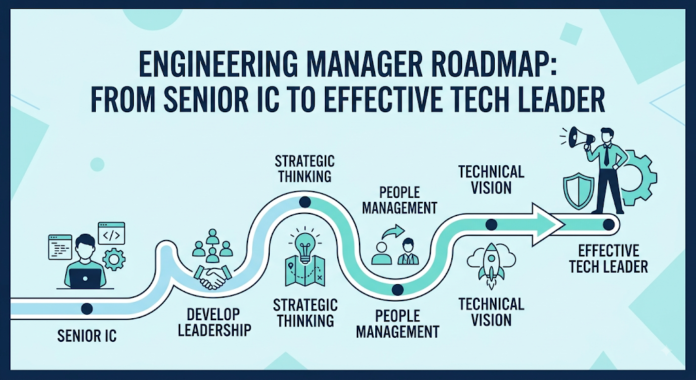
Moving from senior software engineer or tech lead into engineering management is often framed as a logical promotion. In reality, it is a career change.
When you write code, your feedback loop is tight and explicit: you build a feature, write tests, open a pull request, and watch it ship. When you manage engineers, your impact is indirect, slow to materialize, and mediated through other people’s decisions, system architectures, and cross-functional relationships.
If you try to approach engineering management as a “coder who also runs meetings,” you will burn out and bottleneck your team. Successful Engineering Managers (EMs) operate as force multipliers—shifting their focus from how to solve the technical problem to how to build an environment where the team solves technical problems reliably.
Whether you are weighing the choice between the Staff Engineer and EM tracks or trying to navigate your first 90 days in management, this roadmap details the exact capabilities, phases, and mindset shifts required for the transition.
The Decision Matrix: EM Track vs. Staff Engineer Track
Before committing to management, you need to answer a fundamental question: Do you want to manage people, or do you want to manage technical systems?
In mature engineering organizations, the Individual Contributor (IC) track and the Management track run parallel to each other in influence and compensation. A Staff Engineer (L6/E6) and an Engineering Manager (M1/E6) often sit at equivalent compensation bands, but their daily leverage models look completely different.
+------------------------+------------------------------------+------------------------------------+
| Dimension              | Staff / Principal Engineer Track   | Engineering Manager Track          |
+------------------------+------------------------------------+------------------------------------+
| Primary Output         | System architecture, tech strategy | High-performing team, delivery     |
| Main Leverage Point    | Code, RFCs, technical standards    | Hiring, coaching, unblocking, 1:1s |
| Calendar Allocation    | Deep work, architecture reviews    | Cross-functional syncs, alignment  |
| Primary Feedback Loop  | PR approvals, system uptime, perf  | Team retention, velocity, growth   |
| Core Danger Zone       | Over-engineering, ivory-towering   | Micromanagement, player-coach trap |
+------------------------+------------------------------------+------------------------------------+
The Player-Coach Trap: The single biggest mistake new EMs make is trying to remain a primary code contributor. When an EM owns critical-path features, two bad things happen: the manager spends their evening coding after running meetings all day, and engineers hesitate to take ownership because the manager keeps stepping in.
The Four Pillars of Engineering Management
Engineering management rests on four distinct operational pillars. Mastery as an EM requires balancing all four rather than defaulting exclusively to technical execution.
                             [ ENGINEERING MANAGEMENT ]
                                        |
     +-----------------+----------------+----------------+-----------------+
     |                 |                                 |                 |
[ 1. People ]   [ 2. Execution ]                 [ 3. Strategy ]   [ 4. Tech Health ]
  • Coaching       • Sprint cadences               • Org alignment   • Tech debt
  • 1-on-1s        • Unblocking delivery           • Roadmap input   • Architecture
  • Reviews        • Dependency tracking           • Resourcing      • Quality bars
1. People & Development
Your primary job is growing your engineers. This means establishing structured 1-on-1 cadences (focused on feedback and career growth rather than project status updates), writing clear performance evaluations, coaching underperforming staff, and retaining top talent.
2. Execution & Delivery
You own the team’s operational cadence. You monitor Service Level Agreements (SLAs), remove architectural or inter-team blockers, track sprint commitments, and ensure the team ships predictable, high-quality software on schedule.
3. Product & Strategic Alignment
EMs serve as translators between business objectives and technical implementation. You work closely with Product Managers, UX Designers, and business stakeholders to turn product roadmaps into realistic engineering plans.
4. Technical Health & Architecture
While you aren’t writing features day-to-day, you retain accountability for technical standards. You advocate for technical debt reduction, ensure robust testing frameworks, and partner with Tech Leads to establish sound architectural governance.
The Step-by-Step Transition Roadmap
Moving into management is rarely about applying to cold job openings online. The most successful transitions happen internally, where you build leadership credibility long before you get the formal title.
1.Build Signal Before the Title (6–18 Months Out):Demonstrate leadership within your current team.
Stop waiting for permission to lead. Start taking on non-coding coordination responsibilities that relieve pressure on your current manager:
- Mentor junior developers: Onboard new engineers, lead design reviews, and establish pair-programming habits.
- Run team ceremonies: Offer to facilitate sprint retrospectives, standups, or project post-mortems.
- Coordinate cross-team projects: Own initiatives that require aligning developers across multiple teams or departments.
2.Signal Intent & Establish a Handoff Plan:Align with your manager on the transition path.
Have an explicit career conversation with your manager: “I want to explore the engineering management track. What observable gaps do I need to close to be ready?”
Draft an inventory of your current technical ownership and identify specific engineers on your team ready to absorb those responsibilities. A clean technical handoff plan proves you can delegate effectively.
3.Master Core Managerial Capabilities:Focus on written communication and feedback loops.
Before taking on direct reports, build the non-technical muscles that engineering management requires:
- Practice constructive feedback: Learn frameworks like SBI (Situation-Behavior-Impact) to deliver actionable feedback early.
- Refine async writing: EMs communicate through briefs, roadmaps, and status updates. Clear, concise writing builds cross-functional influence.
- Study organizational mechanics: Read foundational management literature like The Manager’s Path by Camille Fournier and An Elegant Puzzle by Will Larson.
4.Execute the First 90 Days:Prioritize context gathering over immediate structural changes.
When you step into the role, resist the urge to overhaul process right away:
- Days 1–30: Conduct individual listening tours with every team member and cross-functional stakeholder. Ask what is slowing them down and what support they feel is missing.
- Days 31–60: Align with your skip-level manager on expectations, team resourcing, and key performance indicators. Establish regular skip-level check-ins.
- Days 61–90: Draft your first performance reviews, optimize team operational rituals, and finalize a two-quarter engineering roadmap with Product.
Tech Lead vs. Engineering Manager: Who Does What?
Confusion between the Tech Lead (TL) and Engineering Manager (EM) roles causes friction in mid-sized tech teams. While both work together closely, their core focus areas diverge.
+--------------------------+-------------------------------------+-------------------------------------+
| Responsibility           | Tech Lead (TL)                      | Engineering Manager (EM)            |
+--------------------------+-------------------------------------+-------------------------------------+
| Code & Architecture      | Owns codebase health & RFCs [1.2.5] | Oversees technical standards [1.1.5]|
| People & Performance     | Mentors on code patterns [1.2.5]    | Owns 1:1s, reviews, comp [1.1.3]    |
| Resourcing & Hiring      | Evaluates technical candidates      | Owns headcount, hiring pipeline [1.1.3]|
| Project Execution        | Breaks down technical tasks [1.2.5] | Manages timeline, risks, scope [1.1.5]|
| Escalations              | Handles architectural blockers [1.2.5]| Handles interpersonal/org blocks   |
+--------------------------+-------------------------------------+-------------------------------------+
A healthy dynamic resembles a partnership: the Tech Lead ensures the team builds the software right, while the Engineering Manager ensures the team has the people, resources, and clarity to build the right thing on time.
Essential Tooling Stack for Engineering Managers
Modern engineering managers rely on an operational toolchain to track health, delivery velocity, and communication across teams:
- Project & Issue Tracking: Jira, Linear, or Asana (for sprint planning and dependency mapping).
- Documentation & Strategy: Confluence, Notion, or Google Docs (for RFCs, 1:1 notes, and team wikis).
- Engineering Metrics & Insights: Jellyfish, Hatica, or LinearB (for tracking allocation, PR throughput, and cycle times).
- Async & Sync Communication: Slack, Microsoft Teams, and Loom (for status updates, announcements, and team alignment).
Sources
- MentorCruise: How to Transition Into an Engineering Manager Role
- Instahyre: IC to Engineering Manager Transition Guide
- EM Tools: Engineering Manager Career Roadmap
- Hatica: Tech Lead vs Engineering Manager Roles & Differences
- Jellyfish: Core Engineering Management Capabilities & Metrics
Frequently Asked Questions
Do Engineering Managers still code?
In most companies with teams larger than 4–6 developers, EMs do not write production code on the critical path. Trying to write code while managing people creates scheduling bottlenecks. EMs maintain technical context through architectural reviews, system demos, and technical roadmap discussions.
How many years of experience do you need to become an Engineering Manager?
Most engineers transition into management after 5 to 8 years of IC experience, including at least 2 to 3 years at a senior or tech lead level. This technical foundation ensures you retain credibility when evaluating complex engineering tradeoffs.
Is it possible to go back to being an Individual Contributor (IC) after being an EM?
Yes. The tech industry increasingly recognizes the “management pendulum”—where professionals switch between IC and EM roles over their careers. Returning to a Staff or Principal Engineer role after management often makes you a more empathetic, business-aligned technical leader.

