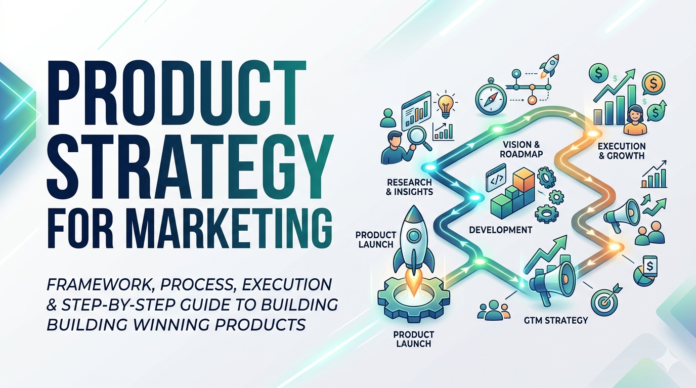
Every successful product starts long before the first feature is built.
Before engineers write code, before marketers launch campaigns, and before sales teams speak to customers, a critical question must be answered:
Why should this product exist in the first place?
Many companies focus heavily on product development but neglect product strategy. As a result, they build features nobody wants, target the wrong audience, or struggle to differentiate themselves from competitors.
A great product does not succeed because it has the most features. It succeeds because it solves a meaningful problem for a specific audience in a way that competitors cannot easily replicate.
This is where product strategy becomes essential.
Product strategy acts as the bridge between business goals, customer needs, market opportunities, and product execution. It provides direction for every team involved in creating, launching, and growing a product.
In this guide, you’ll learn what product strategy in marketing is, why it matters, how to build one from scratch, and the frameworks used by successful companies to create products customers genuinely want.
What Is Product Strategy in Marketing?
Product strategy in marketing is a long-term plan that defines how a product will create value for customers while helping the business achieve its growth objectives.
It establishes a clear direction for the product by answering important questions:
- Who is the product built for?
- What problem does it solve?
- Why is it different from alternatives?
- How will it compete in the market?
- What business outcomes should it achieve?
Rather than focusing on individual features, product strategy focuses on the broader picture.
It connects customer needs with business objectives and ensures every product decision supports a larger vision.
Key Components of Product Strategy
| Component | Purpose |
|---|---|
| Product Vision | Defines the long-term future of the product |
| Target Audience | Identifies who the product serves |
| Value Proposition | Explains why customers should choose it |
| Positioning | Determines how the product competes |
| Goals & KPIs | Measures success |
| Product Roadmap | Guides execution and development |
When these elements work together, teams can make decisions with confidence because everyone understands the destination and the path required to reach it.
Product Vision vs Product Strategy vs Product Roadmap
Many professionals use these terms interchangeably, but they serve different purposes.
| Aspect | Product Vision | Product Strategy | Product Roadmap |
|---|---|---|---|
| Focus | Future aspiration | Competitive plan | Execution plan |
| Time Horizon | 5–10 Years | 1–3 Years | 6–12 Months |
| Purpose | Why the product exists | How it will win | What gets built |
| Detail Level | High-Level | Strategic | Tactical |
| Flexibility | Stable | Moderately Flexible | Frequently Updated |
Think of it this way:
The vision defines the destination.
The strategy determines the route.
The roadmap outlines the turns you’ll take along the journey.
Without vision, teams lack purpose.
Without strategy, teams lack direction.
Without a roadmap, teams lack execution.
Why Product Strategy Is Critical in Marketing
Many products fail not because they are poorly built, but because they solve the wrong problem.
According to multiple industry studies, thousands of products launch every year, yet a significant percentage fail to achieve meaningful adoption.
The common reasons include:
- Weak product-market fit
- Poor differentiation
- Misaligned priorities
- Unclear messaging
- Inadequate customer research
A strong product strategy reduces these risks dramatically.
Benefits of a Strong Product Strategy
| Benefit | Impact |
|---|---|
| Team Alignment | Keeps teams working toward shared goals |
| Better Prioritization | Focuses resources on high-value initiatives |
| Market Differentiation | Clarifies competitive advantages |
| Resource Efficiency | Reduces wasted effort |
| Customer Satisfaction | Solves real customer problems |
| Revenue Growth | Drives adoption and retention |
| Stakeholder Confidence | Builds trust among investors and leadership |
A product strategy acts like a decision-making filter.
Whenever a new feature request, market opportunity, or customer demand appears, teams can evaluate whether it aligns with the broader strategy.
This prevents distractions and helps maintain focus.
The Core Pillars of a Successful Product Strategy
While every organization approaches strategy differently, most successful product strategies are built around five fundamental pillars.
Customer Understanding
Products exist to solve problems.
Without a deep understanding of customer pain points, motivations, and behaviors, product decisions become assumptions rather than informed choices.
Customer understanding should guide every strategic decision.
Differentiation
Customers need a compelling reason to choose your product over competitors.
Differentiation may come from:
- Better user experience
- Lower cost
- Faster results
- Superior technology
- Specialized focus
- Unique features
The strongest products occupy a clear position in the customer’s mind.
Business Alignment
A product strategy should contribute directly to organizational objectives.
This may include:
- Revenue growth
- Market expansion
- Customer retention
- Brand authority
- Profitability
When product strategy and business strategy align, resources are allocated more effectively.
Execution Capability
Even brilliant ideas fail without proper execution.
A strong strategy must be realistic and achievable based on available resources, talent, technology, and timelines.
Measurement
What cannot be measured cannot be improved.
Every strategy should include clear performance indicators that help teams evaluate progress and adjust when necessary.
Step 1: Understand Your Customer Deeply
The foundation of every successful product strategy begins with customer understanding.
Companies often make the mistake of assuming they know what customers want.
The reality is that assumptions frequently lead to failed products.
Instead, successful organizations invest heavily in research.
Customer Research Methods
| Method | Type | Purpose |
|---|---|---|
| Customer Interviews | Qualitative | Understand motivations and frustrations |
| Surveys | Quantitative & Qualitative | Gather broad feedback |
| Focus Groups | Qualitative | Explore opinions in depth |
| User Analytics | Quantitative | Analyze behavior patterns |
| Social Listening | Qualitative | Identify conversations and trends |
Each method reveals a different piece of the puzzle.
Interviews explain why customers behave a certain way.
Analytics reveal what they actually do.
Combining both creates a much clearer picture.
Creating Buyer Personas
After collecting research, organizations often develop buyer personas.
A buyer persona is a detailed representation of an ideal customer.
It typically includes:
- Demographics
- Job role
- Goals
- Challenges
- Purchase motivations
- Objections
- Preferred communication channels
Example Buyer Persona
| Attribute | Example |
|---|---|
| Name | Sarah |
| Role | Marketing Manager |
| Company Size | 100 Employees |
| Goal | Improve campaign performance |
| Challenge | Limited marketing resources |
| Motivation | Increase ROI |
| Objection | Budget constraints |
Personas help teams make decisions based on real customer needs rather than internal assumptions.
Step 2: Define a Clear Product Vision
Once customer needs are understood, the next step is establishing a product vision.
A product vision describes the future state the product aims to create.
It provides inspiration while guiding strategic decisions.
Strong product visions are:
- Customer-focused
- Ambitious
- Memorable
- Easy to communicate
- Aligned with business goals
Elements of a Strong Product Vision
| Element | Purpose |
|---|---|
| Customer Need | Defines the problem being solved |
| Future State | Describes the desired outcome |
| Business Alignment | Supports organizational goals |
| Inspiration | Motivates teams |
A compelling vision keeps teams aligned even as tactics and priorities evolve over time.
Step 3: Find Your Unique Position in the Market
Customers rarely choose products simply because they exist.
They choose products because they provide value that alternatives cannot.
This is why positioning is one of the most important aspects of product strategy.
Positioning defines how your product occupies a distinct place within the market.
Competitive Analysis Framework
Before positioning a product, teams should understand the competitive landscape.
| Analysis Type | Purpose |
|---|---|
| SWOT Analysis | Identify strengths and weaknesses |
| Feature Comparison | Compare product capabilities |
| Pricing Analysis | Evaluate market pricing |
| Customer Reviews | Understand competitor perception |
| Industry Trends | Identify emerging opportunities |
The goal is not to copy competitors.
The goal is to discover opportunities they have overlooked.
Common Differentiation Strategies
Market Leader Strategy
Focus on innovation and category leadership.
Challenger Strategy
Offer a better experience than established competitors.
Niche Strategy
Serve a specific audience exceptionally well.
Cost Leadership Strategy
Compete through affordability and efficiency.
The most successful companies often combine multiple approaches while maintaining a clear value proposition.
Product Strategy Framework: Putting Everything Together
The following framework can be used by businesses of any size when developing a product strategy.
| Stage | Objective | Key Deliverable |
|---|---|---|
| Customer Research | Understand audience | Buyer Personas |
| Vision Creation | Define future direction | Product Vision |
| Market Analysis | Understand competition | Positioning Strategy |
| Goal Setting | Define success | KPIs & Objectives |
| Roadmap Planning | Prioritize initiatives | Product Roadmap |
| Execution | Deliver value | Product Launch & Growth |
A product strategy is not a static document.
It evolves as markets change, customer needs shift, and new opportunities emerge.
However, its purpose remains the same:
To provide clarity, direction, and alignment for everyone involved in building and growing the product.
Product Strategy in Marketing: Framework, Process, Execution & Step-by-Step Guide to Building Winning Products (Part 2)
Step 4: Collaborate With Stakeholders Early and Often
One of the biggest reasons product strategies fail is not because the strategy itself is flawed, but because different teams interpret it differently.
A successful product strategy is never created in isolation.
Product managers, marketers, designers, developers, executives, sales teams, customer success representatives, and customers themselves all possess unique insights that can strengthen the final strategy.
When stakeholders participate early in the process, they become invested in the outcome and are more likely to support execution.
Key Stakeholders in Product Strategy
| Stakeholder | Contribution |
|---|---|
| Product Team | Product requirements, prioritization, user experience |
| Marketing Team | Positioning, messaging, market insights |
| Sales Team | Customer objections, buying behavior |
| Customer Success Team | Customer feedback and retention insights |
| Engineering Team | Technical feasibility and constraints |
| Executives | Strategic direction and resource allocation |
| Customers | Real-world validation and feedback |
Benefits of Cross Functional Collaboration
- Better decision making
- Faster alignment across departments
- Reduced conflicts during execution
- More realistic roadmaps
- Stronger customer focus
- Improved stakeholder buy-in
The strongest product strategies often emerge from healthy discussions between teams rather than decisions made by a single department.
Step 5: Test Before Scaling
Many organizations invest heavily in products before confirming whether customers actually want them.
This approach creates unnecessary risk.
Instead of building everything upfront, successful companies validate ideas early through testing and experimentation.
Testing allows teams to gather evidence before committing significant resources.
Popular Product Validation Methods
| Method | Purpose |
|---|---|
| MVP Testing | Validate product-market fit |
| A/B Testing | Compare alternatives |
| User Interviews | Understand customer reactions |
| Beta Programs | Gather real-world feedback |
| Surveys | Measure customer interest |
| Session Recordings | Observe actual user behavior |
The MVP Approach
MVP stands for Minimum Viable Product.
Rather than building every feature, companies launch the simplest version capable of delivering value.
The goal is not perfection.
The goal is learning.
A successful MVP helps answer questions such as:
- Does the problem truly exist?
- Do customers care enough to pay?
- Which features matter most?
- What needs improvement?
Many billion-dollar products began as simple MVPs.
The Product Strategy Feedback Loop
A successful strategy follows a continuous cycle:
Research → Build → Test → Learn → Improve
Companies that embrace continuous learning generally outperform organizations that treat strategy as a one-time exercise.
Step 6: Execute Through a Product Roadmap
A strategy without execution remains an idea.
This is where product roadmaps become essential.
A roadmap transforms strategic objectives into actionable initiatives.
It provides clarity about what will be built, why it matters, and when it will be delivered.
Components of an Effective Product Roadmap
| Component | Purpose |
|---|---|
| Product Vision | Long-term destination |
| Strategic Goals | Desired outcomes |
| Key Initiatives | Major projects |
| Features | Tactical deliverables |
| Milestones | Progress checkpoints |
| Resources | Budget and personnel |
| Dependencies | Technical requirements |
| Success Metrics | Performance measurement |
Prioritization Frameworks
One challenge every product team faces is deciding what to build first.
Several prioritization models help solve this problem.
MoSCoW Framework
| Category | Meaning |
|---|---|
| Must Have | Critical requirements |
| Should Have | Important but not essential |
| Could Have | Nice-to-have features |
| Won’t Have | Deferred items |
Customer Value Prioritization
Features are ranked according to their impact on customer outcomes.
Business Impact Prioritization
Projects are prioritized based on revenue, retention, or strategic value.
The best roadmaps balance customer needs, business objectives, and technical feasibility.
How Product Strategy and Product Marketing Work Together
Many people confuse product strategy with product marketing.
Although closely related, they serve different purposes.
Product Strategy Answers:
- What should we build?
- Who should we build it for?
- Why does it matter?
- How will we win?
Product Marketing Answers:
- How do we position it?
- How do we communicate value?
- How do we acquire customers?
- How do we increase adoption?
Think of product strategy as creating the destination.
Product marketing helps customers discover why they should join the journey.
Both functions must work together to achieve sustainable growth.
Building a Product Marketing Strategy
A product can be technically brilliant and still fail if customers do not understand its value.
Product marketing bridges that gap.
Step 1: Analyze the Market
Before launching any product, companies need a deep understanding of:
- Market size
- Industry trends
- Customer behavior
- Competitor positioning
- Emerging opportunities
Step 2: Define Your Audience
Not every customer is the right customer.
Segmentation helps identify:
- Ideal customers
- Buying behavior
- Motivations
- Challenges
- Preferences
Step 3: Position and Message the Product
Positioning determines how customers perceive the product.
Strong positioning answers a simple question:
Why should customers choose this product instead of alternatives?
The Four Ps Framework
| Element | Focus |
|---|---|
| Product | Features and benefits |
| Price | Pricing strategy |
| Promotion | Marketing channels |
| Place | Distribution channels |
Step 4: Set Measurable Goals
Without goals, success becomes subjective.
Common objectives include:
- Revenue growth
- Customer acquisition
- Product adoption
- Brand awareness
- Retention improvement
Step 5: Align Internal Teams
Customers should receive a consistent experience regardless of whether they interact with marketing, sales, support, or product teams.
Internal alignment ensures everyone communicates the same value proposition.
Step 6: Develop a Pricing Strategy
Pricing is often one of the most underestimated aspects of product strategy.
The right pricing model can accelerate adoption while maximizing profitability.
Value-Based Pricing: The Most Effective Modern Approach
Traditionally, many businesses used cost-based pricing.
However, modern product organizations increasingly rely on value-based pricing.
Pricing Strategy Comparison
| Pricing Model | Focus |
|---|---|
| Cost-Based Pricing | Production cost |
| Competitive Pricing | Competitor prices |
| Value-Based Pricing | Customer perceived value |
Why Value-Based Pricing Works
- Reflects customer willingness to pay
- Supports premium positioning
- Improves profitability
- Builds stronger customer trust
- Aligns pricing with outcomes
When customers believe the value exceeds the cost, purchasing decisions become significantly easier.
Measuring Product Strategy Success
Even the best strategy is meaningless if results cannot be measured.
Successful product organizations track a combination of business, customer, and product metrics.
Key Product Strategy KPIs
| KPI | Purpose |
|---|---|
| Market Penetration Rate | Market adoption |
| Revenue Growth | Business performance |
| Customer Acquisition Cost | Efficiency |
| Customer Lifetime Value | Long-term profitability |
| Monthly Recurring Revenue | Growth tracking |
| Net Promoter Score | Customer loyalty |
| Retention Rate | Product stickiness |
| Daily Active Users | Product engagement |
Net Promoter Score (NPS)
NPS measures customer loyalty by asking:
“How likely are you to recommend our product to others?”
Customers are categorized as:
- Promoters
- Passives
- Detractors
Higher NPS scores generally indicate stronger customer satisfaction and loyalty.
Real World Product Strategy Examples
Theory is useful.
Real-world examples show strategy in action.
Example 1: ConvertKit
When ConvertKit entered the market, established competitors already dominated email marketing.
Instead of competing broadly, ConvertKit focused specifically on content creators and bloggers.
Their strategy was clear:
Serve one audience exceptionally well.
This niche focus helped them differentiate in a crowded market.
Example 2: Loom
Loom originally entered the market as a simple screen recording solution.
Over time, the company recognized a larger opportunity.
Instead of positioning itself as recording software, Loom positioned itself as an asynchronous communication platform.
This strategic shift aligned perfectly with remote and hybrid work environments.
The result was rapid adoption and market growth.
Example 3: Netflix
Netflix began as a DVD rental service.
Its long-term strategy focused on convenience and accessibility.
As technology evolved, Netflix transformed into a streaming platform and later became a content production powerhouse.
The vision remained consistent while execution evolved with market conditions.
Common Product Strategy Mistakes
Even experienced teams make strategic mistakes.
Understanding these pitfalls can save significant time and resources.
Mistake 1: Weak Product Market Fit
Products fail when they solve problems customers do not care about.
Mistake 2: Poor Positioning
Customers cannot buy products they do not understand.
Mistake 3: Generic Messaging
Vague messaging makes products appear interchangeable with competitors.
Mistake 4: Ignoring Customer Feedback
Customer feedback should continuously shape strategy.
Mistake 5: Team Misalignment
Different interpretations create inconsistent execution.
Mistake 6: Choosing the Wrong Pricing Model
Pricing mistakes often reduce both adoption and profitability.
Essential Tools for Product Strategy
Modern product teams rely on specialized tools to streamline strategy development and execution.
Market Research Tools
- Google Analytics
- Hotjar
- Contentsquare
- SurveyMonkey
- Typeform
Product Planning Tools
- Productboard
- Roadmunk
- ProductPlan
- Aha!
Collaboration Tools
- Slack
- Trello
- Jira
- Asana
- Confluence
These platforms help teams collect insights, prioritize initiatives, and maintain alignment.
Future Trends Shaping Product Strategy
Product strategy continues evolving as technology and customer expectations change.
Several trends are becoming increasingly important.
AI-Powered Insights
Artificial intelligence is helping companies identify patterns, forecast behavior, and uncover opportunities faster than ever before.
Dynamic Customer Segmentation
Traditional customer segments are becoming more fluid.
Modern organizations continuously update segments based on behavior and intent.
Voice of Customer Programs
Customer feedback is moving from occasional surveys to continuous listening systems.
Faster Experimentation
Companies increasingly rely on rapid testing and iteration to reduce uncertainty.
Cross Functional Strategy Development
Product strategy is becoming more collaborative, with input from every department.
The Product Strategy Framework at a Glance
| Stage | Objective |
|---|---|
| Customer Research | Understand customer needs |
| Vision Development | Define future direction |
| Competitive Analysis | Identify opportunities |
| Positioning | Create differentiation |
| Goal Setting | Define success metrics |
| Roadmap Creation | Prioritize initiatives |
| Execution | Deliver customer value |
| Measurement | Track outcomes |
| Optimization | Improve continuously |
Conclusion
A successful product rarely emerges by accident.
Behind every widely adopted product lies a carefully crafted strategy that aligns customer needs, business goals, market opportunities, and execution priorities.
Product strategy in marketing provides the foundation for making smarter decisions, prioritizing effectively, and delivering products that create meaningful value.
The strongest strategies begin with customer understanding, evolve through continuous learning, and remain flexible enough to adapt as markets change.
Companies that invest in product strategy are not simply building products.
They are building solutions that solve real problems, create loyal customers, and generate sustainable growth for years to come.
In an increasingly competitive marketplace, product strategy is no longer optional.
It is one of the most important competitive advantages a business can develop.
Helpful Resources for Learning Product Strategy & Marketing Strategy
Adding a resource section improves credibility and gives readers trusted places to continue learning.
1. Harvard Business Review (HBR) – Strategy & Innovation
Link: Harvard Business Review Strategy Collection
One of the most authoritative sources for business strategy, product leadership, innovation management, and competitive positioning used by executives worldwide.
2. HubSpot Marketing Resources
Link: HubSpot Marketing Library
Offers practical guides on product marketing, customer acquisition, positioning, go-to-market strategies, and growth frameworks.
3. McKinsey & Company – Marketing & Sales Insights
Link: McKinsey Marketing & Sales Insights
Provides research-backed insights on customer behavior, pricing strategies, product growth, digital transformation, and marketing execution.
4. Product School
Link: Product School Resources
A leading platform for product management, product strategy, roadmapping, stakeholder management, and product leadership education.
5. Gartner Marketing Research
Link: Gartner Marketing Research
Offers industry-leading research on marketing strategy, customer experience, product positioning, and business growth trends.
20 FAQs About Product Strategy in Marketing
1. What is product strategy in marketing?
Product strategy in marketing is a long-term plan that defines how a product will solve customer problems, create competitive advantages, and achieve business goals.
2. Why is product strategy important?
A strong product strategy helps businesses prioritize resources, align teams, differentiate from competitors, and build products customers actually want.
3. What is the difference between product strategy and product marketing?
Product strategy focuses on what should be built and why, while product marketing focuses on how to position, promote, and sell the product.
4. What are the key components of a product strategy?
The main components include product vision, target audience, value proposition, positioning, goals, KPIs, and product roadmap.
5. How do you create a product strategy?
The process typically involves customer research, market analysis, defining a vision, creating positioning, setting goals, building a roadmap, and measuring performance.
6. What is a product strategy framework?
A product strategy framework is a structured approach used to define customer needs, market opportunities, business objectives, and execution plans.
7. What is product positioning in marketing?
Product positioning refers to how a product is perceived in the minds of customers compared to competing alternatives.
8. How does customer research influence product strategy?
Customer research helps organizations understand pain points, motivations, behaviors, and unmet needs, leading to better product decisions.
9. What is a product roadmap?
A product roadmap is a strategic document that outlines future initiatives, priorities, timelines, and goals for a product.
10. What is product vision?
Product vision describes the long-term future state a product aims to create and serves as a guiding direction for strategic decisions.
11. What are the most common product strategy mistakes?
Common mistakes include poor product-market fit, weak positioning, ignoring customer feedback, unclear goals, and lack of team alignment.
12. How do successful companies develop product strategies?
Successful companies combine customer insights, market research, competitive analysis, experimentation, and continuous improvement.
13. What role does pricing play in product strategy?
Pricing directly impacts profitability, positioning, customer perception, and product adoption, making it a critical strategic decision.
14. What is value-based pricing?
Value-based pricing sets prices according to the perceived value customers receive rather than production costs alone.
15. How do you measure product strategy success?
Success is measured through KPIs such as revenue growth, customer acquisition, retention rate, customer lifetime value, NPS, and market penetration.
16. What is product-market fit?
Product-market fit occurs when a product successfully solves a meaningful customer problem and experiences strong market demand.
17. Which tools are commonly used for product strategy?
Popular tools include Productboard, Aha!, Jira, Asana, Hotjar, Google Analytics, Typeform, and SurveyMonkey.
18. How often should a product strategy be updated?
Most organizations review product strategies quarterly while making adjustments based on customer feedback, market changes, and business priorities.
19. Can small businesses benefit from product strategy?
Yes. Product strategy helps startups and small businesses focus resources effectively, avoid costly mistakes, and accelerate growth.
20. What skills are required for product strategy roles?
Important skills include strategic thinking, market research, customer analysis, communication, stakeholder management, data analysis, and decision-making.

