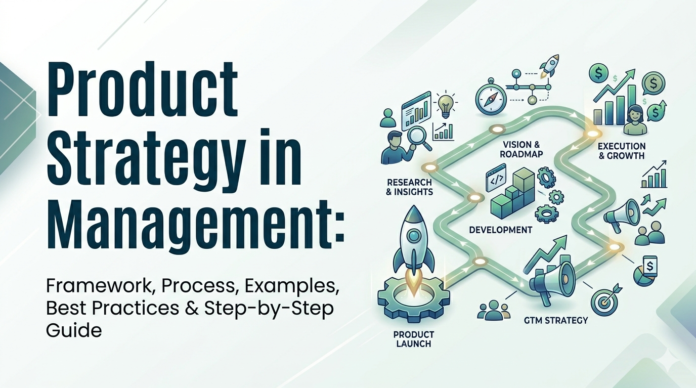
Every successful product begins long before a single feature is developed.
Before engineers write code, before marketers launch campaigns, and before customers interact with a product, there is a strategic layer that determines whether the product has a realistic chance of success.
That layer is product strategy.
Many organizations invest enormous amounts of money into product development, yet a surprising number of products fail to achieve meaningful market adoption. In many cases, the problem is not poor execution. The problem is a lack of strategic direction.
Teams become busy building features, fixing bugs, and responding to customer requests without a clear understanding of where the product is headed or why certain decisions are being made.
Product strategy exists to solve this challenge.
It provides the bridge between a company’s long-term vision and the day-to-day execution performed by product, engineering, design, sales, and marketing teams.
Without strategy, product development becomes reactive.
With strategy, every initiative moves the organization toward a clearly defined destination.
This guide explores product strategy in management, how it fits into the broader product management framework, the key components of a successful strategy, proven frameworks, practical examples, and a step-by-step process for building an effective product strategy.
What Is Product Strategy in Management?
Product strategy in management is a high-level plan that defines how a product will create value for customers while helping the organization achieve its business objectives.
It serves as the guiding framework that connects customer needs, market opportunities, competitive positioning, and business goals.
Rather than focusing on individual features or development tasks, product strategy focuses on the larger picture.
It answers critical questions about who the product serves, what problems it solves, why customers should choose it, and how it will contribute to business success.
Simple Definition
Product strategy is the roadmap for achieving product success.
It explains where the product is going, why it matters, and how the organization plans to get there.
Product Strategy at a Glance
| Component | Purpose |
|---|---|
| Customer Understanding | Identify target users and their needs |
| Market Opportunity | Determine market demand |
| Competitive Positioning | Differentiate from competitors |
| Business Goals | Align with company objectives |
| Product Vision | Define long-term direction |
| Strategic Initiatives | Guide execution priorities |
A strong product strategy ensures every team understands not only what they are building, but also why they are building it.
Why Product Strategy Is Important in Management
Product managers face hundreds of decisions every month.
Should a feature be prioritized?
Should a new market be targeted?
Should resources be allocated toward innovation or optimization?
Without a strategic framework, these decisions become subjective.
Product strategy creates a decision-making system that helps teams evaluate opportunities objectively.
Key Benefits of Product Strategy
| Benefit | Impact |
|---|---|
| Team Alignment | Everyone works toward shared objectives |
| Better Prioritization | Resources focus on high-impact initiatives |
| Improved Decision Making | Strategy guides trade-offs |
| Customer Satisfaction | Products solve real problems |
| Revenue Growth | Business goals remain central |
| Reduced Risk | Teams identify threats early |
Organizations with strong product strategies often execute faster because they spend less time debating priorities.
The Role of Product Strategy Within Product Management
Many professionals confuse product strategy with product management.
While closely connected, they serve different purposes.
Product strategy focuses on direction.
Product management focuses on execution.
Product Strategy vs Product Management
| Aspect | Product Strategy | Product Management |
|---|---|---|
| Focus | Long-term direction | Daily execution |
| Time Horizon | 1 to 3 years | Weeks to months |
| Main Question | Why and how | What and when |
| Output | Strategic plan | Roadmaps and features |
| Scope | Business-wide | Product-specific execution |
Think of product strategy as the blueprint and product management as the construction process.
One provides direction.
The other turns that direction into reality.
Product Strategy Within the Product Management Framework
Product strategy sits at the center of product leadership.
Every successful product organization follows a hierarchy that moves from vision to execution.
Product Management Hierarchy
| Layer | Purpose |
|---|---|
| Product Vision | Long-term purpose |
| Product Strategy | Success plan |
| Product Roadmap | Execution priorities |
| Product Backlog | Detailed work items |
The relationship between these layers is critical.
The vision explains why the product exists.
The strategy explains how the vision will be achieved.
The roadmap translates strategy into initiatives.
The backlog converts initiatives into actionable tasks.
When these layers remain aligned, organizations move efficiently toward their goals.
The Four Critical Questions Product Strategy Must Answer
Every effective product strategy should provide clear answers to four fundamental questions.
1. Who Is the Product For?
Successful products solve problems for specific customers.
Understanding the target audience requires deep customer research, behavioral analysis, interviews, surveys, and market segmentation.
2. Why Would Customers Choose It?
A product must solve a meaningful problem.
The stronger the problem and the better the solution, the more valuable the product becomes.
3. What Makes It Different?
Customers compare alternatives.
Differentiation helps explain why your product deserves attention.
4. What Business Goals Will It Support?
Products exist to create customer value and business value.
The strategy must connect customer outcomes with organizational objectives.
Strategic Question Framework
| Question | Strategic Objective |
|---|---|
| Who is it for? | Target audience definition |
| Why does it matter? | Customer value creation |
| Why choose us? | Competitive differentiation |
| What is the goal? | Business impact |
These four questions form the foundation of every product strategy.
Core Components of Product Strategy
Several essential building blocks support a successful strategy.
Product Vision
The vision describes the future state the product aims to create.
It acts as a long-term destination that guides decision-making.
Target Market
This defines the customers the product is designed to serve.
Clear market definition improves product-market fit and messaging effectiveness.
Value Proposition
The value proposition explains why customers should care about the product.
It highlights benefits, outcomes, and unique advantages.
Competitive Positioning
Positioning determines how customers perceive the product relative to competitors.
Strategic Goals
Goals provide measurable outcomes that allow teams to evaluate progress.
Product Strategy Components Overview
| Component | Purpose |
|---|---|
| Vision | Long-term direction |
| Market | Customer focus |
| Value Proposition | Customer benefit |
| Positioning | Competitive advantage |
| Goals | Success measurement |
Customer-Centric Product Strategy
The most successful products begin with customers.
Companies often fail when they become obsessed with features rather than customer problems.
Product strategy should always start with understanding user needs.
Customer Research Methods
| Method | Purpose |
|---|---|
| Customer Interviews | Discover pain points |
| Surveys | Gather large-scale feedback |
| Focus Groups | Explore perceptions |
| User Testing | Validate assumptions |
| Analytics | Understand behavior |
Customer insights help organizations prioritize opportunities that deliver meaningful value.
Competitive Positioning in Product Strategy
No product operates in isolation.
Customers always have alternatives.
Some alternatives are competitors.
Others are manual processes or existing habits.
Understanding the competitive landscape helps identify opportunities and threats.
Competitive Analysis Areas
- Market share
- Pricing models
- Product features
- Customer reviews
- Strengths and weaknesses
- Emerging trends
Organizations that continuously monitor competitors can adapt their strategies before market conditions change.
Product Differentiation Strategies
Differentiation creates reasons for customers to choose one product over another.
Several forms of differentiation exist.
Feature Differentiation
Unique capabilities competitors cannot easily replicate.
Quality Differentiation
Superior performance, reliability, or user experience.
Service Differentiation
Exceptional support and customer success experiences.
Price Differentiation
Affordable pricing or premium positioning.
Differentiation Framework
| Type | Example |
|---|---|
| Features | Unique functionality |
| Quality | Premium performance |
| Service | Exceptional support |
| Price | Cost advantage |
The strongest products often combine multiple forms of differentiation.
The Goal-First Product Strategy Approach
Many product teams start with features.
Successful product leaders start with goals.
A goal-first approach ensures initiatives align with business outcomes.
Instead of asking:
“What should we build?”
Teams ask:
“What outcome are we trying to achieve?”
This shift improves prioritization and resource allocation.
Examples of Strategic Goals
- Increase customer retention
- Improve revenue growth
- Expand market share
- Improve user engagement
- Reduce customer churn
Every initiative should support at least one strategic objective.
The 5-Step Product Strategy Framework
A great product strategy is not created through guesswork.
It is built through a structured process that combines customer understanding, market intelligence, business objectives, and execution planning.
Organizations that consistently launch successful products typically follow a framework that helps them make better decisions and remain aligned as markets evolve.
Product Strategy Framework Overview
| Step | Objective | Output |
|---|---|---|
| Define Vision | Establish direction | Product vision statement |
| Research Market | Understand opportunities | Customer and market insights |
| Set Goals | Define success | Strategic objectives and KPIs |
| Build Strategy | Create action plan | Product strategy document |
| Create Roadmap | Plan execution | Strategic roadmap |
Following a framework ensures that product decisions are based on evidence rather than assumptions.
Step 1: Define the Product Vision
Every strategy begins with a vision.
The vision represents the future state the organization wants to create.
It provides purpose, inspiration, and long-term direction.
A product vision should be ambitious enough to motivate teams while remaining realistic enough to guide decision-making.
Characteristics of a Strong Product Vision
- Customer focused
- Future oriented
- Easy to understand
- Inspiring and memorable
- Aligned with business goals
Example Product Vision
| Product Type | Vision Example |
|---|---|
| Education Platform | Make quality education accessible to anyone worldwide |
| SaaS Software | Simplify business operations through intelligent automation |
| Healthcare App | Improve preventive healthcare for millions of patients |
A clear vision helps teams remain focused when priorities compete for attention.
Step 2: Conduct Market Research
Once the vision is established, organizations must understand the environment in which the product operates.
Market research provides insights into customers, competitors, industry trends, and growth opportunities.
Without research, strategy becomes speculation.
Areas to Research
| Research Area | Purpose |
|---|---|
| Customer Needs | Understand pain points |
| Industry Trends | Identify opportunities |
| Competitors | Evaluate alternatives |
| Market Size | Assess growth potential |
| Customer Behavior | Understand decision drivers |
Popular Research Methods
- Customer interviews
- User surveys
- Focus groups
- Industry reports
- Competitor analysis
- Analytics platforms
The deeper the research, the stronger the strategic foundation.
Step 3: Set Strategic Goals
Goals transform vision into measurable outcomes.
Without goals, teams struggle to determine whether progress is being made.
Strategic goals should balance customer value and business impact.
Examples of Strategic Objectives
| Objective | Measurement |
|---|---|
| Increase Retention | Customer retention rate |
| Improve Revenue | Monthly recurring revenue |
| Expand Market Share | Market penetration percentage |
| Increase Engagement | Active user growth |
| Improve Satisfaction | Customer satisfaction scores |
SMART Goal Principles
| Principle | Meaning |
|---|---|
| Specific | Clearly defined |
| Measurable | Quantifiable |
| Achievable | Realistic |
| Relevant | Supports strategy |
| Time-Bound | Defined timeframe |
Goals create accountability and focus.
Step 4: Create the Product Strategy
At this stage, research and goals are combined into a coherent strategy.
The strategy explains how the product will achieve desired outcomes.
This is where product leaders make critical choices.
Strategy is not about saying yes to everything.
It is about making deliberate choices regarding where resources should be invested.
Elements of a Product Strategy Document
| Section | Purpose |
|---|---|
| Vision | Long-term direction |
| Customer Segments | Target audience |
| Value Proposition | Customer benefits |
| Competitive Positioning | Market differentiation |
| Strategic Priorities | Areas of focus |
| Success Metrics | Measurement framework |
A strong strategy acts as a decision-making compass for the entire organization.
Step 5: Build the Product Roadmap
Once the strategy is established, execution planning begins.
The roadmap translates strategy into initiatives.
It provides visibility into what will be delivered and when.
Roadmap Components
| Component | Description |
|---|---|
| Strategic Themes | Major focus areas |
| Initiatives | High-level projects |
| Objectives | Desired outcomes |
| Timeline | Expected delivery periods |
The roadmap should communicate direction rather than become a rigid feature list.
Competitive Analysis Frameworks for Product Strategy
Understanding competitors is a crucial part of product management.
Competitive analysis helps organizations identify opportunities, threats, and differentiation strategies.
SWOT Analysis
One of the most widely used strategic tools.
| Category | Purpose |
|---|---|
| Strengths | Internal advantages |
| Weaknesses | Internal limitations |
| Opportunities | External growth areas |
| Threats | External risks |
Porter’s Five Forces
This framework evaluates industry competitiveness.
| Force | Strategic Impact |
|---|---|
| Competitive Rivalry | Existing competitors |
| Supplier Power | Supplier influence |
| Buyer Power | Customer influence |
| New Entrants | Barriers to entry |
| Substitutes | Alternative solutions |
Using structured frameworks improves strategic decision-making.
Developing a Unique Value Proposition
Customers buy outcomes, not features.
A value proposition explains why a customer should choose a product.
It communicates the product’s unique value in a simple and compelling way.
Components of a Strong Value Proposition
| Component | Purpose |
|---|---|
| Problem | Customer challenge |
| Solution | Product offering |
| Benefit | Positive outcome |
| Differentiator | Competitive advantage |
Example Framework
For [target audience]
Who need [specific solution]
Our product provides [key benefit]
Unlike competitors, we offer [unique advantage]
A clear value proposition improves marketing, sales, and product alignment.
Product Strategy and Stakeholder Alignment
Even the best strategy can fail if stakeholders are not aligned.
Product managers spend a significant portion of their time communicating strategy and building consensus.
Key Stakeholders
| Stakeholder | Strategic Interest |
|---|---|
| Leadership | Business outcomes |
| Engineering | Technical feasibility |
| Design | User experience |
| Marketing | Market positioning |
| Sales | Customer acquisition |
| Customer Success | Retention and satisfaction |
Alignment reduces confusion and accelerates execution.
Techniques for Building Alignment
- Regular strategy reviews
- Transparent communication
- Shared KPIs
- Cross-functional workshops
- Executive sponsorship
Organizations succeed when teams move in the same direction.
Product Strategy KPIs and Success Metrics
Measurement is essential.
Without metrics, teams cannot determine whether a strategy is working.
KPIs should directly connect to strategic objectives.
Customer Metrics
| Metric | Purpose |
|---|---|
| Customer Retention Rate | Loyalty measurement |
| Customer Satisfaction Score | Experience measurement |
| Net Promoter Score | Recommendation likelihood |
| Churn Rate | Customer loss tracking |
Business Metrics
| Metric | Purpose |
|---|---|
| Revenue Growth | Financial performance |
| Profit Margin | Profitability |
| Market Share | Competitive position |
| Customer Acquisition Cost | Growth efficiency |
Product Metrics
| Metric | Purpose |
|---|---|
| Feature Adoption | Usage measurement |
| Active Users | Engagement tracking |
| Session Duration | Product stickiness |
| Conversion Rate | Goal completion |
The best KPIs measure outcomes rather than activity.
Product Strategy Execution Best Practices
A strategy only creates value when executed effectively.
Several practices consistently improve execution quality.
1. Focus on Outcomes
Successful teams measure business results rather than feature releases.
2. Prioritize Ruthlessly
Resources are always limited.
Focus on initiatives that generate the highest impact.
3. Validate Assumptions
Customer behavior often surprises teams.
Continuous validation reduces risk.
4. Use Data and Customer Feedback
Decision-making should combine quantitative and qualitative insights.
5. Communicate Frequently
People cannot execute a strategy they do not understand.
Common Product Strategy Mistakes
Many product initiatives fail because of preventable strategic mistakes.
Mistake 1: Building Without Customer Research
Assumptions often lead to poor product-market fit.
Mistake 2: Chasing Competitors
Blindly copying competitors rarely creates sustainable advantages.
Mistake 3: Lack of Clear Differentiation
Products need a compelling reason to exist.
Mistake 4: Weak Prioritization
Trying to do everything usually results in accomplishing very little.
Mistake 5: Ignoring Market Changes
Markets evolve continuously.
Strategies must evolve as well.
Mistake 6: Poor Internal Alignment
Conflicting priorities slow execution.
Mistake 7: Measuring Vanity Metrics
Not every metric reflects genuine business value.
Avoiding these mistakes dramatically improves product success rates.
Product Strategy Tools Used by Product Managers
Modern product teams rely on specialized tools to plan, execute, and measure strategy.
Strategy and Roadmap Tools
| Tool | Purpose |
|---|---|
| ProductPlan | Strategic roadmaps |
| Aha! | Product planning |
| Productboard | Prioritization and strategy |
| Roadmunk | Roadmap visualization |
Project Management Tools
| Tool | Purpose |
|---|---|
| Jira | Backlog management |
| Asana | Task tracking |
| ClickUp | Project management |
| Trello | Workflow organization |
Customer Research Tools
| Tool | Purpose |
|---|---|
| Hotjar | User behavior insights |
| SurveyMonkey | Customer surveys |
| Typeform | Feedback collection |
| Google Analytics | Usage analysis |
Tools support execution, but strategy remains a human responsibility.
Real-World Product Strategy Example
Consider a hypothetical SaaS company offering project management software.
Vision
Help distributed teams collaborate seamlessly.
Target Audience
Small and medium-sized businesses.
Problem
Remote teams struggle with communication and task visibility.
Value Proposition
Simple collaboration software with real-time project tracking.
Strategic Goals
| Goal | KPI |
|---|---|
| Increase Customers | New customer growth |
| Improve Retention | Retention rate |
| Expand Revenue | Subscription revenue |
Strategic Initiatives
- Improve onboarding
- Enhance collaboration tools
- Launch AI-powered productivity features
- Expand integrations
This example illustrates how strategy connects vision, customers, goals, and execution.
Future Trends in Product Strategy Management
The product management landscape continues to evolve rapidly.
Several trends are shaping the future of product strategy.
AI-Assisted Decision Making
Artificial intelligence helps product teams identify patterns, forecast demand, and analyze customer behavior.
Customer-Led Growth
Organizations increasingly rely on customer feedback to drive strategic decisions.
Outcome-Based Product Management
Teams focus more on business results and customer outcomes rather than feature delivery.
Data-Driven Strategy
Real-time analytics enable faster decision-making and continuous optimization.
Ecosystem Thinking
Products increasingly operate as part of interconnected platforms and ecosystems.
Product leaders who embrace these trends gain significant competitive advantages.
Final Thoughts
Product strategy is the foundation upon which successful products are built.
It provides direction, alignment, prioritization, and purpose.
Without a strategy, product development becomes reactive and fragmented.
With a strategy, organizations can confidently make decisions, allocate resources, satisfy customers, and achieve business objectives.
The most successful companies understand that product strategy is not a one-time exercise.
It is an ongoing process of learning, adapting, and refining based on customer feedback, market conditions, competitive dynamics, and business goals.
Whether you are a product manager, founder, executive, or aspiring product leader, mastering product strategy is one of the most valuable skills you can develop.
A well-defined product strategy does more than guide a product.
It guides an entire organization toward sustainable growth, customer success, and long-term market leadership.
20 FAQs About Product Strategy in Management
1. What is product strategy in management?
Product strategy in management is a high-level plan that defines how a product will create value for customers while helping a business achieve its goals. It connects product vision, customer needs, and execution plans.
2. Why is product strategy important?
Product strategy provides direction, helps prioritize resources, aligns teams, reduces wasted effort, and ensures product decisions support business objectives.
3. What is the difference between product strategy and product management?
Product strategy focuses on long-term direction and business goals, while product management focuses on executing the strategy through roadmaps, features, and delivery.
4. What are the key components of a product strategy?
The main components include product vision, target market, customer needs, value proposition, competitive positioning, strategic goals, and success metrics.
5. What role does product strategy play in product management?
Product strategy serves as the foundation for product management by guiding priorities, roadmap decisions, resource allocation, and feature development.
6. What are the four critical questions product strategy answers?
Product strategy answers:
- Who is the product for?
- Why do customers need it?
- What makes it different?
- What business goals will it achieve?
7. How does product strategy differ from a product roadmap?
A product strategy explains why and how a product will succeed, while a roadmap outlines what initiatives will be delivered and when.
8. How long should a product strategy last?
Most product strategies cover a period of one to three years, although they should be reviewed regularly and adjusted when market conditions change.
9. What is a customer-centric product strategy?
A customer-centric strategy focuses on understanding customer problems, needs, behaviors, and goals before making product decisions.
10. How do product managers create a product strategy?
Product managers typically conduct research, analyze competitors, define goals, identify customer needs, establish positioning, and align stakeholders around a shared vision.
11. What is a product vision?
A product vision is a long-term statement that describes the future impact and purpose of a product.
12. What is a value proposition in product strategy?
A value proposition explains the unique benefit a product provides and why customers should choose it over alternatives.
13. How important is market research in product strategy?
Market research is essential because it helps validate customer needs, identify opportunities, understand competitors, and reduce strategic risk.
14. What KPIs should be used to measure product strategy success?
Common KPIs include customer retention, revenue growth, customer satisfaction, active users, feature adoption, churn rate, and market share.
15. What is competitive positioning?
Competitive positioning defines how a product is perceived in comparison to competitors and highlights its unique advantages.
16. What are the most common product strategy mistakes?
Common mistakes include poor customer research, unclear goals, weak differentiation, lack of stakeholder alignment, and focusing on features instead of outcomes.
17. How often should a product strategy be updated?
Most companies review product strategy quarterly and perform major strategic evaluations annually.
18. What tools help with product strategy management?
Popular tools include Productboard, ProductPlan, Aha!, Jira, Roadmunk, Miro, Confluence, Hotjar, and Google Analytics.
19. Can startups benefit from product strategy?
Yes. Product strategy helps startups prioritize limited resources, validate ideas faster, avoid costly mistakes, and achieve product-market fit more efficiently.
20. What skills are required for product strategy?
Important skills include strategic thinking, customer research, market analysis, communication, stakeholder management, data analysis, prioritization, and decision-making.
Bonus SEO FAQs
What is the product strategy framework?
A product strategy framework is a structured approach used to define product vision, goals, customer needs, competitive positioning, and execution plans.
How do you create a product strategy roadmap?
Start with business objectives, identify strategic initiatives, prioritize opportunities, define timelines, and align stakeholders around key outcomes.
What is the relationship between product vision and product strategy?
Product vision defines where the product wants to go, while product strategy explains how the organization will reach that destination.
What makes a successful product strategy?
A successful product strategy aligns customer value, business goals, market opportunities, competitive advantages, and execution priorities.
Is product strategy a responsibility of product managers?
Yes, although product strategy is often developed collaboratively with executives, engineering leaders, designers, marketing teams, and other stakeholders.

