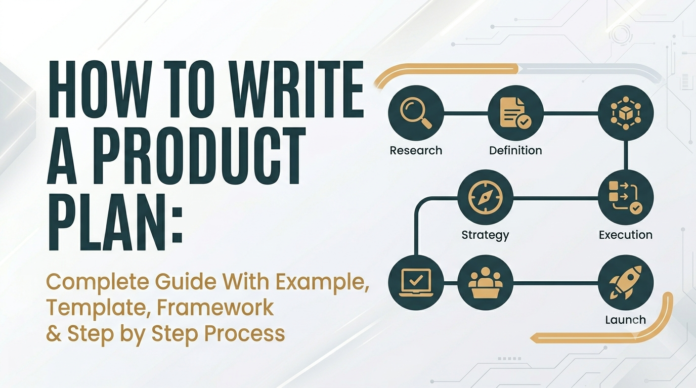
Every successful product starts with a clear plan. Whether you are launching a startup, introducing a new feature, improving an existing product, or expanding into a new market, having a well structured product plan significantly increases your chances of success.
Many people confuse a product plan with a product roadmap or a business plan. While these documents are related, a product plan serves a unique purpose. It explains what you are building, why customers need it, how it supports business objectives, who the target audience is, and how the product will move from an idea to a successful launch.
Without a product plan, teams often work in different directions. Product managers prioritize one thing, developers focus on another, while marketing prepares campaigns without a clear understanding of the product’s value. A well written product plan keeps everyone aligned and provides a single source of truth throughout the product lifecycle.
In this comprehensive guide, you will learn what a product plan is, why it matters, how to write one from scratch, the essential components every product plan should include, a practical example, a ready to use template, and the common mistakes to avoid.
What Is a Product Plan?
A product plan is a strategic document that outlines how a product will be developed, launched, marketed, and improved over time. It combines customer research, business objectives, market insights, competitive analysis, pricing, product positioning, and execution into one structured document.
Unlike a simple list of product features, a product plan explains the reasoning behind every major decision. It answers important business questions before development begins, reducing uncertainty and helping teams make informed choices.
A strong product plan typically answers the following questions:
- What customer problem does the product solve?
- Who is the ideal customer?
- What makes the product different from competitors?
- How will the product generate revenue?
- What is the launch strategy?
- How will success be measured?
Because markets constantly evolve, product plans should never be treated as static documents. They should be reviewed regularly and updated whenever customer needs, market conditions, or business priorities change.
Product Plan at a Glance
| Element | Purpose |
|---|---|
| Product Opportunity | Explains why the product should exist |
| Target Audience | Defines ideal customers |
| Market Research | Validates demand |
| Product Concept | Describes the solution |
| Business Model | Explains revenue generation |
| Go to Market Strategy | Defines launch approach |
| Development Plan | Organizes execution |
| Risk Assessment | Identifies potential challenges |
| Success Metrics | Measures performance |
Why Is a Product Plan Important?
Building a product without a plan is similar to constructing a building without architectural drawings. You may eventually complete the project, but delays, budget overruns, confusion, and poor quality become much more likely.
A product plan provides direction before development begins. It ensures that every department understands its responsibilities and contributes toward the same business objectives.
Some of the biggest benefits include:
Better Team Alignment
Engineering, marketing, sales, customer support, finance, and leadership all work from the same strategic document. This reduces misunderstandings and improves collaboration.
Smarter Decision Making
Product teams constantly face difficult choices regarding features, pricing, deadlines, and priorities. A product plan provides the context needed to make better decisions.
Lower Business Risk
Market validation, competitor research, feasibility analysis, and customer interviews reduce the likelihood of launching products that nobody wants.
Faster Product Development
When objectives, responsibilities, and timelines are clearly documented, teams spend less time debating priorities and more time building.
Improved Customer Focus
A customer centered product plan ensures that development decisions are driven by user needs instead of internal assumptions.
Product Plan vs Product Roadmap vs Business Plan
These documents often work together, but they serve different purposes.
| Aspect | Product Plan | Product Roadmap | Business Plan |
| Primary Focus | Overall product strategy | Feature timeline | Entire business |
| Time Horizon | Medium to long term | Short to medium term | Long term |
| Audience | Product teams | Internal stakeholders | Investors and executives |
| Includes Market Research | Yes | Limited | Yes |
| Includes Development Timeline | Yes | Yes | High level |
| Includes Financial Strategy | Basic | No | Detailed |
Think of it this way:
The business plan explains the company.
The product plan explains the product.
The roadmap explains when product initiatives will be delivered.
Essential Components of a Product Plan
Although every organization structures product plans differently, most successful plans include similar building blocks.
| Component | Why It Matters |
| Product Overview | Introduces the product |
| Problem Statement | Explains customer pain points |
| Customer Research | Validates demand |
| Target Audience | Defines who will use it |
| Competitor Analysis | Understands market competition |
| Product Concept | Explains solution |
| Value Proposition | Shows why customers should care |
| Revenue Model | Explains monetization |
| Go to Market Strategy | Plans launch |
| Development Roadmap | Organizes execution |
| Risk Assessment | Identifies uncertainties |
| Success Metrics | Measures outcomes |
Each section builds upon the previous one, creating a complete picture of the product.
Step 1: Define the Product Opportunity
Every successful product begins by identifying a meaningful opportunity rather than simply generating ideas.
Instead of asking, “What product should we build?” successful product managers ask, “What important problem can we solve?”
The opportunity section explains why the product deserves to exist and why customers would care.
Questions to Answer
- What customer pain point exists?
- Why is the problem important?
- Why has it not been solved effectively?
- What market opportunity does this create?
- Why is now the right time?
Example
Imagine a company discovers that many office professionals regularly forget to drink enough water during busy workdays.
Existing reminder apps feel generic, while traditional water bottles offer no tracking or personalization.
This gap creates an opportunity for a smart hydration solution that combines hardware with an intelligent mobile application.
Rather than starting with technology, the product starts with a clearly defined customer problem.
Best Practices
- Support assumptions with customer research.
- Focus on one primary problem.
- Explain the market timing.
- Quantify the opportunity whenever possible.
Step 2: Define the Target Audience
A product designed for everyone rarely satisfies anyone.
The most successful products solve specific problems for clearly defined customer groups.
Identifying your audience helps shape features, messaging, pricing, marketing campaigns, and customer support.
Questions to Answer
- Who is the ideal customer?
- What problems do they experience?
- What motivates them to buy?
- What goals are they trying to achieve?
- Which audience should receive the highest priority?
Customer Segmentation Example
| Audience | Needs |
| Office Professionals | Hydration reminders during work |
| Students | Affordable wellness tracking |
| Fitness Enthusiasts | Water intake linked with workouts |
| Travelers | Portable hydration monitoring |
Instead of trying to serve every possible customer, successful product teams focus on one primary audience first before expanding into additional markets.
Buyer Persona Example
| Attribute | Example |
| Name | Rahul |
| Age | 29 |
| Occupation | Software Engineer |
| Goal | Improve health while working long hours |
| Challenge | Frequently forgets to drink water |
| Buying Motivation | Convenience and health tracking |
Buyer personas help teams understand customers beyond simple demographics.
Step 3: Conduct Market Research
Once the opportunity and target audience have been identified, the next step is validating whether enough demand exists.
Market research reduces uncertainty and provides evidence that customers actually need the proposed solution.
Good research combines qualitative and quantitative information.
Areas to Research
- Industry growth
- Customer behavior
- Buying patterns
- Competitor products
- Pricing expectations
- Technology trends
- Market size
Market Research Checklist
| Research Area | Purpose |
| Customer Interviews | Understand pain points |
| Online Surveys | Validate demand |
| Competitor Analysis | Discover market gaps |
| Product Reviews | Learn customer frustrations |
| Industry Reports | Understand market trends |
| Social Media Discussions | Capture customer opinions |
Example
Suppose research shows that most hydration products focus on athletes.
Very few products specifically target office workers who spend long hours sitting at desks.
This insight reveals an underserved customer segment and creates an opportunity for differentiation.
Common Research Mistakes
- Relying only on internal assumptions
- Ignoring competitor strengths
- Surveying too few customers
- Overlooking pricing expectations
- Misinterpreting customer feedback
Quality research forms the foundation of every successful product plan.
Step 4: Write the Product Concept
With the market opportunity validated, you can now define the product itself.
The product concept explains what the product is, how it works, and why customers should choose it over competing solutions.
This section should be concise yet detailed enough for stakeholders to understand the overall vision.
Questions to Answer
- What exactly is the product?
- Which core features solve the customer’s problem?
- How does it improve the customer’s life?
- What differentiates it from alternatives?
Example
HydratePro is a smart water bottle equipped with sensors that automatically measure water intake throughout the day.
The bottle connects to a mobile application that provides personalized reminders, hydration analytics, daily goals, and wellness recommendations based on user activity.
Unlike traditional bottles or generic reminder apps, it combines physical convenience with intelligent tracking in one seamless experience.
Product Concept Table
| Element | Description |
| Product Name | HydratePro |
| Category | Smart Wellness Device |
| Core Problem Solved | Inconsistent daily hydration |
| Primary Features | Intake tracking, reminders, analytics |
| Unique Value Proposition | Automated hydration monitoring with personalized insights |
A clearly written product concept ensures everyone involved in development understands exactly what is being built and why it matters.
Step 5: Explain the Business Model
A great product solves customer problems, but it must also create value for the business. This is where the business model becomes an essential part of your product plan.
The business model explains how the product will generate revenue, sustain operations, and contribute to long term business growth. Investors, stakeholders, and leadership teams often review this section carefully because it determines whether the product is financially viable.
A business model is much more than choosing a price. It includes pricing strategy, expected costs, profit margins, recurring revenue opportunities, and future monetization possibilities.
Questions to Answer
- How will the product generate revenue?
- What pricing model is most appropriate?
- What are the estimated development and operating costs?
- Will there be subscriptions, upgrades, or premium versions?
- What is the expected profit margin?
Common Business Models
| Business Model | Best For | Example |
|---|---|---|
| One Time Purchase | Physical products | Smart devices |
| Subscription | SaaS products | Netflix |
| Freemium | Mobile apps | Spotify |
| Tiered Pricing | Enterprise software | HubSpot |
| Marketplace Commission | Platforms | Airbnb |
Example
For the HydratePro Smart Water Bottle:
| Item | Details |
| Basic Version | ₹1,499 |
| Premium Version | ₹2,499 |
| Monthly Subscription | Advanced hydration analytics |
| Accessories | Replacement lids and filters |
| Future Revenue | Corporate wellness partnerships |
Diversifying revenue streams helps reduce business risk while increasing customer lifetime value.
Step 6: Build the Go to Market Plan
Even the best products fail if customers never hear about them.
The Go to Market Plan explains how your product will reach its intended audience, generate awareness, acquire customers, and drive long term adoption.
Rather than focusing solely on marketing, this section coordinates product, marketing, sales, customer support, and distribution into a unified launch strategy.
Questions to Answer
- Where will customers discover the product?
- Which marketing channels will be used?
- What messaging will attract buyers?
- How will sales be supported?
- Who owns each launch activity?
Go to Market Framework
| Component | Purpose |
| Target Audience | Identify buyers |
| Positioning | Define product message |
| Pricing | Support customer expectations |
| Marketing Channels | Create awareness |
| Sales Strategy | Convert prospects |
| Customer Support | Improve adoption |
Example Launch Strategy
HydratePro plans to launch through:
- Amazon
- Flipkart
- Official company website
- Instagram campaigns
- Fitness influencers
- YouTube product reviews
- Email newsletters
- Corporate wellness partnerships
Instead of depending on a single marketing channel, the company creates multiple customer touchpoints before launch.
Step 7: Create the Development Plan
A product idea only becomes valuable after successful execution.
The development plan organizes the work required to move from concept to launch. It outlines timelines, milestones, team responsibilities, and delivery expectations.
Without a structured development plan, projects often experience delays, budget overruns, and unclear ownership.
Questions to Answer
- What are the major project phases?
- Who owns each milestone?
- What dependencies exist?
- What is the estimated launch timeline?
Sample Development Timeline
| Phase | Duration |
| Market Validation | Weeks 1 to 2 |
| Product Design | Weeks 3 to 4 |
| Prototype Development | Weeks 5 to 7 |
| User Testing | Weeks 8 to 9 |
| Product Improvements | Week 10 |
| Launch Preparation | Week 11 |
| Public Launch | Week 12 |
Breaking the project into smaller milestones allows teams to monitor progress more effectively.
Step 8: Identify Risks and Dependencies
Every product carries uncertainty.
Ignoring potential risks does not eliminate them. Instead, identifying risks early allows teams to prepare contingency plans before problems affect the launch.
Risk management is one of the strongest indicators of mature product planning.
Common Product Risks
| Risk | Possible Impact |
| Development delays | Missed launch date |
| Budget overruns | Reduced profitability |
| Weak customer demand | Low sales |
| Technical challenges | Poor product quality |
| Supply chain issues | Manufacturing delays |
| Compliance problems | Legal complications |
Project Dependencies
A successful product launch often depends on support from multiple departments.
Examples include:
- Engineering resources
- UI and UX designers
- Legal approval
- Marketing campaigns
- Customer support training
- Analytics implementation
- Manufacturing partners
Recognizing dependencies early prevents unexpected bottlenecks later.
Step 9: Define Success Metrics
Every product needs measurable objectives.
Without clearly defined metrics, it becomes impossible to determine whether the product achieved its intended goals.
Good success metrics should align with both customer outcomes and business performance.
Common Product KPIs
| KPI | Measures |
| Revenue | Financial performance |
| Customer Acquisition | New users |
| Conversion Rate | Sales effectiveness |
| Customer Retention | Long term usage |
| Monthly Active Users | Product engagement |
| Customer Satisfaction | User experience |
| Net Promoter Score | Customer loyalty |
Example Goals
For HydratePro, the company may define success as:
- 5,000 units sold during the first quarter.
- 35 percent mobile app activation rate.
- Customer satisfaction score above 90 percent.
- Repeat purchase rate above 20 percent.
- Net Promoter Score greater than 40.
These measurable objectives help teams evaluate performance objectively after launch.
Complete Product Plan Example
Below is a simplified product plan combining all major sections into one practical example.
Product Overview
Product Name: HydratePro
A smart hydration bottle designed to help busy professionals monitor daily water intake through automatic tracking and personalized reminders.
Problem Statement
Many people fail to drink sufficient water during busy workdays because existing reminder solutions lack convenience and personalization.
Target Audience
- Office professionals
- University students
- Fitness enthusiasts
- Frequent travelers
Product Concept
A reusable smart bottle connected to a mobile application that tracks hydration automatically and provides personalized health recommendations.
Unique Value Proposition
HydratePro combines intelligent tracking, health insights, and ease of use into a single hydration solution.
Pricing Strategy
| Version | Price |
| Basic | ₹1,499 |
| Premium | ₹2,499 |
| Subscription | Monthly wellness insights |
Go to Market Plan
Sales Channels:
- Amazon
- Flipkart
- Official Website
Marketing Activities:
- Influencer partnerships
- Social media advertising
- Email campaigns
- Corporate wellness programs
Development Roadmap
- Customer Research
- Prototype Design
- Beta Testing
- Manufacturing
- Marketing Preparation
- Public Launch
Success Metrics
- Units Sold
- Revenue
- Customer Satisfaction
- App Engagement
- Repeat Purchases
Ready to Use Product Plan Template
The following template can be customized for almost any product.
| Section | Details |
| Product Name | |
| Product Overview | |
| Problem Statement | |
| Target Audience | |
| Customer Research Summary | |
| Competitor Analysis | |
| Product Concept | |
| Unique Value Proposition | |
| Pricing Strategy | |
| Revenue Model | |
| Go to Market Plan | |
| Development Timeline | |
| Risks | |
| Dependencies | |
| Success Metrics | |
| Product Owner | |
| Expected Launch Date |
This template serves as a practical starting point for startups, established businesses, and product managers.
Common Mistakes When Writing a Product Plan
Many teams invest months building products before realizing important planning mistakes could have been avoided.
Some of the most common mistakes include:
Defining the Audience Too Broadly
Trying to serve everyone usually results in a product that strongly satisfies no one.
Skipping Customer Research
Assumptions are rarely as reliable as real customer feedback.
Ignoring Competitor Analysis
Understanding competitors helps identify differentiation opportunities.
Focusing Only on Features
Customers purchase solutions, not feature lists.
Missing Success Metrics
Without measurable goals, evaluating product performance becomes difficult.
Treating the Plan as Permanent
Markets change continuously. Product plans should evolve with customer feedback and business priorities.
Best Practices for Writing an Effective Product Plan
Experienced product teams consistently follow several planning principles.
- Begin with customer problems instead of product ideas.
- Support decisions with market research.
- Write clear and measurable business objectives.
- Align every feature with customer value.
- Prioritize simplicity over unnecessary complexity.
- Involve engineering, marketing, sales, and customer support early.
- Review the product plan regularly and update it as new insights emerge.
Final Thoughts
A product plan is far more than a planning document. It is the strategic foundation that guides every major product decision from the initial idea to long term growth.
An effective product plan aligns teams around a common vision, validates customer demand before significant investment, identifies risks early, defines measurable business objectives, and creates a structured path toward successful execution.
Whether you are launching a completely new product, improving an existing offering, entering new markets, or preparing for rapid business growth, investing time in a well researched and carefully structured product plan will improve decision making, reduce uncertainty, and increase the likelihood of long term success.
The strongest product plans are never treated as finished documents. They evolve continuously as markets change, customers provide feedback, competitors introduce new innovations, and business priorities shift. Teams that regularly review and refine their product plans are better positioned to build products that deliver lasting value for both customers and the business.

