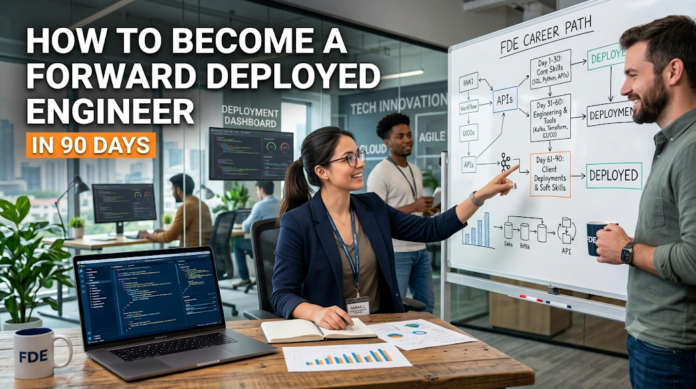
Most guides to becoming a Forward Deployed Engineer assume you already have three years of experience. This one is different. This one is for the college student or fresh graduate who has heard about the FDE role, knows the compensation is strong, and wants a realistic plan to get there as fast as possible.
The honest answer is that becoming a full FDE in 90 days is ambitious. The honest follow-up is that 90 days is enough to become a credible FDE candidate: someone who can show up to an interview with deployed projects, clear communication, and the basics of customer engineering already in muscle memory. From there, your first real FDE job is what turns you into a strong FDE.
This guide gives you a complete 90-day plan. It includes the month-by-month focus, a day-by-day breakdown of what to study, the project ideas that actually get you hired, the daily formula, and a clear-eyed look at what comes after day 90.
Is 90 Days Realistic for a Fresher?
A quick reality check before you start.
A pure FDE role, with full customer-facing responsibility and zero handholding, is rarely a fresher role. Most companies want FDEs to handle ambiguity and client pressure from day one, which is hard to expect from someone who has never worked professionally.
But 90 days is enough to:
- Build a strong engineering foundation
- Ship two real deployed projects, including one AI-related
- Practice the customer and communication skills that separate FDEs from regular engineers
- Apply for FDE-adjacent roles: junior FDE, solutions engineer intern, AI application engineer, technical consultant, or FDE residency programs
The smarter path for most freshers is to use 90 days to become FDE-adjacent, then move into a true FDE role after 6 to 12 months of real exposure. The plan below is built around that. It is ambitious but not fantasy.
What an FDE Actually Does (Quick Refresher)
A Forward Deployed Engineer is a software engineer embedded with customers to build, customize, and deploy working solutions. Unlike a regular product engineer, an FDE spends significant time in customer environments, on customer calls, and on customer code. The output is a working solution in the customer’s stack, not a feature in the home product.
The role is most common at AI and enterprise software companies (Palantir, Anduril, Scale AI, OpenAI, Anthropic, Databricks) where the gap between the product and the customer’s reality is large.
For a fresher, the practical takeaway is this: the FDE role is a hybrid of software engineering, customer communication, and product thinking. Your 90 days need to touch all three.
What You Need to Know Before Day 1
Before you start, get clear on three things.
1. Pick one language and stick with it. Python is the strongest choice for FDE roles because most AI tooling, scripting, and data work happens in Python. JavaScript or TypeScript is a fine second choice if you are stronger there. Do not split your time across two languages during the 90 days. Pick one, get fluent, learn the other later.
2. Set up your environment once. Install your language, an IDE, Git, Docker, and a free cloud account (AWS, GCP, Vercel, or Render). Spend day 0 getting this right so the next 89 days are friction-free.
3. Decide your target FDE flavor. Modern FDE work splits into two flavors: AI FDE (building AI features in customer environments) and traditional enterprise FDE (building data pipelines, integrations, and operational tools). The 90-day plan covers both, but lean AI if you are aiming at AI companies.
The 90-Day Plan: Month by Month
The plan is split into three focused months. Each month has one theme. Do not skip ahead.
Month 1: Core Engineering Foundations
Theme: build the engineering base that everything else stands on.
In month one, you are not yet acting like an FDE. You are building the engineering depth you will need for the rest of the 90 days. A weak foundation here makes months two and three much harder.
Focus areas:
- One language to fluency
- Data structures and algorithms (the basics, not the deep cuts)
- SQL and databases
- Git, HTTP, REST APIs, and testing
- Basic system design: APIs, databases, caching, auth
- Docker and deployment fundamentals
Time commitment: 2 to 3 hours per day, 5 days a week, plus 2 project days.
Outcome by end of month: You can write a small REST API with auth, a SQL schema, and a tested backend, and you can explain how it works.
Month 2: Build and Deploy Real Projects
Theme: ship two real projects, end to end, on the public internet.
Month two is where the FDE candidate starts to look different from a regular fresher. The portfolio you build here is what gets you interviews.
Focus areas:
- One end-to-end full-stack project (backend, database, deployment)
- One AI or data project (RAG chatbot, dashboard, automation tool)
- Logging, error handling, tests
- Deployment on a real cloud platform
- README and case study per project
Time commitment: 2 to 3 hours per day, with longer weekend sessions for project work.
Outcome by end of month: Two deployed projects on your GitHub, with clear documentation, that a hiring manager can click and try.
Month 3: Customer Skills and Interview Prep
Theme: become the FDE-shaped candidate, not just a coder.
Month three is where most freshers under-invest. They spend the time doing more LeetCode. That is a mistake. The skills that separate an FDE from a regular engineer are communication, problem framing, and customer comfort. Month three is where you build them.
Focus areas:
- Problem framing and customer scenario practice
- Behavioral interview stories (STAR format)
- System design questions at the FDE level (rate limiter, chatbot, API design)
- AI deployment concepts (RAG, embeddings, evaluation, latency, cost)
- Mock interviews, resume polish, application push
Time commitment: 2 to 3 hours per day, plus weekly mock interviews.
Outcome by end of month: A clear answer to “Why FDE?”, a polished resume, two strong projects, and 5 to 10 applications in flight.
Day-by-Day Breakdown (The Full 90 Days)
Below is the day-by-day plan. Treat it as a guide, not a prison. If you need an extra day on a topic, take it. If a project takes longer than expected, that is fine. The point is daily momentum, not perfect adherence.
Days 1 to 30: Foundations
The first month is heavy on fundamentals. Do not skip this.
Days 1 to 7: Setup and language basics
- Day 1: Set your goal. Pick Python or JavaScript. Clean up your GitHub.
- Day 2: Language basics. Variables, loops, functions, conditionals. Write 10 small programs.
- Day 3: Practice arrays and strings. Solve 5 easy problems.
- Day 4: Learn hash maps and sets. Solve 5 problems using them.
- Day 5: Time complexity basics. Rewrite yesterday’s solutions more efficiently.
- Day 6: Git basics. Commit, push, branch, pull request. Upload practice code.
- Day 7: Review the week. Fix weak areas.
Days 8 to 14: Data structures
- Day 8: Recursion basics. Solve 3 problems.
- Day 9: Stacks and queues. Solve 5 problems.
- Day 10: Linked lists. Solve 4 problems.
- Day 11: Sorting. Implement bubble, merge, and quick sort.
- Day 12: Binary search. Solve 5 problems.
- Day 13: Trees basics. Study traversal.
- Day 14: Solve 4 tree problems. Review all mistakes.
Days 15 to 21: SQL and APIs
- Day 15: SQL basics. SELECT, WHERE, ORDER BY, GROUP BY.
- Day 16: SQL joins. Solve 10 queries.
- Day 17: Subqueries and window functions.
- Day 18: REST APIs. GET, POST, PUT, DELETE.
- Day 19: Build a small API. Add one GET and one POST route.
- Day 20: JSON, request/response. Test with sample inputs.
- Day 21: Mixed review. SQL, APIs, and DSA together.
Days 22 to 30: Databases, auth, and ops
- Day 22: Database basics. Tables, keys, indexes, normalization.
- Day 23: Auth basics. Sessions, tokens, password hashing.
- Day 24: Add login/signup logic to your small API.
- Day 25: Testing basics. Write 3 to 5 unit tests.
- Day 26: Debugging practice. Find and fix errors in your own code.
- Day 27: Linux or command line basics. Navigation and file commands.
- Day 28: Full review of the month. Make a revision sheet.
- Day 29: Mini mock test on coding and SQL. Identify weak topics.
- Day 30: Light day. Plan month two.
Days 31 to 60: Build and Deploy Two Projects
The second month is where the FDE candidate starts to look real.
Days 31 to 45: Project 1 (a full-stack deployed app)
- Day 31: Choose Project 1. Keep it practical and simple.
- Day 32: Write the problem statement. Define features and tech stack.
- Day 33: Design the database schema.
- Day 34: Set up the backend structure. Folders, routes, files.
- Day 35: Build authentication or basic user flow.
- Day 36: Build the main feature.
- Day 37: Connect to the database.
- Day 38: Validation and error handling.
- Day 39: Add tests.
- Day 40: Clean and refactor.
- Day 41: Deployment basics. Environment variables and hosting.
- Day 42: Deploy Project 1.
- Day 43: Fix deployment bugs.
- Day 44: Write a strong README.
- Day 45: Screenshots and feature explanation. Commit final version.
Days 46 to 60: Project 2 (an AI or data project)
- Day 46: Choose Project 2. Make it FDE-like. A dashboard, RAG chatbot, or automation tool.
- Day 47: Define the use case and the user.
- Day 48: Design the architecture.
- Day 49: Backend setup.
- Day 50: Build the core feature.
- Day 51: Database or API integration.
- Day 52: Add a frontend or interface if needed.
- Day 53: Logging and error handling.
- Day 54: Add tests.
- Day 55: Improve UX and fix bugs.
- Day 56: Deploy Project 2.
- Day 57: README for Project 2.
- Day 58: Write short project notes for interview explanation.
- Day 59: Revise both projects deeply.
- Day 60: Polish the GitHub profile with both projects.
Days 61 to 90: Customer Skills and Interview Prep
The third month is what makes you FDE-shaped.
Days 61 to 70: FDE mindset and customer scenarios
- Day 61: Read about what FDEs actually do. Take notes.
- Day 62: Study common FDE responsibilities. Write your own version.
- Day 63: Practice answering “Why FDE?” out loud, three different ways.
- Day 64: Practice “Tell me about yourself” until it is 90 seconds long.
- Day 65: Practice behavioral stories in STAR format. Three strong ones.
- Day 66: Practice explaining one of your projects to a non-technical person.
- Day 67: Practice explaining trade-offs in simple English.
- Day 68: Solve 5 coding problems under time pressure.
- Day 69: Solve 5 SQL problems under time pressure.
- Day 70: Trees, graphs, and hash maps review.
Days 71 to 80: System design, AI, and mocks
- Day 71: System design basics again. APIs, caching, databases.
- Day 72: Practice designing a rate limiter.
- Day 73: Practice designing a URL parser.
- Day 74: Practice designing a simple chatbot or support tool.
- Day 75: AI basics. RAG, embeddings, latency.
- Day 76: Practice explaining an AI solution in business language.
- Day 77: Mock interview for coding.
- Day 78: Mock interview for behavioral questions.
- Day 79: Mock interview for system design.
- Day 80: Review every mistake from the mocks.
Days 81 to 90: Resume, applications, and final review
- Day 81: Improve resume wording. Make it sharper, more outcome-focused.
- Day 82: Strong LinkedIn summary.
- Day 83: Short elevator pitch.
- Day 84: Research companies that hire FDE-adjacent roles.
- Day 85: Build a job application tracker.
- Day 86: Apply to internships, junior roles, and adjacent roles.
- Day 87: Practice client scenario questions.
- Day 88: Review both projects one more time.
- Day 89: Final interview notes. Rehearse once.
- Day 90: Full self-assessment. Decide your next 90 days.
Weekly Structure That Actually Works
Most freshers fail the 90-day plan not because the plan is wrong, but because they skip days. A simple weekly structure prevents that.
A working week looks like this:
- 5 weekdays: 2 to 3 hours per day, split between theory and practice
- 2 weekend days: longer project work, plus revision
- One mock interview or case study practice per week
- One review of GitHub, resume, and weak areas every two weeks
That rhythm is enough to cover the 90-day plan in real time without burning out. The biggest mistake is trying to do 6 hours a day for two weeks, then collapsing for two weeks. Consistency beats intensity.
The Daily Formula
Every study day should follow roughly the same shape:
- 1 hour: learn a new concept (theory, video, reading)
- 1 hour: apply it (problems, building, coding)
- 30 minutes: review mistakes and write down what you learned
- 15 minutes: notes, revision, GitHub commits
That ratio of input to output to reflection is what turns information into skill. Most freshers skip the last two steps. They learn a topic, solve some problems, and move on. The retention is terrible. The daily formula forces a small review loop that compounds.
4 Project Ideas That Get You Hired
The projects you build in month two are the single biggest factor in whether you get interviews. Generic projects (a to-do list, a calculator, a basic CRUD app) do not move the needle. FDE-flavored projects do.
A shortlist of project ideas that work:
1. Internal knowledge base with RAG. A simple app where a company can upload documents and ask questions. Use LangChain or LlamaIndex, an embedding model, a vector store, and a clean UI. This is the most FDE-shaped project because it is exactly the kind of thing customers ask AI companies to build.
2. Customer support automation tool. A small app that classifies incoming support tickets, suggests responses, and routes urgent ones. Combines LLM calls, basic NLP, and a small backend. Realistic, scoped, and demonstrable.
3. End-to-end SaaS with auth, billing, and dashboard. Build a real product, not a toy. Authentication, a database, a paid plan via Stripe, a dashboard, an admin panel. Deploy on Vercel or Render. This shows you can ship a real piece of software.
4. Data pipeline with monitoring. Pull data from a public API, transform it, store it, and surface it in a dashboard with basic monitoring and alerting. Demonstrates SQL, APIs, system design, and ops thinking. Especially good for traditional enterprise FDE roles.
Pick one AI project (1 or 2) and one non-AI project (3 or 4). That mix signals range, which is what FDE hiring managers want.
What Most Freshers Get Wrong
The 90-day plan is straightforward. The reason most freshers fail it is one of a few common mistakes.
1. Skipping deployment. A project that only runs on your laptop does not count. Hire managers want to click a link and try the thing. Deploy every project. It is one weekend of work, and it changes how your portfolio reads.
2. Only doing LeetCode. DSA matters, but it is a tiny share of the FDE interview. If your 90 days is 80% LeetCode, you are preparing for the wrong role.
3. Ignoring communication practice. The skills that separate FDEs from regular engineers are the soft skills. If you are not practicing explanations, customer scenarios, and behavioral stories, you are not actually preparing for FDE.
4. Building toy projects. A to-do list, a calculator, or a basic CRUD app does not move the needle. Build something that looks like a real product. The bar is “would a hiring manager click on this and keep exploring for 30 seconds.”
5. Memorizing instead of understanding. FDE interviews ask about trade-offs, not facts. If you can recite a system design pattern but cannot explain why you would choose one over the other, you will not pass.
6. Waiting until day 90 to apply. Apply throughout month three. Every application is practice. The first ten applications are mostly learning. The eleventh onward starts to convert.
7. Going alone. Find one or two friends on the same plan, or join a public cohort. The plan is much easier to follow when someone is checking in on you.
After 90 Days: What’s Next
Day 90 is a milestone, not a finish line. After 90 days, you are a credible FDE-adjacent candidate. The next phase depends on your outcome.
If you landed interviews: Treat every interview as a learning event. The first one or two will be rough. That is normal. Debrief after each one, fix the weak spots, and reapply to similar roles. The conversion rate climbs fast.
If you have not landed interviews yet: Audit your portfolio. Are the projects deployed? Are the READMEs clear? Is your resume telling a coherent story? Most fresher FDE candidates fail the application stage because their portfolio does not read as FDE-shaped, not because they lack the skills. Rewrite the resume around outcomes, not features.
If you want a stronger base: Take the next 90 days to deepen what you built. Add a third project, contribute to an open-source AI tool, or take on a freelance client project (even a small one) to get real customer exposure.
If you want to specialize: Pick a vertical. AI FDE for enterprise, data FDE for analytics, security FDE for regulated industries. Specializing makes you more valuable and easier to place.
The 90-day plan is the on-ramp. The next 6 to 12 months are where you become a real FDE.
The Honest Reality Check
A few things to be honest about before you start.
- The job market for pure FDE roles is competitive. Many companies prefer candidates with 2 to 4 years of experience. The fresher route usually means starting in a solutions engineer, technical consultant, or AI application engineer role first.
- Strong communication matters more than strong coding. The fresher who can explain a technical idea clearly to a non-technical person will often beat the fresher who can solve harder DSA but cannot hold a customer conversation.
- AI fluency is now expected. In 2026, an FDE candidate who cannot talk about RAG, embeddings, and evals is at a meaningful disadvantage. Build at least one AI project.
- The 90-day plan is hard but doable. Expect to skip a few days. Expect to struggle on some topics. Expect to feel behind. The plan is the average, not the minimum. If you do 80% of it well, you are ahead of most candidates.
- The first real FDE job is the actual training. This 90-day plan gets you to the door. The job itself is what makes you an FDE.
Conclusion
Becoming a Forward Deployed Engineer in 90 days as a fresher is not about being the best coder. It is about being the most well-rounded candidate: someone who can code, deploy, communicate, and frame problems. That mix is rare, which is why FDEs are paid well and hired selectively.
The plan is simple. Month one builds the engineering foundation. Month two ships two real projects. Month three practices the customer and interview skills that close the gap. The day-by-day breakdown gives you a clear path. The project list gives you the right shape. The daily formula keeps you consistent.
If you follow 80% of this plan for 90 days, you will be a stronger candidate than 90% of freshers applying to FDE roles. The first FDE-adjacent job is what makes you a real FDE.
Start today. Day one is just picking a language and cleaning up your GitHub. Everything else follows from that.
Frequently Asked Questions
Can a fresher become a Forward Deployed Engineer in 90 days? A pure FDE role is rarely a true fresher role, but 90 days is enough to become a strong FDE-adjacent candidate. You can build the engineering foundation, ship two deployed projects, and develop the communication skills needed to apply for junior FDE, solutions engineer, technical consultant, or AI application engineer roles. From there, the first job is what turns you into a real FDE.
What skills does a fresher need to become an FDE? The most important skills for a fresher FDE candidate are programming in one language (usually Python), SQL and databases, system design basics, deployment and DevOps fundamentals, problem framing, customer communication, and basic AI concepts like RAG, embeddings, and evaluation. Strong communication matters as much as strong coding.
Do I need AI experience to become an FDE in 2026? For most modern FDE roles, yes. Customers expect FDEs to understand LLMs, RAG, evals, and model trade-offs. AI fluency is no longer a specialty; it is a baseline expectation. A fresher should build at least one AI project before applying.
What projects should a fresher FDE candidate build? Strong projects for a fresher FDE include an internal knowledge base with RAG, a customer support automation tool, an end-to-end SaaS with auth and billing, and a data pipeline with monitoring and dashboards. Pick one AI project and one non-AI project to show range.
Which is better for a fresher: FDE at a startup or a large company? For most freshers, a startup or mid-sized company is the better first FDE role because the scope is broader, the customer exposure is more direct, and the learning curve is steeper. Large companies often have narrower FDE tracks and prefer candidates with prior experience. Start where the learning is fastest.
What is the typical FDE interview process for a fresher? Most FDE interviews for freshers have three rounds: a coding round (DSA plus SQL), a system design or project round, and a behavioral plus customer scenario round. Some companies add a take-home assignment or a presentation round. Expect at least one round to focus specifically on customer communication.
What is the salary of a junior Forward Deployed Engineer? In 2026, junior FDEs at AI and enterprise companies typically earn $130k to $200k base, with equity on top. FDE-adjacent roles (solutions engineer, technical consultant) are usually in a similar range, sometimes slightly lower for the first year. Total compensation can push past $250k for strong performers at well-funded companies.
Should a fresher learn DSA or build projects first? Both matter, but for FDE roles, projects usually matter more. A reasonable split is 30% DSA, 50% projects, 20% communication and customer skills. The exact mix depends on the company. AI-heavy FDE roles care more about projects. Traditional enterprise FDE roles care a bit more about DSA.
How is the FDE interview different from a regular SWE interview? A regular SWE interview focuses heavily on coding, system design, and behavioral questions. An FDE interview adds a customer scenario round, often with a hiring manager or a current FDE, where you are asked how you would handle an angry customer, a vague requirement, a deadline crunch, or a trade-off decision. Communication and problem framing are graded as seriously as coding.
What if I cannot finish the 90-day plan? That is fine. Most freshers hit 70% to 80% of the plan in real time. The goal is to build momentum and ship real projects, not to complete every day perfectly. If you ship two deployed projects and can speak fluently about customer engineering by the end of 90 days, you are ahead of most candidates.

