Growing a business has never been easier, yet it has never been more competitive. Every day, thousands of companies launch websites, apps, SaaS products, ecommerce stores, and digital services, all competing for the same audience. Traditional marketing alone often struggles to keep pace because advertising costs continue to rise while customer attention becomes increasingly limited.
This challenge gave birth to a completely different approach called growth hacking.
Unlike conventional marketing, growth hacking is built around rapid experimentation, continuous learning, customer behavior analysis, and creative thinking. Instead of investing heavily in one campaign and hoping for results, growth hackers test dozens of ideas, measure everything, and scale only what works.
The concept first became popular among startups with limited budgets, but today it is used by global companies including Dropbox, Airbnb, Slack, Spotify, Netflix, Canva, HubSpot, and many others.
Whether you manage a startup, an established company, an ecommerce brand, or a SaaS platform, understanding growth hacking can dramatically improve customer acquisition, retention, referrals, and revenue.
This guide explains everything you need to know about growth hacking in digital marketing, including its framework, strategy, process, examples, tools, benefits, mistakes, and implementation techniques.
What is Growth Hacking in Digital Marketing?
Growth hacking is an experiment driven marketing methodology that focuses on achieving rapid and sustainable business growth through creative strategies, product improvements, customer psychology, automation, and data analysis.
Instead of relying only on advertisements, growth hacking looks at the entire customer journey.
It asks questions such as:
- Where do customers discover us?
- Why do visitors leave?
- What encourages them to sign up?
- Why do customers return?
- What makes them recommend us?
The answers become opportunities for growth.
Unlike traditional marketers who often focus on awareness campaigns, growth hackers continuously optimize every stage of the customer lifecycle.
Simple Definition
Growth hacking is the process of using rapid experiments, customer insights, technology, and digital marketing techniques to increase business growth while minimizing marketing costs.
Growth Hacking vs Traditional Marketing
| Growth Hacking | Traditional Marketing |
|---|---|
| Experiment driven | Campaign driven |
| Focuses on rapid growth | Focuses on brand awareness |
| Data based decisions | Experience based decisions |
| Tests continuously | Fewer experiments |
| Product and marketing work together | Marketing often works independently |
| Low cost scalable tactics | Larger advertising budgets |
| Measures every customer action | Measures campaign performance |
Why Growth Hacking Has Become So Popular
Today’s digital businesses need predictable growth.
However, increasing advertising budgets every year is not sustainable.
Growth hacking became popular because it focuses on improving efficiency rather than simply increasing spending.
Instead of asking,
“How can we spend more?”
Growth hackers ask,
“How can we grow faster using smarter ideas?”
This mindset creates long term competitive advantages.
Core Principles of Growth Hacking
Although every company applies growth hacking differently, successful growth strategies usually follow several common principles.
Customer First Thinking
Growth begins by understanding customer behavior.
Businesses that solve real customer problems grow much faster than businesses focused only on selling products.
Every experiment should improve customer experience.
Continuous Experimentation
Growth hacking is based on testing.
Small improvements often create surprisingly large results.
Examples include:
- New landing page headlines
- Different pricing models
- Shorter signup forms
- Better onboarding
- Personalized emails
- Improved CTAs
Instead of assuming what works, growth hackers measure everything.
Data Driven Decisions
Opinions rarely drive successful growth.
Numbers do.
Growth hackers constantly monitor:
| Metric | Why It Matters |
|---|---|
| Conversion Rate | Measures effectiveness |
| Customer Acquisition Cost | Shows marketing efficiency |
| Customer Lifetime Value | Determines profitability |
| Churn Rate | Measures retention |
| Referral Rate | Indicates customer advocacy |
| Engagement Rate | Measures product usage |
| Bounce Rate | Reveals landing page quality |
Scalability
The best growth hacks continue producing results without requiring proportional increases in budget.
For example:
One successful referral program can continue generating thousands of new customers every month.
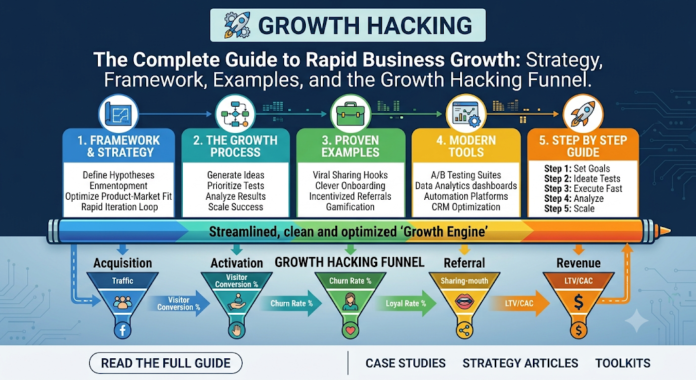
The Growth Hacking Funnel
Most growth hacking strategies follow a structured framework called the AARRR Funnel.
It was introduced by entrepreneur Dave McClure and remains one of the most widely used growth frameworks.
Acquisition
Acquisition focuses on attracting visitors.
Popular acquisition channels include:
| Channel | Example |
|---|---|
| SEO | Blog content |
| Social Media | Instagram campaigns |
| Google Ads | Paid search |
| Email Marketing | Newsletters |
| Influencer Marketing | Product reviews |
| YouTube | Educational videos |
| Referral Traffic | Partner websites |
The objective is attracting qualified visitors rather than random traffic.
Activation
Acquiring visitors is only the beginning.
Activation happens when users experience the product’s value quickly.
Examples include:
- Creating an account
- Completing onboarding
- Making the first purchase
- Uploading the first file
- Sending the first message
Good activation dramatically improves future retention.
Retention
Retention determines whether customers continue using the product.
Businesses that ignore retention usually experience high customer acquisition costs.
Retention strategies include:
- Personalized emails
- Push notifications
- Loyalty programs
- Product updates
- Gamification
- Educational content
Referral
Satisfied customers become marketers.
Referral systems encourage customers to invite friends through incentives.
Dropbox remains one of the best examples.
Instead of paying advertisers, Dropbox rewarded existing users with additional storage space.
The strategy generated millions of new users.
Revenue
Growth ultimately means increasing revenue.
Revenue optimization includes:
- Upselling
- Cross selling
- Subscription upgrades
- Premium features
- Better pricing strategies
- Reduced churn
The Complete AARRR Framework
| Funnel Stage | Main Goal | KPI |
|---|---|---|
| Acquisition | Get visitors | Website Traffic |
| Activation | First success | Signup Rate |
| Retention | Repeat usage | Returning Users |
| Referral | Customer recommendations | Referral Rate |
| Revenue | Profitability | Customer Lifetime Value |
Step by Step Growth Hacking Strategy
Step 1: Set One Growth Objective
Trying to improve everything at once usually fails.
Instead, focus on one measurable goal.
Examples include:
- Increase trial signups by 30%
- Reduce churn by 15%
- Double referral traffic
- Improve landing page conversion rate
Specific goals create better experiments.
Step 2: Understand Your Customers
Growth starts with customer research.
Learn:
- Their frustrations
- Buying motivations
- Common objections
- Decision making process
- Preferred communication channels
Research methods include:
| Research Method | Purpose |
|---|---|
| Customer Interviews | Discover pain points |
| Surveys | Gather opinions |
| Product Analytics | Measure behavior |
| Heatmaps | Observe interactions |
| Session Recordings | Identify friction |
| Reviews | Understand complaints |
Step 3: Identify Funnel Bottlenecks
Growth rarely requires rebuilding everything.
Usually one stage performs poorly.
Example:
| Funnel Stage | Performance |
|---|---|
| Traffic | Excellent |
| Signup | Average |
| Activation | Poor |
| Retention | Excellent |
In this case, activation becomes the priority.
Step 4: Generate Growth Ideas
Once bottlenecks are identified, brainstorm multiple experiments.
Examples include:
- Simplify signup
- Improve landing page copy
- Offer free trials
- Add testimonials
- Create referral incentives
- Improve onboarding tutorials
- Introduce gamification
Not every idea succeeds.
That is perfectly normal.
Step 5: Prioritize Experiments
Since resources are limited, prioritize based on expected impact.
A simple prioritization table helps.
| Experiment | Expected Impact | Difficulty | Priority |
|---|---|---|---|
| Better CTA | High | Low | High |
| Referral Program | Very High | Medium | High |
| Website Redesign | Medium | High | Medium |
| AI Chatbot | Medium | High | Low |
High impact and low effort ideas should be tested first.
Step 6: Measure Results
Every experiment needs measurable outcomes.
Track:
- Click through rate
- Signup conversion
- Revenue growth
- Customer retention
- Referral percentage
- Bounce rate
Growth hacking without measurement becomes guesswork.
Step 7: Scale Successful Experiments
Winning experiments should become permanent strategies.
Document:
- What changed
- Why it worked
- Measured improvement
- Future optimization opportunities
This creates repeatable growth systems rather than isolated successes.
Essential Growth Hacking Channels
Different businesses rely on different channels depending on their audience and objectives.
| Channel | Best For | Example |
|---|---|---|
| SEO | Long term traffic | Educational blogs |
| Email Marketing | Retention | Personalized campaigns |
| Social Media | Brand awareness | Instagram Reels |
| Paid Ads | Fast acquisition | Google Ads |
| Influencer Marketing | Trust building | Product reviews |
| Referral Programs | Viral growth | Invite rewards |
| Content Marketing | Authority | Case studies |
| Communities | Engagement | Reddit, Quora, LinkedIn |
Best Growth Hacking Tools
| Tool | Purpose |
|---|---|
| Google Analytics | Website analytics |
| Hotjar | User behavior |
| Mixpanel | Product analytics |
| HubSpot | CRM and automation |
| Ahrefs | SEO analysis |
| Semrush | Keyword research |
| Mailchimp | Email automation |
| Canva | Marketing creatives |
| Zapier | Workflow automation |
| Optimizely | A/B testing |
Real World Growth Hacking Examples That Changed the Digital Marketing Industry
The best way to understand growth hacking is to study companies that have successfully used it. These businesses did not necessarily have the biggest marketing budgets. Instead, they found creative ways to attract customers, improve user experience, and encourage people to share their products naturally.
Below are some of the most successful growth hacking examples that continue to inspire marketers around the world.
Dropbox: Referral Marketing That Created Viral Growth
Dropbox transformed cloud storage into a viral product by rewarding users for inviting friends. Instead of spending millions on paid advertising, the company offered additional free storage to both the referrer and the new user.
This simple incentive encouraged customers to become brand ambassadors.
Why It Worked
- The reward was valuable to both users.
- Sharing required very little effort.
- Every new customer created opportunities for even more referrals.
- Customer acquisition costs remained low.
| Strategy | Result |
|---|---|
| Referral Program | Millions of new users |
| Mutual Rewards | Higher customer participation |
| Viral Sharing | Exponential user growth |
| Low Marketing Cost | Improved ROI |
Airbnb: Expanding Reach Through Smart Distribution
In its early years, Airbnb struggled to attract enough users. Instead of relying solely on advertising, the company found innovative ways to increase visibility by placing property listings where travelers were already searching.
Combined with professional photography, trust signals, and customer reviews, Airbnb rapidly expanded its marketplace.
Lessons Learned
- Meet customers where they already spend time.
- Build trust before asking for bookings.
- Improve product presentation.
Slack: Product Led Growth in Action
Slack’s growth came from its product rather than aggressive advertising.
One employee would invite teammates, who then invited additional colleagues. Before long, entire organizations adopted the platform.
The product itself became the marketing channel.
Growth Strategy
| Growth Technique | Business Impact |
|---|---|
| Team Invitations | Organic expansion |
| Free Version | Easy adoption |
| Simple Onboarding | Faster activation |
| Excellent User Experience | High retention |
Spotify: Personalized Experiences Increase Retention
Spotify focuses heavily on personalization.
Weekly playlists, annual listening summaries, and AI recommendations encourage users to return regularly.
Its famous “Wrapped” campaign also became a viral marketing phenomenon as millions of users voluntarily shared their listening statistics on social media.
Canva: Removing Friction Through Freemium
Canva made graphic design accessible to everyone.
Instead of requiring payment upfront, users could immediately begin designing for free.
Once customers became comfortable using the platform, many upgraded to premium subscriptions.
This reduced barriers to entry while increasing long term revenue.
Netflix: Data Driven Personalization
Netflix constantly experiments with recommendations, thumbnails, previews, and user interfaces.
Even artwork for the same movie may appear differently depending on individual viewing behavior.
These small improvements significantly increase engagement and viewing time.
Uber: Referral Programs and Convenience
Uber accelerated growth through referral rewards and seamless customer experience.
Passengers earned ride credits by inviting friends, while drivers also benefited from referral incentives.
The convenience of requesting transportation through a smartphone encouraged repeat usage.
PayPal: Paying Customers to Join
One of the earliest growth hacks involved PayPal paying users to create accounts and refer friends.
Although expensive initially, the strategy dramatically expanded its user base and created long term network effects.
Notion: Community Driven Marketing
Rather than relying heavily on paid advertising, Notion invested in education, templates, creators, and community engagement.
Thousands of users voluntarily created tutorials and shared templates online.
This user generated content became an ongoing source of customer acquisition.
Zoom: Simplicity Became the Marketing Strategy
Zoom succeeded because joining a meeting required almost no technical knowledge.
Users experienced value immediately.
As businesses invited clients and coworkers into meetings, the platform naturally spread through organizations.
Growth Hacking Framework
Although every company follows its own path, successful growth hacking strategies generally follow a structured framework.
| Phase | Primary Objective | Key Activities |
|---|---|---|
| Research | Understand customers | Interviews, analytics, surveys |
| Identify Opportunity | Find bottlenecks | Funnel analysis |
| Generate Ideas | Brainstorm solutions | Team workshops |
| Prioritize | Select best experiments | ICE scoring |
| Test | Run experiments | A/B testing |
| Measure | Analyze results | KPIs and analytics |
| Scale | Expand winning ideas | Automation and optimization |
Product Led Growth vs Growth Hacking
Although the terms are sometimes used interchangeably, they are different approaches.
| Product Led Growth | Growth Hacking |
|---|---|
| Product drives acquisition | Marketing and product work together |
| Focus on product experience | Focus on rapid experimentation |
| Long term strategy | Continuous optimization |
| Product is primary growth engine | Multiple channels create growth |
| User experience first | Growth metrics first |
Many successful companies combine both strategies.
A/B Testing in Growth Hacking
A/B testing compares two versions of a webpage, email, advertisement, or feature to determine which performs better.
Instead of guessing, marketers allow customer behavior to determine the winner.
Common A/B Tests
- Landing page headlines
- Button colors
- Pricing pages
- Product descriptions
- Email subject lines
- Signup forms
- Call to action buttons
| Test Element | Success Metric |
|---|---|
| Landing Page | Conversion Rate |
| Email Subject | Open Rate |
| CTA Button | Click Rate |
| Pricing Page | Purchase Rate |
| Signup Form | Registration Rate |
Growth Hacking Metrics Every Business Should Track
Without data, growth hacking becomes impossible.
Below are the most important performance indicators.
| KPI | Meaning | Why It Matters |
|---|---|---|
| CAC | Customer Acquisition Cost | Marketing efficiency |
| LTV | Customer Lifetime Value | Long term profitability |
| Conversion Rate | Visitor to customer percentage | Funnel performance |
| Churn Rate | Customers leaving | Retention measurement |
| NPS | Customer satisfaction | Brand loyalty |
| Referral Rate | Word of mouth growth | Organic acquisition |
| Retention Rate | Returning customers | Sustainable growth |
Growth Hacking Process from Start to Scale
Businesses usually progress through several stages before achieving consistent growth.
| Stage | Objective |
|---|---|
| Research | Learn about customers |
| Planning | Select growth opportunities |
| Experimentation | Test ideas |
| Validation | Measure outcomes |
| Scaling | Expand successful tactics |
| Automation | Improve efficiency |
| Optimization | Continue improving performance |
Common Growth Hacking Mistakes
Many companies misunderstand growth hacking by focusing only on shortcuts.
The most successful businesses avoid these mistakes.
Ignoring Product Quality
No marketing strategy can permanently compensate for a poor product.
Satisfied customers remain the foundation of sustainable growth.
Chasing Vanity Metrics
Large follower counts do not necessarily generate revenue.
Focus on meaningful business metrics instead.
Examples include:
- Revenue
- Customer retention
- Repeat purchases
- Conversion rates
Running Too Many Experiments
Testing dozens of ideas simultaneously often creates confusion.
Instead, test one hypothesis, measure the outcome, and document the findings before moving forward.
Forgetting Existing Customers
Many companies invest heavily in acquiring new users while neglecting existing customers.
Retention often produces higher returns than acquisition.
Copying Other Companies
A tactic that succeeds for one business may fail completely for another.
Always adapt strategies to your audience, industry, and business goals.
How to Build Your Own Growth Hacking Strategy
If you are starting from scratch, follow this practical implementation framework.
Step 1
Understand your customer through interviews, surveys, and analytics.
Step 2
Identify the biggest growth bottleneck in your customer journey.
Step 3
Generate multiple improvement ideas.
Step 4
Prioritize experiments using expected impact and implementation effort.
Step 5
Launch small controlled experiments.
Step 6
Measure every important KPI.
Step 7
Scale successful experiments across additional channels.
Step 8
Repeat the cycle continuously.
Growth hacking is an ongoing process rather than a one time campaign.
Best Practices for Successful Growth Hacking
Businesses that consistently achieve rapid growth usually follow several best practices.
- Build around customer needs instead of assumptions.
- Measure every experiment objectively.
- Focus on solving one problem at a time.
- Improve onboarding before increasing advertising.
- Use automation wherever possible.
- Encourage referrals with meaningful incentives.
- Combine marketing with product improvements.
- Continue optimizing even after successful campaigns.
Growth Hacking Strategy Checklist
| Activity | Completed |
|---|---|
| Customer research completed | □ |
| Funnel analyzed | □ |
| Growth goal defined | □ |
| KPIs selected | □ |
| Experiments prioritized | □ |
| A/B testing planned | □ |
| Analytics configured | □ |
| Winning experiments documented | □ |
| Scaling strategy created | □ |
| Continuous optimization scheduled | □ |
Traditional Marketing vs Growth Hacking Summary
| Factor | Traditional Marketing | Growth Hacking |
|---|---|---|
| Objective | Brand awareness | Rapid business growth |
| Budget | Higher | Lower |
| Decision Making | Experience based | Data driven |
| Experimentation | Limited | Continuous |
| Measurement | Campaign results | Entire customer journey |
| Customer Focus | Marketing funnel | Product and marketing together |
| Speed | Moderate | Fast |
| Scalability | Budget dependent | Process dependent |
Future Trends in Growth Hacking
Growth hacking continues to evolve alongside technology.
Some emerging trends include:
- Artificial intelligence powered personalization.
- Predictive customer analytics.
- No code automation platforms.
- Conversational marketing.
- Interactive content.
- Product led growth.
- Community driven marketing.
- Privacy focused customer acquisition.
Businesses that embrace these trends will be better positioned to compete in increasingly crowded digital markets.
Final Conclusion
Growth hacking has transformed the way modern businesses think about marketing. Rather than depending solely on expensive advertising campaigns, it encourages companies to understand customer behavior, test ideas rapidly, and make decisions based on measurable results.
The most successful growth hacks are often surprisingly simple. A referral reward, a smoother onboarding process, a better landing page, or a personalized email campaign can generate significant improvements when backed by data and continuous experimentation.
Whether you run a startup, SaaS business, ecommerce store, or established enterprise, growth hacking provides a structured framework for achieving sustainable growth without relying entirely on larger marketing budgets.
Success does not come from finding one magical tactic. It comes from building a culture of experimentation, learning from customers, improving continuously, and scaling only the strategies that consistently deliver results.
Businesses that combine creativity with analytics, marketing with product development, and experimentation with customer value are the ones most likely to achieve long term digital growth in today’s highly competitive marketplace.
FAQs
1. What is growth hacking in digital marketing?
Growth hacking in digital marketing is a data driven marketing approach that uses rapid experimentation, product improvements, analytics, and creative strategies to increase customer acquisition, retention, referrals, and revenue while keeping marketing costs as low as possible.
2. What is the difference between growth hacking and traditional marketing?
Traditional marketing mainly focuses on brand awareness and long term campaigns, while growth hacking focuses on rapid experimentation, measurable results, customer behavior analysis, and scalable growth strategies using both marketing and product improvements.
3. What is the AARRR growth hacking framework?
The AARRR framework consists of five stages: Acquisition, Activation, Retention, Referral, and Revenue. It helps businesses optimize every step of the customer journey to achieve sustainable growth.
4. What are some famous examples of growth hacking?
Some of the most successful growth hacking examples include Dropbox’s referral program, Airbnb’s marketplace expansion strategy, Slack’s product led growth, Spotify’s personalized recommendations, Canva’s freemium model, Uber’s referral campaigns, and Netflix’s AI driven personalization.
5. Which metrics are most important in a growth hacking strategy?
The most important growth hacking metrics include Customer Acquisition Cost (CAC), Customer Lifetime Value (LTV), Conversion Rate, Retention Rate, Churn Rate, Referral Rate, Net Promoter Score (NPS), and Monthly Active Users (MAU). These KPIs help measure marketing efficiency and business growth.
6. Is growth hacking suitable only for startups?
No. Although growth hacking became popular among startups, it is now widely used by SaaS companies, ecommerce businesses, enterprises, agencies, and global brands. Any business looking to grow through data driven experimentation can benefit from growth hacking.
7. How can beginners start implementing growth hacking?
Beginners should start by defining one measurable growth goal, understanding their target audience, analyzing the customer journey, identifying bottlenecks, running small experiments, measuring results, and scaling only the strategies that consistently improve business performance.

