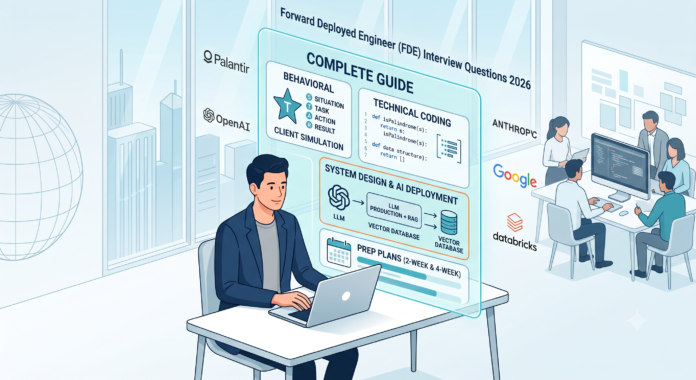
The Forward Deployed Engineer (FDE) position has become one of the most critical roles at top enterprise software and artificial intelligence providers. Spearheaded by companies like Palantir and rapidly adopted across modern AI pioneers including OpenAI, Anthropic, Databricks, and Google, the FDE model bridges the gap between core engineering and enterprise value creation.
Preparing for a Forward Deployed Engineering interview requires a distinct strategy compared to traditional Software Development Engineer (SDE) roles. You are not only evaluated on data structures, algorithms, and system architecture, but also on your ability to deploy software in production, interface directly with client stakeholders, iterate rapidly under high uncertainty, and translate complex enterprise workflows into scalable engineering implementations.
This comprehensive guide breaks down the core architecture of the FDE interview process, analyzes the underlying evaluation frameworks, and provides model technical and behavioral answers designed to demonstrate high-agency engineering.
What Is a Forward Deployed Engineer?
A Forward Deployed Engineer operates at the intersection of production software development, field deployment, systems integration, and technical consulting.
Unlike core product engineers who build generalized platforms, or solutions architects who primarily write technical proposals and light proof-of-concepts, FDEs write production-grade code directly within client environments. They take platform infrastructure and extend, integrate, and customize it to solve pressing enterprise problems.
       ┌────────────────────────────────────────────────────────┐
       │               FORWARD DEPLOYED ENGINEER                │
       └───────────────────────────┬────────────────────────────┘
                                   │
         ┌─────────────────────────┼─────────────────────────┐
         ▼                         ▼                         ▼
┌──────────────────┐      ┌──────────────────┐      ┌──────────────────┐
│ Systems & Coding │      │ Field Deployment │      │  Client Strategy │
│ • Systems Design │      │ • Custom Integr. │      │ • Problem Framing│
│ • Production AI  │      │ • Rapid Prototypes│     │ • Value Proof    │
│ • Full-Stack Dev │      │ • Production Ops │      │ • Stakeholders   │
└──────────────────┘      └──────────────────┘      └──────────────────┘
Core Responsibilities of an FDE
- Production Integration: Connecting core AI models, data pipelines, and platforms to legacy databases, cloud infrastructure, and proprietary APIs.
- Rapid Prototyping & Iteration: Building working end-to-end applications in days or weeks rather than months to prove technical feasibility.
- Problem Framing & Scoping: Translating ambiguous business problems into structured technical specifications.
- Cross-Functional Communication: Serving as the technical bridge between client leadership, operational end-users, and internal core engineering teams.
- Production Reliability & Scale: Ensuring deployed solutions adhere to enterprise security, compliance, performance, and latency requirements.
Category 1: Behavioral & Mindset Questions
Interviewer evaluation for behavioral rounds focuses on your customer orientation, priority management, and ability to translate technical concepts into operational decisions.
Question 1: Why do you want to pursue a Forward Deployed Engineer role instead of a traditional backend or platform engineering role?
Strategic Answer
“While traditional software engineering focuses on building generalized platform abstractions, I am driven by the direct, tangible application of code to critical operational problems. As a Forward Deployed Engineer, I can compress the feedback loop between writing software and measuring its real-world impact.
In a platform role, feature validation often flows through layers of product management and indirect metrics over quarters. As an FDE, I work directly at the deployment edge. I observe where systems fail in production, where data pipelines break under legacy constraints, and how operational users interact with the software. This exposure sharpens both my engineering instincts and my commercial judgment.
Furthermore, modern software challenges—especially in enterprise AI and large-scale data integrations—are rarely pure algorithmic failures; they are system integration, deployment, and adoption challenges. Being forward deployed allows me to architect end-to-end solutions, rapidly prototype under constraint, and ensure that technical capabilities produce measurable business outcomes.”
Key Evaluation Criteria
- Clear understanding of the operational differences between SDE and FDE roles.
- Emphasis on rapid feedback loops, agency, and production impact.
- Appreciation for both technical architecture and business value.
Question 2: Walk me through a scenario where you had to explain a complex, highly technical system failure or architectural constraint to non-technical client stakeholders.
Strategic Answer
“During an enterprise deployment of a retrieval-augmented search platform, our vector database index synchronization began failing under spike loads, leading to stale search results. The client’s executive sponsor was concerned that the core model was halluncinating and demanded an immediate model change.
To explain the issue effectively:
- Stripped away low-level technical jargon: Instead of discussing distributed vector indices, HNSW graphs, and write-ahead log bottlenecks, I framed the issue around an operational analogy. I explained the system as a library where the books (our document data) were updated faster than the library index card catalog could be reprinted.
- Separated the cognitive engine from the data feed: I demonstrated that the model itself was functioning correctly, but it was being provided out-of-date reference documents due to an ingestion queue delay.
- Framed the solution in trade-offs: I presented two actionable options: temporarily slowing down bulk background ingestion during peak working hours to maintain search freshness, or upgrading the ingestion node cluster with an immediate cost estimate.
By framing the issue around systemic throughput rather than abstract software failures, the client understood the infrastructure constraint, approved the cluster upgrade, and authorized us to implement persistent queue monitoring.”
Key Evaluation Criteria
- Use of structured communication to demystify complex systems.
- Ability to map technical root causes to operational analogies.
- Focus on presenting clear decision frameworks rather than defensive explanations.
Question 3: How do you prioritize engineering trade-offs when facing strict deadlines and aggressive client expectations?
Strategic Answer
“When faced with tight delivery constraints, I apply a strict prioritization framework centered on the Minimum Viable Production (MVP) solution:
                      HIGH IMPACT
                           │
       ┌───────────────────┼───────────────────┐
       │   MUST BUILD      │   DEFER / PHASE 2 │
       │                   │                   │
       │  • Core Data Flow │  • Advanced UI    │
       │  • Security Auth  │  • Automation     │
       │  • Primary Model  │  • Fine Tuning    │
       │    Pipeline       │    Analytics      │
URGENT ────────────────────┼─────────────────── NOT URGENT
       │   LEVERAGE OPS    │   CUT ENTIRELY    │
       │                   │                   │
       │  • Manual Audits  │  • Speculative    │
       │  • Managed Cloud  │    Optimizations  │
       │  • Pre-built APIs │  • Non-essential  │
       │                   │    Integrations   │
       └───────────────────┴───────────────────┘
                           │
                       LOW IMPACT
- Isolate Mandatory Critical Path Dependencies: Identify the single data flow or core model output that solves 80% of the operational bottleneck. Everything else is secondary.
- Leverage Pre-built Components and Managed Infrastructure: Substitute custom-built modules with proven open-source libraries, managed APIs, or cloud-native services to minimize novel attack surfaces and maintenance overhead.
- Decouple Complete Automation from Working Interfaces: If an automated data validation pipeline requires two weeks to build, I write a robust schema validator that flags anomalies for manual review, allowing the primary deployment to proceed on schedule.
- Maintain Explicit Stakeholder Transparency: Document trade-offs openly. Communicate what is being built for immediate release, what is being deferred to Phase 2, and the technical debt generated by the expedited timeline.”
Key Evaluation Criteria
- Systematic approach to scope management and risk reduction.
- Willingness to make hard architectural trade-offs to ship code.
- Proactive communication regarding technical debt and delivery phases.
Category 2: Technical Coding & Algorithmic Problem Solving
FDE technical coding rounds test your ability to write clean, maintainable, edge-case-resistant code efficiently.
Question 4: String Processing & Sanitization (Palindrome Verification)
Problem Statement: Write an optimal function to determine if a string is a valid palindrome, considering only alphanumeric characters and ignoring case.
Python Implementation
Python
def is_palindrome(s: str) -> bool:
    """
    Determines if a string is a palindrome using a two-pointer approach.
    Time Complexity: O(N)
    Space Complexity: O(1)
    """
    left, right = 0, len(s) - 1

    while left < right:
        # Move left pointer if current character is non-alphanumeric
        while left < right and not s[left].isalnum():
            left += 1
        # Move right pointer if current character is non-alphanumeric
        while left < right and not s[right].isalnum():
            right -= 1

        # Compare normalized characters
        if s[left].lower() != s[right].lower():
            return False

        left += 1
        right -= 1

    return True

# Test Verification
if __name__ == "__main__":
    test_cases = [
        ("A man, a plan, a canal: Panama", True),
        ("race a car", False),
        (" ", True),
        ("0P", False)
    ]
    for text, expected in test_cases:
        assert is_palindrome(text) == expected, f"Failed on {text}"
    print("All palindrome test cases passed successfully.")
Complexity & Optimization Analysis
- Time Complexity: $\mathcal{O}(N)$ where $N$ is the length of the string. The algorithm performs a single pass with two pointers.
- Space Complexity: $\mathcal{O}(1)$ auxiliary space. Unlike solutions that construct a filtered copy using string concatenation or list comprehensions (which incur $\mathcal{O}(N)$ memory allocations), the two-pointer approach mutates no memory and operates entirely in place.
Question 5: Missing Element Discovery in Unsorted Sequences
Problem Statement: Given an array containing $n-1$ distinct integers taken from the range $1$ to $n$, find the single missing integer using an approach optimal for execution in low-memory environments.
Python Implementation
Python
def find_missing_number_xor(nums: list[int], n: int) -> int:
    """
    Identifies the missing number in an array ranging from 1 to N using Bitwise XOR.
    Time Complexity: O(N)
    Space Complexity: O(1)
    """
    # XOR all numbers from 1 to N
    xor_full = 0
    for i in range(1, n + 1):
        xor_full ^= i

    # XOR all numbers present in the input list
    xor_arr = 0
    for num in nums:
        xor_arr ^= num

    # The result of XORing both sets isolates the missing value
    return xor_full ^ xor_arr

# Test Verification
if __name__ == "__main__":
    assert find_missing_number_xor([1, 2, 4, 5, 6], 6) == 3
    assert find_missing_number_xor([2, 3, 1, 5], 5) == 4
    print("XOR missing number verification successful.")
Mathematical & Implementation Justification
While the arithmetic summation formula $\frac{n(n+1)}{2} – \sum \text{nums}$ yields an $\mathcal{O}(N)$ time and $\mathcal{O}(1)$ space solution, it is susceptible to integer overflow in languages with fixed-size integer primitives (e.g., C++, Java, Rust) when $N$ exceeds threshold limits (e.g., $N > 2^{16}$ for 32-bit signed integers during multiplication).
The Bitwise XOR approach relies on the properties of boolean logic:
- $A \oplus A = 0$
- $A \oplus 0 = A$
- Associativity and commutativity: $(A \oplus B) \oplus C = A \oplus (B \oplus C)$
By computing $(1 \oplus 2 \oplus \dots \oplus n) \oplus (\text{nums}[0] \oplus \text{nums}[1] \dots)$, every present integer cancels itself out, leaving the missing integer. This eliminates integer overflow risk entirely.
Question 6: Sliding Window Variable Invariant (Longest Substring Without Repeating Characters)
Problem Statement: Given a string s, find the length of the longest substring without repeating characters.
Python Implementation
Python
def length_of_longest_substring(s: str) -> int:
    """
    Finds the length of the longest unique character substring via dynamic sliding window.
    Time Complexity: O(N)
    Space Complexity: O(min(N, M)) where M is the character set size.
    """
    char_map = {}  # Maps character to its most recent index
    left = 0
    max_length = 0

    for right, char in enumerate(s):
        # If character is within current window, shift left boundary past last seen index
        if char in char_map and char_map[char] >= left:
            left = char_map[char] + 1

        char_map[char] = right
        current_window_len = right - left + 1
        if current_window_len > max_length:
            max_length = current_window_len

    return max_length

# Test Verification
if __name__ == "__main__":
    assert length_of_longest_substring("abcabcbb") == 3
    assert length_of_longest_substring("bbbbb") == 1
    assert length_of_longest_substring("pwwkew") == 3
    assert length_of_longest_substring("") == 0
    print("Sliding window algorithm verification passed.")
Structural Walkthrough
The sliding window uses two pointers (left and right) defining a valid substring boundaries invariant:
String:  a  b  c  a  b  c  b  b
         ▲     ▲
       left  right   -> Window: "abc" (length 3), char_map={'a':0, 'b':1, 'c':2}

Next Step:
String:  a  b  c  a  b  c  b  b
            ▲     ▲
          left  right -> 'a' seen at index 0 (>= left). Update left to 0 + 1 = 1.
                         Window: "bca" (length 3), char_map updated.
Instead of incrementally advancing the left pointer in a nested while loop (which executes up to $2N$ pointer movements), storing the index of each character in a hash map allows the left pointer to jump directly past the duplicate character’s last seen position.
Category 3: System Design & Integration Architecture
FDE system design scenarios assess your capability to architect resilient infrastructure that interfaces reliably with third-party, unpredictable enterprise systems.
Question 7: Design an Enterprise API Rate Limiter with Sliding Window Tracking
Scenario: You need to deploy a rate limiter at an enterprise client API gateway to protect backend microservices from resource exhaustion while ensuring low latency and thread-safe execution under concurrent loads.
Python Implementation
Python
import time
from collections import deque
from threading import Lock

class SlidingWindowRateLimiter:
    """
    Thread-safe, sliding window log rate limiter for enterprise API gateways.
    Provides sub-millisecond validation while preventing burst traffic exploits.
    """
    def __init__(self, max_requests: int, window_seconds: float):
        self.max_requests = max_requests
        self.window_seconds = window_seconds
        self.user_logs: dict[str, deque[float]] = {}
        self._lock = Lock()

    def is_allowed(self, client_id: str) -> tuple[bool, dict[str, float | int]]:
        """
        Evaluates whether a request from client_id is allowed under current policy.
        Returns a tuple of (allowed_status, metadata_headers).
        """
        now = time.time()
        clear_threshold = now - self.window_seconds

        with self._lock:
            if client_id not in self.user_logs:
                self.user_logs[client_id] = deque()

            log = self.user_logs[client_id]

            # Evict stale timestamps outside current sliding window
            while log and log[0] <= clear_threshold:
                log.popleft()

            # Evaluate remaining request capacity
            if len(log) < self.max_requests:
                log.append(now)
                remaining = self.max_requests - len(log)
                reset_time = self.window_seconds - (now - log[0]) if log else self.window_seconds
                return True, {
                    "X-RateLimit-Limit": self.max_requests,
                    "X-RateLimit-Remaining": remaining,
                    "X-RateLimit-Reset": round(reset_time, 2)
                }
            else:
                retry_after = self.window_seconds - (now - log[0])
                return False, {
                    "X-RateLimit-Limit": self.max_requests,
                    "X-RateLimit-Remaining": 0,
                    "Retry-After": round(retry_after, 2)
                }

# Verification Simulation
if __name__ == "__main__":
    limiter = SlidingWindowRateLimiter(max_requests=3, window_seconds=2.0)

    # Simulate bursts
    client = "enterprise_client_alpha"
    print(limiter.is_allowed(client)[0])  # True (1/3)
    print(limiter.is_allowed(client)[0])  # True (2/3)
    print(limiter.is_allowed(client)[0])  # True (3/3)

    allowed, headers = limiter.is_allowed(client)
    print(allowed)  # False (Limit Exceeded)
    print(f"Rate Limit Metadata Response: {headers}")

    time.sleep(2.1)
    print(limiter.is_allowed(client)[0])  # True (Window Cleared)
Architectural Architecture & Trade-Offs
[ Incoming Request ] ──► [ Locking Mechanisms ]
                                │
                                ▼
                   [ Get Client Timestamp Queue ]
                                │
                                ▼
                  [ Evict Entries < (Now - Window) ]
                                │
               ┌────────────────┴────────────────┐
               ▼                                 ▼
     [ Queue Size < Limit ]           [ Queue Size >= Limit ]
               │                                 │
               ▼                                 ▼
      • Append Timestamp                • Reject Request (429)
      • Return 200 OK                   • Return Retry-After Header
Comparison of Implementation Approaches
| Approach | Memory Usage | Precision | Concurrency Handling | Production Suitability |
| Fixed Window Counter | $\mathcal{O}(1)$ | Low (Boundary Bursts) | Atomic Counters | Basic internal services |
| Leaky Bucket | $\mathcal{O}(\text{Queue Size})$ | Moderate (Smooths Rate) | Queue Synchronization | Asynchronous background jobs |
| Token Bucket | $\mathcal{O}(1)$ | High | Atomic Token Decrement | API Gateways, Microservices |
| Sliding Window Log | $\mathcal{O}(N)$ per client | Absolute Precision | Mutex Locks / Redis Sorted Sets | Security-critical enterprise limits |
Category 4: Production AI & Deployment Engineering
Modern FDE roles demand expert knowledge in deploying, monitoring, and maintaining Large Language Models (LLMs) and vector search pipelines within corporate networks.
Question 8: Architectural Blueprint for Deploying Production RAG and LLM Systems
Scenario: An enterprise client requires an on-premise or VPC-isolated Retrieval-Augmented Generation (RAG) system to process millions of internal PDF reports, policy documents, and structured tables securely.
┌─────────────────────────────────────────────────────────────────────────────┐
│                       ENTERPRISE VPC / ON-PREMISE BOUNDARY                   │
│                                                                             │
│  ┌──────────────┐    ┌─────────────────┐    ┌────────────────────────────┐  │
│  │ Document     │───►│ Ingestion Worker│───►│ Chunking & Metadata        │  │
│  │ Repositories │    │ (Unstructured)  │    │ Enrichment                 │  │
│  └──────────────┘    └─────────────────┘    └──────────────┬─────────────┘  │
│                                                            │                │
│                                                            ▼                │
│  ┌──────────────┐    ┌─────────────────┐    ┌────────────────────────────┐  │
│  │ Vector DB    │◄───│ Embedding Model │◄───│ Dense & Sparse Hybrid      │  │
│  │ (Qdrant/Pg)  │    │ Engine          │    │ Vectorizers                │  │
│  └──────┬───────┘    └─────────────────┘    └────────────────────────────┘  │
│         │                                                                   │
│         │ Hybrid Retrieval (Dense Vector + BM25 Lexical)                    │
│         ▼                                                                   │
│  ┌───────────────────────────────────────────────────────────────────────┐  │
│  │ Cross-Encoder Re-Ranker Node (Cohere / BGE-Reranker)                  │  │
│  └──────────────────────────────────┬────────────────────────────────────┘  │
│                                     │                                       │
│                                     ▼ Top-K Context Filtered                │
│  ┌──────────────┐    ┌───────────────────────────────────────────────────┐  │
│  │ Client App / │───►│ FastAPI Service Guardrails (NVIDIA NeMo / Llama)  │  │
│  │ User Query   │    └──────────────────────┬────────────────────────────┘  │
│  └──────────────┘                           │                               │
│                                             ▼ Enriched Prompt               │
│                                ┌──────────────────────────┐                 │
│                                │ Quantized LLM Inference  │                 │
│                                │ Engine (vLLM / TGI)      │                 │
│                                └──────────────────────────┘                 │
└─────────────────────────────────────────────────────────────────────────────┘
Detailed Production Architecture Steps
1. Data Ingestion & Indexing Pipeline
- Extraction: Convert unstructured source files (PDFs, DOCX, HTML) using tools like
UnstructuredorMarker, preserving reading order, document layouts, and embedded table structures. - Chunking Strategy: Avoid naive character splitters. Implement parent-document chunking or semantic boundary chunking (splitting on header hierarchies and contextual paragraphs, typically 512 to 1024 tokens with 10-15% overlap).
- Metadata Injection: Enrich each chunk payload with structural attributes:
document_id,security_clearance_level,created_date,source_url, andparent_section_header.
2. Hybrid Retrieval Optimization
- Combine Dense Vector Retrieval (capturing deep semantic meaning via embedding models like
bge-large-en-v1.5ortext-embedding-3-large) with Sparse Lexical Search (BM25 or SPLADE for exact matching of part numbers, names, and codes). - Pass top $K=50$ retrieved candidates to a local Cross-Encoder Re-ranker (e.g.,
bge-reranker-large) to re-score relevance, outputting the top $K=5$ most relevant context chunks to the LLM context window.
3. LLM Serving & Contextual Guardrails
- Inference Engine: Serve open or fine-tuned LLMs (e.g., Llama 3, Mistral) using optimized engines like vLLM or TensorRT-LLM leveraging PagedAttention to optimize GPU memory utilization and maximize request throughput.
- Security & Prompt Integrity: Pass input queries and context blocks through a guardrail layer (e.g., NVIDIA NeMo Guardrails) to prevent prompt injection attacks, restrict system output to authorized contextual domain data, and sanitize personally identifiable information (PII).
4. Observability, Metrics & Evaluation
- Evaluate the system continuously using the RAG Triad framework:
- Context Relevance: Did the retriever fetch context relevant to the user query?
- Groundedness: Is the generated response derived exclusively from the retrieved context?
- Answer Relevance: Did the response directly and accurately address the user query?
- Track latency budgets (P95 Target < 1.5 seconds) breaking down ingestion, vector lookup, re-ranking, and LLM Time-To-First-Token (TTFT).
Category 5: Client Simulation & Emergency Protocols
Client simulation rounds replicate real-world enterprise deployments under stressful, ambiguous operational conditions.
Question 9: High-Stakes Scenario: Production API Failures During an Enterprise Client Onboarding
Scenario: You are deployed on-site at a financial enterprise client. The platform you deployed is failing with sporadic HTTP 500 errors during an executive demonstration led by the client sponsor. The client VP expresses frustration and questions the reliability of your system.
Tactical Action Plan
                   CLIENT EMBEDDED CRISIS PROTOCOL
                                  │
    ┌─────────────────────────────┼─────────────────────────────┐
    ▼                             ▼                             ▼
1. Triage & De-escalate      2. Isolate Root Cause         3. Mitigate & Deploy
• Validate operational impact • Review gateway log traces  • Implement workaround
• Communicate calm ownership  • Isolate network layer      • Apply fallback logic
• Establish explicit status    • Replicate failure payload • Validate fix live
Step 1: Immediate Communication & De-escalation
- Acknowledge without defensiveness: “I understand that these errors interrupt the live review and impact your confidence in the launch. I am taking direct ownership of resolving this right now.”
- Establish operational transparency: Request a brief 10-minute recess or shift focus to pre-recorded workflow sequences while immediately opening the diagnostic telemetry dashboard.
Step 2: Diagnostic Isolation & Systemic Root Cause Analysis
- Inspect live cluster logs using structured trace IDs across the application gateway:Bash
# Query recent 5xx responses filtered by high-watermark timestamps kubectl logs -l app=fde-api-gateway --since=15m | grep -E "HTTP/1.1 5[0-9]{2}" -B 2 -A 5 - Discovery: The gateway logs reveal
ETIMEDOUTconnection exceptions occurring during data transformation calls to an internal legacy client database adapter. - Root Cause: The client’s legacy database pool maxed out concurrent connections due to default connection limits, causing connection pool starvation when our platform dispatched parallel processing requests.
Step 3: Temporary Mitigation & Long-Term System Fix
- Immediate Workaround (Applied within 10 minutes): Adjust application deployment environment variables to temporarily restrict outgoing worker concurrency pools and introduce exponential backoff retries with jitter:Python
# Dynamic concurrency backoff patch applied via deployment config MAX_CONCURRENT_DB_WORKERS = 5 RETRY_BACKOFF_FACTOR = 1.5 - System Verification: Re-run automated smoke integration tests to verify error rates drop back to 0.0%.
- Executive Summary Briefing: Deliver a post-incident recap to the client sponsor explaining the root cause (legacy connection pool saturation), the immediate fix applied (concurrency throttling), and the long-term solution (enabling connection pooling via Redis/PgBouncer with upgraded connection quotas).
FDE Preparation Strategy & Execution Checklist
To navigate the Forward Deployed Engineering interview pipeline, follow this roadmap:
┌─────────────────────────────────────────────────────────────────────────────┐
│                           2-WEEK PREPARATION ROADMAP                        │
├──────────────────────────────┬──────────────────────────────────────────────┤
│ Week 1: Core Mechanics       │ Week 2: Systems & Field Scenarios            │
├──────────────────────────────┼──────────────────────────────────────────────┤
│ Days 1-3: Data Structures    │ Days 8-10: Production AI & RAG Engineering   │
│ • Two-Pointers, Sliding Window│ • Embeddings, Vector DBs, Hybrid Search     │
│ • Hash Maps, String Logic    │ • Quantization, vLLM, Guardrails Frameworks  │
├──────────────────────────────┼──────────────────────────────────────────────┤
│ Days 4-5: System Architecture│ Days 11-12: Client Simulation & Behavioral  │
│ • API Gateways, Rate Limiting│ • STAR Framework Scenarios (Conflict/Time)   │
│ • Caching, Relational vs NoSQL│ • Technical De-escalation & Trade-offs       │
├──────────────────────────────┼──────────────────────────────────────────────┤
│ Days 6-7: Full-Stack Integration│ Days 13-14: Comprehensive Mock Interviews  │
│ • Docker, FastAPIs, Async IO │ • Complete end-to-end whiteboarding          │
│ • DB Pooling & Error Handling│ • Live debugging & architectural defense     │
└──────────────────────────────┴──────────────────────────────────────────────┘
Final Interview Execution Checklist
- Clarify Assumptions Early: Always ask clarifying questions regarding scale, throughput, data schema constraints, and latency targets before jumping into design or code.
- Explain Trade-offs Explicitly: When picking a tool or algorithm (e.g., Sliding Window Log vs. Token Bucket, Hybrid Search vs. Pure Vector Search), articulate why it fits the specific enterprise constraints.
- Prioritize System Reliability: Focus on edge cases, error handling, retries, security boundaries, and telemetry logging—FDE interviewers favor practical production readiness over pure theoretical elegance.
- Demonstrate High Agency: Convey an ownership mindset. Frame past technical contributions around operational outcomes, rapid execution under constraint, and clear business value creation.

