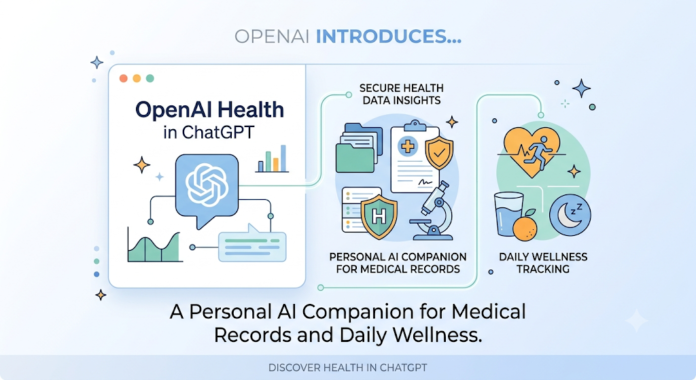
Every week, over 300 million people ask ChatGPT questions about their physical well-being. They request explanations for confusing blood panels, look up potential side effects of newly prescribed medications, or try to make sense of vague symptoms before booking a doctor’s appointment. Until recently, those users had to manually copy and paste lab results or re-type complex medical histories into every new chat window.
That manual barrier has dissolved. OpenAI has officially released Health in ChatGPT for logged-in US users aged 18 and older across Free, Go, Plus, and Pro tiers. This expansion transforms the chatbot from a generic search tool into a deeply personalized health companion capable of connecting directly to Apple Health, electronic health record (EHR) networks, and specialized platforms such as One Medical and Function Health.
By unifying fragmented data scattered across patient portals, fitness trackers, and lab reports, OpenAI is building an ambient layer for personal health navigation. However, this unprecedented level of access brings significant regulatory, legal, and clinical challenges. Connecting medical records to a consumer AI platform quietly removes those files from federal privacy protection under HIPAA, creating fresh debates among privacy advocates, physicians, and health technology companies.
The Shift From Generic Advice to Contextual Intelligence
For years, search engines and digital assistants answered medical questions in isolation. A user searching for explanations of high ALT levels in a blood test received standard textbook definitions. The system had no way of knowing whether that user had a history of fatty liver disease, took specific daily supplements, or recently completed an intense training session.
Health in ChatGPT bridges this gap by grounding responses in verified personal data. Instead of treating every prompt as a blank slate, the AI reads connected records to deliver tailored contextual responses.
Health in ChatGPT: Key Capabilities of the Integrated Experience
- Longitudinal Lab Tracking: Rather than evaluating a single lab result in a vacuum, ChatGPT can compare current blood work against historical panels spanning several years to identify subtle multi-year trends.
- Pre-Appointment Summaries: The system can synthesize recent visit notes, active prescriptions, and recent symptom logs into a clean, prioritized list of questions for an upcoming clinical consultation.
- Lifestyle and Metric Correlation: By connecting wearable data via Apple Health, users can analyze how variations in sleep duration or resting heart rate align with exercise loads, stress markers, or dietary adjustments.
- Plain Language Translation: Clinical jargon in post-visit summaries, pathology reports, and radiology readings can be converted into clear, accessible language without stripping out vital technical nuances.
Earlier iterations of OpenAI’s health testing required users to navigate to a dedicated health workspace inside the app. Product usage data revealed that over 70% of health-related inquiries occurred organically during regular chats, such as asking for recipe adjustments based on dietary restrictions or planning lower-impact workouts following a documented joint injury. As a result, OpenAI integrated health context directly into the main conversation stream, allowing users to draw upon their health profile whenever relevant by tagging @Health or enabling global access.
Supported Health Connections and Data Pipelines
The system relies on secure connections across consumer mobile frameworks, digital health platforms, and nationwide clinical EHR networks.
+-----------------------------------------------------------------------+
|                            USER INTERFACE                             |
|              ChatGPT Main Chat Window & Dedicated Health Tab           |
+-----------------------------------------------------------------------+
                                   |
                                   v
+-----------------------------------------------------------------------+
|                   OPENAI HEALTH CONTEXTUAL ENGINE                     |
|           GPT-5.5 Instant (Free) / GPT-5.6 Sol (Paid Plans)            |
+-----------------------------------------------------------------------+
            ^                                           ^
            |                                           |
+-----------------------+                   +-----------------------+
|  CONSUMER WEARABLES   |                   |  CLINICAL DATA HUB    |
|   Apple Health Kit    |                   |   b.well Data Pipeline|
|  (Sleep, HR, Activity)|                   |  (EHR Integration)    |
+-----------------------+                   +-----------------------+
                                                        |
                                            +-----------+-----------+
                                            |           |           |
                                            v           v           v
                                        Epic Systems  Oracle   One Medical /
                                         MyChart     Health   Function Health
To deliver comprehensive insights, OpenAI partners with health data aggregator b.well Connected Health to manage clinical data pipelines. This infrastructure allows users to pull medical information from major healthcare systems, including Epic Systems, Oracle Health (formerly Cerner), One Medical, and Function Health.
Comparison of Health Data Connectors
| Data Connector | Primary Data Types | Update Frequency | Target Use Case |
| Apple Health | Daily steps, sleep stages, resting heart rate, workout metrics, respiratory rate | Real-time sync via iOS framework | Lifestyle analysis, athletic recovery, sleep optimization |
| Hospital EHR Systems (Epic / Oracle) | Diagnostic imaging notes, outpatient visit summaries, inpatient discharge records, immunizations | On-demand or periodic polling | Complex medical history review, multi-year illness tracking |
| One Medical | Primary care notes, internal lab orders, active prescription lists, referral records | Continuous platform integration | Pre-appointment preparation, medication adherence checks |
| Function Health | Biomarker panels, cardiovascular risk profiles, metabolic markers, hormone levels | Batch import upon lab release | In-depth lab interpretation, preventative health tracking |
Model Architecture: GPT-5.5 Instant vs. GPT-5.6 Sol
The launch introduces two distinct model tiers fine-tuned for health communication, contextual reasoning, and triage safety.
GPT-5.5 Instant
Available to users on the free tier, GPT-5.5 Instant delivers accessible health intelligence. The model is trained to recognize urgent symptoms, prompt users for missing clinical background, and communicate uncertainty clearly. On standard internal benchmarks, GPT-5.5 Instant performs on par with earlier frontier reasoning models while executing responses at much higher speeds.
GPT-5.6 Sol
Offered exclusively to Plus, Pro, and Go subscribers, GPT-5.6 Sol represents OpenAI’s most advanced reasoning model for complex medical queries. It excels at cross-referencing multiple lab values across extended periods, evaluating conflicting treatment options discussed by specialists, and extracting actionable details from dense clinical notes.
                             BENCHMARK PERFORMANCE
   0%       10%      20%      30%      40%      50%      60%      70%      80%      90%     100%
   |--------|--------|--------|--------|--------|--------|--------|--------|--------|--------|

   GPT-5.5 Instant
   [=========================================================================>  ] (~82%)

   GPT-5.6 Sol (Frontier Model)
   [===================================================================================>] (~94%)

   * Performance metrics based on HealthBench Professional clinical evaluation scores.
To validate these models, OpenAI collaborated with hundreds of practicing physicians worldwide to construct HealthBench Professional, a standardized testing benchmark. HealthBench evaluates model responses across six clinical dimensions:
- Factuality and Accuracy: Eliminating clinical hallucinations and verifying laboratory reference ranges.
- Safety and Escalation: Identifying red-flag emergency symptoms (such as chest pain, sudden numbness, or acute shortness of breath) and directing users to immediate emergency care.
- Communication Clarity: Translating medical terminology into clear, accessible language without oversimplifying key diagnoses.
- Contextual Awareness: Correctly interpreting historical health conditions and active prescriptions when answering new queries.
- Completeness: Addressing all aspects of a patient’s question while identifying missing contextual details.
- Appropriate Hesitation: Acknowledging limitations when available data is insufficient to draw definitive conclusions.
Privacy, Security, and the Legal Regulatory Gap
While the utility of connecting medical records to an AI model is significant, it introduces important data privacy considerations.
The HIPAA Exemption Reality
The Health Insurance Portability and Accountability Act (HIPAA), enacted in 1996 by the U.S. Department of Health and Human Services, strictly regulates how “covered entities” (such as hospitals, doctors, insurance providers, and healthcare clearinghouses) store, share, and protect Protected Health Information (PHI).
OpenAI is a consumer software provider, not a covered entity under federal law. The moment a user consents to export their records from a hospital portal like Epic MyChart into ChatGPT, those files cross outside the legal boundary of HIPAA protection.
+--------------------------------------------------+
|               HIPAA PROTECTED ZONE               |
|  Hospitals, Clinics, Physicians, Epic MyChart    |
|  * Governed by Federal Privacy Laws & Fines      |
|  * Strict Limits on Data Sharing & Commercial Use|
+--------------------------------------------------+
                        |
                        | User Explicitly Authorizes Export
                        v
+--------------------------------------------------+
|           CONSUMER AI PRIVACY ZONE               |
|      OpenAI Health in ChatGPT Platform           |
|  * Governed by OpenAI Terms of Service           |
|  * Contractual Commitments (Not Federal HIPAA)   |
|  * Opt-Out of Model Training & Ad Targeting      |
+--------------------------------------------------+
As Sara Geoghegan, senior counsel at the Electronic Privacy Information Center (EPIC), noted during the rollout, transferring medical records to consumer platforms removes traditional statutory protections, leaving user privacy governed primarily by corporate terms of service.
Technical Safeguards Implemented by OpenAI
To mitigate privacy risks, OpenAI has built dedicated infrastructure controls around connected health data:
- No Foundation Model Training: Connected health records, Apple Health metrics, and conversations that utilize health data are excluded from training OpenAI’s base models, regardless of general account settings.
- No Advertising Targeting: Connected health metrics are strictly segregated from commercial advertising mechanisms.
- Enhanced Encryption Standards: Health information is encrypted in transit using TLS 1.3 and at rest using AES-256 protocols, with additional key segregation for stored clinical data.
- Granular Data Permissions: By default, ChatGPT prompts users for explicit permission before accessing connected health data to answer a query. Users can grant temporary single-use access or enable standing permission inside app settings.
- 30-Day Disconnection Deletion: When a user disconnects a provider account or revokes Apple Health access, synced records are purged from active production servers within 30 days.
- Memory Controls: While ChatGPT can store memories created during health discussions, users can manage or delete these memories at any time, or use Temporary Chat mode to prevent memory creation entirely.
Active Legal Scrutiny and Safety Controversies
The nationwide launch occurred amid active legal scrutiny. Just one day prior to the official rollout, a lawsuit was filed against OpenAI and CEO Sam Altman in San Francisco Superior Court (Winters v. OpenAI).
The complaint, brought by a Florida resident, alleges that ChatGPT-4o provided misleading medical guidance that delayed necessary care for severe cardiovascular symptoms. According to court documents, the chatbot mischaracterized severe dizziness and alarming blood pressure fluctuations as routine fatigue, leading the plaintiff to delay emergency treatment.
OpenAI addresses these concerns by emphasizing that ChatGPT is designed to support, not replace, clinical judgment. Prominent disclaimers caution users that output should never serve as the primary basis for diagnostic decisions, medication changes, or skipping professional consultations.
During a press briefing, OpenAI executives underscored that hundreds of millions of people already rely on unverified search engine queries for medical advice. Providing an AI companion trained alongside physicians offers a safer, more structured alternative than wading through scattered web forums.
The Clinical Perspective: Augmenting vs. Replacing Human Wisdom
Writing in Forbes, Dr. Sai Balasubramanian, M.D., J.D., highlighted both the potential and limitations of consumer health AI. He noted that while hyper-personalized AI can improve health literacy, clinical medicine requires human context that algorithms cannot replicate:
Healthcare delivery is not as algorithmic as people may think. If it were purely rules-based, access and outcomes would have been solved decades ago. Physicians do more than apply algorithms to symptoms; they account for psychological, social, and practical factors that define a patient’s life. Healthcare remains an art informed by science.
+-----------------------------------------------------------------------+
|                       THE DUAL HEALTHCARE MODEL                       |
+-----------------------------------------------------------------------+
|  ARTIFICIAL INTELLIGENCE (ChatGPT)   |   HUMAN CLINICIAN (MD / DO)    |
+--------------------------------------+--------------------------------+
| * Rapid pattern synthesis             | * Diagnostic wisdom & intuition|
| * Multi-year lab trend analysis       | * Physical examinations & touch|
| * Terminology translation            | * Empathy & emotional context  |
| * 24/7 informational availability    | * Nuanced treatment decisions  |
| * Structural appointment prep        | * Ethical care accountability  |
+-----------------------------------------------------------------------+
AI tools serve as efficient instruments for gathering data, building timelines, and translating medical terms. However, turning that information into an effective treatment plan requires a licensed professional who understands a patient’s broader life circumstances.
How Health in ChatGPT Improves Clinical Encounters
Rather than disrupting doctor-patient relationships, thoughtful AI use can make office visits more productive:
- Better Prepared Patients: Patients who organize their symptom histories and list their questions ahead of time help clinicians make the most of limited appointment slots.
- Improved Treatment Adherence: When patients understand why a medication was prescribed and how it works, they are more likely to follow their treatment plan consistently.
- Reduced Administrative Friction: Doctors spend less time re-explaining routine lab definitions, allowing them to focus on diagnostic decisions and treatment strategy.
Step-by-Step Setup and Data Management Guide
For users looking to connect their health records securely, following a structured setup process ensures proper data control.
+-----------------------------------------------------------------------+
|                   INITIALIZATION & CONNECTIONS                        |
|  Open Sidebar -> Select Health -> Click Get Started -> Choose Accounts|
+-----------------------------------------------------------------------+
                                   |
                                   v
+-----------------------------------------------------------------------+
|                      AUTHENTICATION & SYNCING                         |
|  Sign into Hospital Portals (Epic/Oracle) or Authorize Apple Health   |
+-----------------------------------------------------------------------+
                                   |
                                   v
+-----------------------------------------------------------------------+
|                      RECONCILIATION & AUDIT                           |
|   Review Active Medications, Conditions, and Add Missing Context      |
+-----------------------------------------------------------------------+
                                   |
                                   v
+-----------------------------------------------------------------------+
|                       ACTIVE USAGE & CONTROLS                         |
|   Use @Health in Chat -> Manage Permission Prompts in Settings        |
+-----------------------------------------------------------------------+
1.Access the Health Hub:iOS app or web browser required.
Open ChatGPT on web or iOS, navigate to the left sidebar menu, and select Health. If it is not visible, locate it under the More options section.
2.Connect Data Sources:Authenticate with providers.
Select Get Started and choose your preferred connections. To link hospital systems, search for your network (such as Epic MyChart, Cleveland Clinic, or Sutter Health) and log in using your patient portal credentials. To link fitness metrics on iOS, select Apple Health and toggle the specific metrics you wish to share.
3.Audit and Reconcile Synced Records:Verify active profiles.
Once initial synchronization finishes, navigate to the Records tab inside Health. Review your listed conditions, active prescriptions, and historical procedures. Remove outdated medications (such as completed antibiotic courses) and add relevant family health history that may be missing.
4.Configure Permission Controls:Set access boundaries.
Open Settings > Plugins > Health. Choose whether ChatGPT should ask for explicit permission before accessing connected data for each prompt, or set it to always allow access for seamless conversations.
5.Initiate Contextual Conversations:Use targeted prompts.
Begin a new chat and ask your question naturally. You can type @Health to explicitly prompt ChatGPT to pull context from your connected profile.
Practical Prompts for Everyday Health Conversations
To get the most out of Health in ChatGPT, users should use detailed prompts that specify the context they need:
1. Longitudinal Blood Work Comparison
“@Health Compare my latest lipid panel from last month with my results from two years ago. Outline which values improved, which increased, and list three dietary questions I should ask my preventive cardiologist.”
2. Post-Visit Summary Plain-Language Translation
“@Health I’m looking at my recent discharge summary from my orthopedic visit. Can you translate the clinical terms into plain English and build a weekly checklist for my at-home recovery exercises?”
3. Workout and Recovery Optimization
“@Health Cross-reference my Apple Health sleep data over the past month with my recorded workout intensity. Do you see any patterns between my deep sleep duration and my heavy leg days?”
4. Appointment Preparation
“@Health Summarize my recent visit notes, active prescriptions, and recent blood pressure logs into a single page I can print out for my primary care visit next Tuesday.”
The Broader Industry Impact: Disrupting Digital Health Ecosystems
The release of Health in ChatGPT represents a significant shift for the digital health landscape. By embedding health record analysis directly into a widely used AI assistant, OpenAI has established an ambient layer over traditional, fragmented health tools.
+-----------------------------------------------------------------------+
|                   TRADITIONAL DIGITAL HEALTH STACK                    |
|  [MyChart Portal]   [Standalone Lab App]   [Niche Fitness Tracker]    |
|   (Siloed Data)       (Isolated Insights)     (Proprietary Scores)    |
+-----------------------------------------------------------------------+
                                   |
                                   v  Replaced by Ambient AI Integration
+-----------------------------------------------------------------------+
|                    UNIFIED AMBIENT HEALTH LAYER                       |
|                         ChatGPT Health Hub                            |
|     (Aggregates, Cross-References, & Explains Across All Sources)     |
+-----------------------------------------------------------------------+
Impact on Traditional Patient Portals
For over two decades, systems like Epic MyChart served as the primary digital touchpoint for patients accessing test results and care plans. However, traditional portals function primarily as static repositories. They display raw numbers and clinical notes without explaining what those results mean in the context of a patient’s broader health history.
Health in ChatGPT turns those static records into interactive, understandable summaries. As a result, consumer expectations are shifting from basic data access to intelligent interpretation.
Implications for Digital Health Startups
Specialized apps built solely to summarize medical records or offer basic lab tracking now face competition from general-purpose AI platforms. To remain competitive, digital health companies must offer capabilities that go beyond simple text processing, such as direct clinical workflows, remote patient monitoring hardware, or accredited telehealth integrations.
Frequently Asked Questions (FAQs)
Is Health in ChatGPT covered under HIPAA regulations?
No. OpenAI is a consumer technology provider, not a covered healthcare entity. When you connect Apple Health or export hospital records to ChatGPT, that information moves outside HIPAA protection. Data usage is governed by OpenAI’s Privacy Policy and Health Privacy Notice.
Can ChatGPT diagnose illnesses or prescribe medications?
No. ChatGPT is designed strictly for educational, organizational, and contextual assistance. It cannot legally or clinically diagnose medical conditions, issue prescriptions, or modify treatment plans. Always consult a licensed healthcare professional for medical decisions.
Does OpenAI train its core AI models on my medical records?
No. OpenAI explicitly excludes connected medical records, Apple Health data, and health conversations from base model training and advertising targeting. This policy applies across all user tiers, including Free accounts.
What happens to my data if I disconnect my health accounts?
When you disconnect a provider or app account under Settings, OpenAI deletes all synced records associated with that source from its production servers within 30 days. Past chat conversations containing referenced health text remain in your chat history until you delete those chats manually.
Is Health in ChatGPT available globally?
Currently, Health in ChatGPT is available only to logged-in users aged 18 and older located within the United States. OpenAI has not yet announced rollout timelines for international markets due to varying regional health data regulations, such as GDPR in the European Union.
Key Takeaways and Future Outlook
The launch of Health in ChatGPT marks a major step forward in consumer health technology. By connecting fragmented medical records with advanced AI reasoning models, users can better understand their personal health data, track changes over time, and prepare for medical appointments.
At the same time, this convenience requires users to navigate new privacy and safety considerations. Connecting health records shifts those files outside federal HIPAA protections, relying instead on contractual privacy guarantees. Furthermore, while AI models continue to improve on clinical evaluations, they remain information tools that support, rather than replace, human medical expertise.
As consumer AI tools become more integrated into healthcare, the key to success lies in balance. Using AI to organize records and build health literacy, while relying on qualified physicians for diagnosis and treatment, allows patients to advocate for their health with greater clarity and confidence.

