For decades, semiconductors have quietly powered almost every modern device around us. From smartphones and laptops to electric vehicles, satellites, defence equipment, medical devices, artificial intelligence systems, and industrial automation, semiconductor chips are the foundation of today’s digital economy.
Yet despite being one of the world’s largest technology markets, India remained heavily dependent on imported semiconductor chips. Every global supply chain disruption, geopolitical conflict, or manufacturing slowdown exposed how vulnerable the country’s electronics industry had become.
That story is now beginning to change.
With the launch of PM Modi Semiconductor Mission 2.0, the Indian government is taking another major step toward building a complete semiconductor ecosystem inside the country. Combined with new investments from global companies and Indian manufacturers, including the CG Power semiconductor plant in Gujarat, India is no longer aiming to become only an electronics assembler. Instead, it wants to become a significant semiconductor manufacturing destination.
The inauguration of new semiconductor facilities in Gujarat represents much more than another industrial project. It signals India’s ambition to become a trusted global technology manufacturing hub over the coming decade.
Why Semiconductors Matter More Than Ever
Every modern technology product depends on semiconductor chips.
Without semiconductors, industries such as automotive manufacturing, telecommunications, cloud computing, renewable energy, consumer electronics, aerospace, defence, robotics, healthcare, and artificial intelligence simply cannot function.
Some common products powered by semiconductor chips include:
- Smartphones
- Electric vehicles
- Data centers
- Smart televisions
- Medical imaging equipment
- Industrial robots
- Defence communication systems
- 5G infrastructure
- Smart home devices
- AI servers
The worldwide semiconductor market continues to expand as artificial intelligence, automation, and connected devices increase demand for advanced computing hardware.
This is exactly why almost every major economy has announced semiconductor manufacturing incentives over the past few years.
India is now becoming part of that global transformation.
India’s Dependence on Imported Chips
Before the launch of the India Semiconductor Mission, India imported almost every advanced semiconductor used by domestic manufacturers.
This dependence created several challenges.
| Challenge | Impact |
| Import dependence | Higher manufacturing costs |
| Global shortages | Production delays |
| Currency fluctuations | Increased electronics prices |
| Geopolitical risks | Supply chain uncertainty |
| Limited domestic ecosystem | Fewer high technology jobs |
The COVID-19 pandemic clearly demonstrated these risks.
Vehicle manufacturers across the world had to reduce production because semiconductor chips were unavailable.
Consumer electronics companies delayed product launches.
Manufacturing costs increased significantly.
Governments worldwide realized that semiconductor manufacturing had become a matter of economic security.
India reached the same conclusion.
Understanding PM Modi Semiconductor Mission 2.0
The original India Semiconductor Mission introduced financial incentives to encourage semiconductor manufacturing inside India.
Now, PM Modi Semiconductor Mission 2.0 expands that vision.
Rather than focusing only on attracting factories, Mission 2.0 aims to develop an entire semiconductor ecosystem.
The broader objectives include:
• Semiconductor manufacturing
• Chip packaging
• Assembly and testing
• Research and development
• Equipment manufacturing
• Design innovation
• Skill development
• Global supply chain partnerships
• Domestic component manufacturing
The goal is straightforward.
Instead of importing every stage of semiconductor production, India wants to participate across the entire value chain.
This approach creates long-term competitiveness rather than temporary manufacturing capacity.
The Role of Gujarat in India’s Semiconductor Journey
When people discuss India’s semiconductor ambitions, one state consistently appears at the center of every major announcement.
That state is Gujarat.
Several factors make Gujarat an attractive destination for semiconductor manufacturing.
Reliable industrial infrastructure.
Excellent logistics.
Port connectivity.
Industrial corridors.
Availability of skilled manpower.
Pro-industry policies.
Strong electricity supply.
These advantages have encouraged both Indian companies and international technology firms to establish semiconductor facilities within the state.
Sanand, in particular, has quickly transformed from an automobile manufacturing hub into one of India’s fastest-growing semiconductor clusters.
CG Power Semiconductor Plant in Gujarat
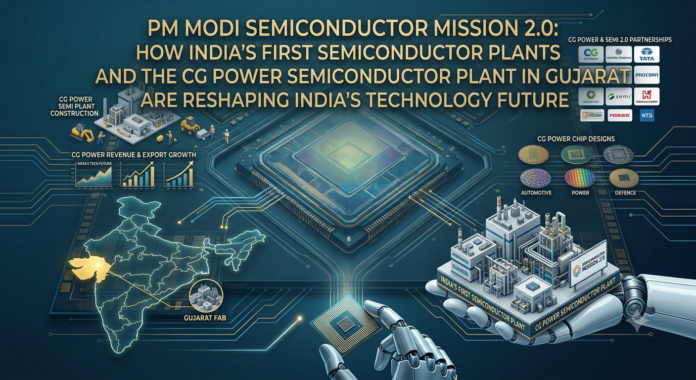
One of the biggest milestones in India’s semiconductor journey has been the inauguration of the CG Power semiconductor plant in Gujarat.
The facility represents one of India’s most important semiconductor investments and is designed as an Outsourced Semiconductor Assembly and Test, or OSAT, facility.
Unlike semiconductor fabrication plants that manufacture silicon wafers, an OSAT facility performs several equally important processes.
These include:
- Chip assembly
- Packaging
- Testing
- Quality validation
- Reliability verification
- Final preparation for commercial deployment
These processes ensure semiconductor chips meet strict performance standards before being integrated into electronic products.
The Gujarat facility is expected to support industries including:
• Automotive electronics
• Industrial automation
• Telecommunications
• Internet of Things
• Consumer electronics
• 5G infrastructure
The project represents an investment of approximately ₹7,500 crore and is expected to manufacture billions of semiconductor units annually once full capacity is achieved.
Why the CG Power Plant Is a Turning Point
Many people assume semiconductor manufacturing begins and ends with fabrication.
In reality, packaging and testing represent critical stages in semiconductor production.
Without them, chips cannot be delivered to customers.
The CG Power semiconductor facility allows India to strengthen an essential part of the semiconductor value chain.
Benefits include:
| Advantage | Long Term Impact |
| Domestic chip packaging | Reduced import dependence |
| Advanced testing | Higher product quality |
| Export opportunities | Increased foreign revenue |
| Technology partnerships | Faster innovation |
| Skilled employment | High value engineering jobs |
| Manufacturing ecosystem | Greater investor confidence |
This creates opportunities not only for large corporations but also for hundreds of suppliers that support semiconductor manufacturing.
India’s First Semiconductor Plant and the Beginning of a New Era
One phrase frequently appearing in recent discussions is India’s first semiconductor plant.
While different facilities perform different semiconductor functions, the significance lies in the fact that India has moved from planning to actual commercial semiconductor production.
Recent inaugurations in Gujarat have demonstrated that semiconductor manufacturing is no longer a future vision.
It is now becoming an operational reality.
Several facilities covering assembly, testing, packaging, and memory manufacturing are beginning commercial production, marking a significant milestone in India’s industrial development.
Building an Entire Semiconductor Ecosystem
A semiconductor factory alone cannot create a global manufacturing hub.
It requires an interconnected ecosystem.
That includes suppliers of:
• Chemicals
• Specialty gases
• Precision machinery
• Electronic materials
• Testing equipment
• Packaging materials
• Design software
• Logistics services
• Research institutions
• Universities
• Skilled engineers
Mission 2.0 recognizes this challenge.
Instead of supporting isolated manufacturing plants, the government aims to encourage the development of every supporting industry that contributes to semiconductor production.
This integrated strategy increases India’s competitiveness while attracting additional global investment.
Artificial Intelligence Is Accelerating Chip Demand
The timing of India’s semiconductor expansion is especially important.
Artificial intelligence is driving unprecedented demand for computing hardware.
Every AI model requires enormous processing power.
Every cloud platform depends on specialized semiconductor chips.
Every autonomous vehicle needs advanced processors.
Every smart factory relies on industrial semiconductor systems.
As AI adoption continues to accelerate across industries, global demand for semiconductor manufacturing is expected to increase substantially.
India’s investment in semiconductor infrastructure positions the country to participate in one of the world’s fastest-growing technology sectors.
How Semiconductor Mission 2.0 Can Transform India’s Economy
The impact of PM Modi Semiconductor Mission 2.0 extends well beyond electronics manufacturing. It has the potential to influence nearly every major sector of the Indian economy.
Semiconductor manufacturing is considered one of the highest-value industries in the world because it creates long-term investment, supports innovation, and generates skilled employment. Every new semiconductor facility encourages dozens of supporting industries to establish operations nearby.
As India’s semiconductor ecosystem expands, industries such as logistics, industrial construction, precision engineering, automation, software development, research, and advanced manufacturing are also expected to benefit.
Unlike traditional manufacturing sectors that rely heavily on low-cost labor, semiconductor production creates opportunities for engineers, scientists, technicians, researchers, and highly trained professionals. This makes it an important contributor to India’s long-term economic growth.
Employment Opportunities Across the Semiconductor Value Chain
One of the most significant advantages of developing a domestic semiconductor industry is the creation of high-quality jobs.
While semiconductor plants require advanced automation, they also depend on thousands of skilled professionals across different disciplines.
Some of the roles expected to see increasing demand include:
| Industry Role | Primary Responsibilities |
| Process Engineers | Oversee semiconductor manufacturing processes |
| Packaging Engineers | Design and optimize chip packaging |
| Testing Specialists | Validate chip performance and reliability |
| Equipment Engineers | Maintain advanced manufacturing systems |
| Quality Control Engineers | Ensure production standards |
| Research Scientists | Develop next-generation semiconductor technologies |
| Automation Engineers | Improve manufacturing efficiency |
| Supply Chain Specialists | Manage materials and logistics |
| Data Engineers | Analyze manufacturing performance |
| Industrial Safety Experts | Maintain compliance and operational safety |
Universities and technical institutes are also expected to expand semiconductor-related education programs to meet future workforce demand.
Why Global Companies Are Looking at India
Over the past several years, multinational technology companies have been searching for ways to diversify their manufacturing operations.
Several factors have contributed to this shift.
These include changing geopolitical dynamics, supply chain disruptions, rising manufacturing costs in some regions, and the growing demand for resilient production networks.
India offers several competitive advantages.
• Large engineering talent pool
• Expanding domestic electronics market
• Government incentive programs
• Strong software industry
• Growing manufacturing infrastructure
• Strategic geographic location
These strengths make India an increasingly attractive destination for semiconductor manufacturing and related investments.
India’s Position Compared With Global Semiconductor Leaders
Although India has made significant progress, it is still in the early stages compared with countries that have decades of semiconductor manufacturing experience.
The table below provides a simplified comparison.
| Country | Primary Strength |
| Taiwan | Advanced semiconductor fabrication |
| South Korea | Memory chips and advanced manufacturing |
| United States | Chip design and research |
| Japan | Semiconductor materials and equipment |
| China | Large-scale manufacturing and investment |
| India | Emerging manufacturing, packaging, design, and talent development |
Rather than competing directly in every area immediately, India is focusing on building capabilities step by step while strengthening its position across multiple parts of the semiconductor value chain.
Gujarat Is Becoming India’s Semiconductor Hub
The concentration of semiconductor projects in Gujarat is not accidental.
The state has invested heavily in industrial infrastructure over many years, making it well suited for advanced manufacturing.
Several characteristics contribute to Gujarat’s growing importance.
• Reliable electricity infrastructure
• Modern industrial parks
• Excellent road connectivity
• International ports
• Business-friendly policies
• Availability of industrial land
• Strong manufacturing ecosystem
With projects such as the CG Power semiconductor plant in Gujarat, along with other semiconductor investments, Gujarat is rapidly emerging as one of India’s most important technology manufacturing destinations.
Strengthening India’s Electronics Manufacturing Industry
India already manufactures millions of smartphones, televisions, consumer electronics products, and electrical appliances each year.
As semiconductor manufacturing expands, domestic electronics companies may benefit from:
• Reduced dependence on imported chips
• Improved supply chain reliability
• Faster production timelines
• Lower logistics costs
• Greater product innovation
• Enhanced export competitiveness
These improvements could strengthen India’s position as a global electronics manufacturing hub.
Supporting Emerging Technologies
Semiconductors are becoming increasingly important as new technologies continue to evolve.
Some of the fastest-growing industries that rely heavily on advanced semiconductor chips include:
- Artificial Intelligence
- Electric Vehicles
- Autonomous Driving Systems
- Renewable Energy
- Robotics
- Medical Technology
- Space Technology
- Defense Electronics
- Internet of Things
- Cloud Computing
By investing in semiconductor infrastructure today, India is preparing to support the industries that will define the next generation of technological innovation.
Challenges That Still Need to Be Addressed
While the progress is encouraging, building a globally competitive semiconductor industry is a long-term effort.
Several challenges remain.
High Capital Investment
Semiconductor facilities require investments worth billions of dollars and continuous technology upgrades.
Skilled Workforce Development
The industry requires highly specialized engineers and technicians who must receive advanced training.
Technology Partnerships
Collaboration with global semiconductor leaders remains essential for knowledge transfer and technological advancement.
Supply Chain Development
India must continue developing suppliers of semiconductor materials, chemicals, gases, machinery, and precision equipment.
Research and Innovation
Long-term competitiveness will depend on sustained investment in research, product development, and innovation.
Addressing these challenges will be essential to ensuring the long-term success of Semiconductor Mission 2.0.
What Mission 2.0 Means for Indian Businesses
The benefits of a stronger semiconductor ecosystem extend beyond large technology companies.
Businesses across multiple industries may gain from improved access to semiconductor components.
Examples include:
| Industry | Potential Benefits |
| Automotive | Better chip availability for connected vehicles |
| Consumer Electronics | Faster production cycles |
| Healthcare | Growth in medical device manufacturing |
| Renewable Energy | Improved power electronics |
| Telecommunications | Expansion of 5G infrastructure |
| Manufacturing | Increased industrial automation |
| Defense | Greater domestic technology capabilities |
This creates opportunities for both established companies and emerging startups.
Frequently Asked Questions
What is PM Modi Semiconductor Mission 2.0?
Semiconductor Mission 2.0 is the next phase of India’s strategy to develop a comprehensive semiconductor ecosystem, including manufacturing, packaging, testing, research, design, and supply chain development.
Why is the CG Power semiconductor plant in Gujarat important?
The CG Power facility strengthens India’s semiconductor packaging and testing capabilities, helping reduce dependence on imports while supporting domestic and global electronics manufacturing.
Is this India’s first semiconductor plant?
Recent semiconductor facilities mark India’s transition from planning to operational semiconductor manufacturing. Different plants perform different functions, including fabrication, assembly, testing, and packaging, but together they represent the country’s first large-scale commercial semiconductor manufacturing ecosystem.
Why are semiconductors important?
Semiconductors power nearly every modern electronic device, including smartphones, computers, electric vehicles, medical equipment, industrial machinery, and artificial intelligence systems.
Which industries will benefit the most?
Automotive, telecommunications, consumer electronics, healthcare, renewable energy, aerospace, defense, industrial automation, and AI are expected to benefit significantly.
Key Takeaways
| Topic | Summary |
| Government Vision | Build a complete semiconductor ecosystem in India |
| Gujarat’s Role | Emerging as India’s leading semiconductor manufacturing hub |
| CG Power Facility | Strengthens assembly, packaging, and testing capabilities |
| Economic Impact | Investment, exports, skilled employment, and innovation |
| Future Focus | Research, advanced manufacturing, supply chain resilience |
Conclusion
The launch of PM Modi Semiconductor Mission 2.0 represents one of the most ambitious industrial initiatives undertaken in India’s recent history.
For years, India was recognized primarily for its software services, engineering talent, and growing consumer market. Today, the country’s ambitions are expanding beyond software into advanced manufacturing, semiconductor production, and high-value technology innovation.
Projects such as the CG Power semiconductor plant in Gujarat, together with other semiconductor facilities, are laying the foundation for a more resilient and self-reliant electronics ecosystem. While building a globally competitive semiconductor industry will take time, the progress made so far demonstrates that India is moving from aspiration to execution.
The journey is far from complete. Continued investment in research, talent development, infrastructure, and international partnerships will be essential. However, the momentum generated by Semiconductor Mission 2.0 suggests that India is positioning itself to play a far more significant role in the global semiconductor supply chain over the coming decades.
As demand for artificial intelligence, electric vehicles, advanced communications, and smart technologies continues to grow, semiconductors will remain at the heart of innovation. By strengthening domestic capabilities today, India is preparing not only to meet its own technological needs but also to contribute meaningfully to the future of global electronics manufacturing.

