Every successful product offers much more than what customers see on the surface. When someone purchases a smartphone, they are not simply buying a device. They are investing in convenience, communication, entertainment, productivity, and a lifestyle. Likewise, when a traveler books a hotel room, they are not purchasing four walls and a bed. They are seeking comfort, security, relaxation, and an enjoyable experience.
This difference between what businesses sell and what customers actually buy is one of the most important concepts in marketing. It was explained brilliantly by marketing expert Philip Kotler through his widely recognized framework known as the 5 Levels of Product.
Kotler’s model demonstrates that every product consists of multiple layers of value. While companies often focus on improving features or lowering prices, customers evaluate products based on how effectively they solve problems, meet expectations, provide additional benefits, and continue evolving over time.
Understanding these five levels helps businesses design products that stand out in competitive markets, strengthen customer loyalty, improve brand positioning, and create long term competitive advantages. The framework is equally valuable for startups launching their first product and multinational companies managing global product portfolios.
In this comprehensive guide, you will learn what Kotler’s 5 Levels of Product are, why they remain relevant today, how each level contributes to customer satisfaction, practical examples from leading companies, implementation strategies, common mistakes, and how businesses can apply this framework to develop products customers genuinely value.
What Are Kotler’s 5 Levels of Product?
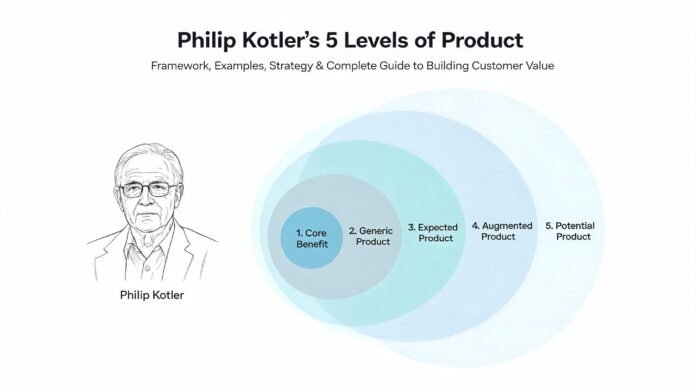
Philip Kotler introduced the concept of the 5 Levels of Product to explain that a product is much more than its physical characteristics. Every product delivers value at several different layers, beginning with the customer’s core need and extending to future innovations that keep the product competitive.
The five levels are:
| Product Level | Purpose |
|---|---|
| Core Benefit | The fundamental need the customer wants to satisfy |
| Generic Product | The basic product required to deliver that benefit |
| Expected Product | Features and quality customers normally expect |
| Augmented Product | Additional benefits that differentiate the product |
| Potential Product | Future improvements and innovations |
These levels build upon one another. Businesses that understand every layer are better positioned to create products that satisfy customers while maintaining a competitive advantage.
Why Kotler’s Product Levels Matter
Many businesses mistakenly believe success comes from building more features.
In reality, successful companies focus on delivering more value.
Kotler’s framework encourages organizations to think beyond manufacturing and consider the complete customer experience.
Benefits include:
- Better product planning.
- Stronger customer satisfaction.
- Clear product differentiation.
- Higher customer loyalty.
- Better innovation planning.
- Improved competitive positioning.
- Increased long term profitability.
- Stronger brand reputation.
Rather than competing solely on specifications or price, companies compete by creating richer customer experiences.
Understanding Customer Value Through the Five Levels
Customers rarely purchase products simply because they exist.
They purchase outcomes.
For example:
A person buying a drill does not actually want the drill.
They want holes in the wall.
Similarly,
A customer purchasing project management software is not buying dashboards and task lists.
They are buying improved productivity and better collaboration.
Kotler’s framework begins with this simple but powerful principle.
Businesses should first understand why customers buy before deciding what to build.
Level One: Core Benefit
The Core Benefit represents the primary reason a customer purchases a product.
It answers one fundamental question:
What problem is the customer actually trying to solve?
This level focuses entirely on customer needs rather than product features.
Every successful product begins by addressing a meaningful problem.
Characteristics of the Core Benefit
- Solves a customer problem.
- Delivers meaningful value.
- Focuses on customer outcomes.
- Exists before product features are considered.
- Drives purchasing decisions.
Examples of Core Benefits
| Product | Core Benefit |
|---|---|
| Hotel | Rest and comfort |
| Smartphone | Communication and connectivity |
| Car | Transportation |
| Insurance | Financial security |
| Banking App | Convenient money management |
| Food Delivery App | Convenience and time savings |
| Online Learning Platform | Skill development |
| Fitness Tracker | Better health awareness |
Notice that none of these benefits describe physical products.
Instead, they describe customer outcomes.
Real World Example: Netflix
Customers do not subscribe to Netflix because they want an application.
They subscribe because they want entertainment whenever they choose.
The streaming platform is simply the method for delivering that benefit.
Understanding this allows Netflix to invest heavily in personalized recommendations and exclusive content rather than simply improving the application interface.
Questions Businesses Should Ask
Before building any product, product managers should ask:
- What customer problem are we solving?
- Why does this problem matter?
- How urgent is the need?
- What alternatives already exist?
- Why would customers choose our solution?
Answering these questions prevents companies from building products nobody actually needs.
Level Two: Generic Product
Once the core benefit is identified, businesses develop the Generic Product.
This is the simplest functional version capable of delivering the promised benefit.
It contains only the essential components required for the product to perform its intended purpose.
Think of it as the minimum viable version before additional enhancements are introduced.
Characteristics of the Generic Product
- Basic functionality.
- Essential features.
- Meets minimum quality standards.
- Delivers the core benefit.
- No premium enhancements.
Examples
| Product | Generic Product |
|---|---|
| Hotel | Clean room, bed, bathroom |
| Laptop | Processor, keyboard, display |
| Smartphone | Calling, messaging, internet |
| Restaurant | Food and seating |
| Online Course | Video lessons |
| Banking App | Balance checking and transfers |
At this stage, products are often difficult to differentiate because competitors usually provide similar functionality.
Generic Product Example
Imagine launching an online grocery delivery application.
The minimum product might include:
- Product catalog.
- Shopping cart.
- Secure payment.
- Order tracking.
- Delivery confirmation.
These features satisfy the basic customer need.
Everything beyond this belongs to higher product levels.
Level Three: Expected Product
Customers naturally develop expectations based on previous experiences, competitor offerings, and industry standards.
The Expected Product represents everything customers assume will be included when purchasing.
These expectations may never appear in advertisements because customers simply assume they already exist.
If businesses fail to meet these expectations, customer dissatisfaction follows immediately.
Meeting expectations does not create competitive advantage.
It simply prevents disappointment.
Examples of Customer Expectations
Hotel guests expect:
- Clean rooms.
- Comfortable beds.
- Safe environment.
- Working air conditioning.
- Friendly staff.
Airline passengers expect:
- Safe flights.
- Comfortable seating.
- Professional staff.
- On time departures.
- Clean cabins.
Online shoppers expect:
- Secure payments.
- Fast website performance.
- Accurate product information.
- Delivery updates.
- Easy returns.
Expected Product Table
| Industry | Customer Expectations |
|---|---|
| Banking | Secure transactions, fast transfers |
| Healthcare | Professional care, accurate diagnosis |
| SaaS Software | Reliable uptime, customer support |
| E Commerce | Fast delivery, secure checkout |
| Hospitality | Cleanliness, safety, hospitality |
Businesses often lose customers not because competitors are better but because they fail to deliver expected standards.
Difference Between Generic and Expected Product
Many people confuse these two levels.
The distinction is simple.
| Generic Product | Expected Product |
|---|---|
| Basic functionality | Industry standard expectations |
| Required to operate | Required to satisfy customers |
| Minimal features | Standard experience |
| Product focused | Customer focused |
For example,
A hotel providing a room fulfills the Generic Product.
Providing clean sheets, WiFi, hot water, and courteous service fulfills the Expected Product.
Customers rarely praise expected features because they assume they should already exist.
Failing to provide them, however, leads to negative reviews.
Why Understanding Customer Expectations Matters
Customer expectations continuously evolve.
Features considered premium five years ago often become standard today.
For example:
- Free WiFi was once an Augmented Product.
- Today it is generally considered an Expected Product.
Similarly,
Cloud storage, mobile applications, biometric authentication, and online customer support have gradually shifted from premium benefits to standard expectations across many industries.
Businesses must continuously monitor changing expectations if they wish to remain competitive.
How Businesses Identify Customer Expectations
Organizations typically gather information through:
- Customer interviews.
- Surveys.
- Online reviews.
- Competitor analysis.
- Customer support conversations.
- Social media discussions.
- Product usage analytics.
- Market research.
Understanding customer expectations helps companies prioritize investments that improve satisfaction while avoiding unnecessary features.
Key Takeaways from the First Three Levels
The first three levels establish the foundation of every successful product.
The Core Benefit identifies why customers buy.
The Generic Product delivers the minimum functional solution.
The Expected Product ensures customers receive the experience they consider standard.
Only after mastering these levels should businesses invest heavily in differentiation and innovation.
These foundational layers create the trust upon which long term customer relationships are built.
Level Four: Augmented Product
The augmented product represents everything a business adds beyond the customer’s basic expectations. These additional benefits create differentiation and encourage customers to choose one brand over another, even when competing products offer similar core functionality.
At this stage, businesses compete through experiences rather than simply through products.
An augmented product may include:
- Extended warranties
- Free installation
- Premium customer support
- Loyalty programs
- Mobile applications
- Personalized recommendations
- Fast delivery
- Training and onboarding
- Regular software updates
- Membership benefits
The purpose of augmentation is to increase customer satisfaction while building long-term loyalty.
Example
Suppose two companies sell identical laptops with similar hardware specifications.
Company A simply delivers the laptop.
Company B provides:
- Two years of warranty
- Free accidental damage protection
- Cloud storage
- Priority customer support
- Free software setup
- Student discounts
Although the physical product is almost identical, most customers perceive Company B as offering significantly greater value because of the augmented product.
Why the Augmented Product Matters
In highly competitive industries, the physical product alone rarely creates a lasting competitive advantage.
Instead, businesses differentiate themselves through:
| Augmented Feature | Customer Benefit |
|---|---|
| Free delivery | Greater convenience |
| Installation support | Easier onboarding |
| Product tutorials | Better customer experience |
| Loyalty rewards | Increased customer retention |
| Premium customer support | Higher customer satisfaction |
| Subscription services | Continuous value |
| Product ecosystem | Stronger brand loyalty |
Today, companies like Apple, Amazon, and Tesla invest billions of dollars in building their augmented products because they know customers remember the experience long after the purchase.
Level Five: Potential Product
The potential product represents everything the product could become in the future through innovation, technology, customer feedback, and market evolution.
This level focuses on long-term possibilities rather than current capabilities.
Businesses that continuously improve their products stay competitive for years, while companies that stop innovating often lose market share.
Potential products include:
- AI integration
- Automation
- Smart personalization
- New hardware versions
- Future software updates
- Sustainability improvements
- New subscription services
- Integration with emerging technologies
Example
Consider a smart fitness watch.
Today it may track:
- Heart rate
- Calories burned
- Sleep quality
- Daily steps
Its potential product could eventually include:
- AI health coaching
- Blood glucose monitoring
- Stress prediction
- Personalized fitness plans
- Early disease detection
- Emergency health alerts
Customers may purchase the current version partly because they trust the company to continue improving it over time.
Why the Potential Product Matters
Innovation never stops.
Today’s exciting feature eventually becomes tomorrow’s basic expectation.
For example:
- Mobile cameras were once considered premium.
- Fingerprint sensors became expected.
- Face recognition is now common.
- AI assistants are quickly becoming standard.
Companies that consistently invest in future innovation remain industry leaders.
| Current Feature | Future Potential |
|---|---|
| Voice assistant | Conversational AI |
| Fitness tracking | Predictive health analytics |
| GPS navigation | Autonomous navigation |
| Cloud storage | AI-powered knowledge management |
| Mobile payments | Biometric payment systems |
Potential products shape the future of customer expectations.
How the Five Levels Work Together
Kotler designed these five levels as a hierarchy rather than five independent concepts.
Each level builds upon the previous one to create greater customer value.
| Product Level | Main Focus |
|---|---|
| Core Benefit | Customer need |
| Generic Product | Basic solution |
| Expected Product | Industry standards |
| Augmented Product | Competitive differentiation |
| Potential Product | Future innovation |
Think of building a house.
The foundation represents the core benefit.
The walls and roof represent the generic product.
Furniture represents the expected product.
Luxury interiors represent the augmented product.
Future renovations represent the potential product.
Every successful product grows through these layers over time.
Real Company Case Studies
Apple
Apple rarely competes on hardware specifications alone.
| Product Level | Apple Example |
|---|---|
| Core Benefit | Communication and productivity |
| Generic Product | iPhone smartphone |
| Expected Product | High-quality display, fast performance, secure operating system |
| Augmented Product | AppleCare, iCloud, Apple Pay, App Store, ecosystem integration |
| Potential Product | AI-powered features, satellite communication, health monitoring |
Apple’s ecosystem is one of its strongest augmented products.
Amazon
Amazon demonstrates how services can become the company’s biggest competitive advantage.
| Product Level | Amazon Example |
|---|---|
| Core Benefit | Convenient shopping |
| Generic Product | Online marketplace |
| Expected Product | Large product selection and secure payments |
| Augmented Product | Prime delivery, Prime Video, easy returns, Alexa integration |
| Potential Product | AI shopping assistants, drone delivery, predictive purchasing |
Tesla
Tesla competes through continuous innovation.
| Product Level | Tesla Example |
|---|---|
| Core Benefit | Transportation |
| Generic Product | Electric vehicle |
| Expected Product | Long battery life, comfortable interiors |
| Augmented Product | Autopilot, OTA software updates, Supercharger network |
| Potential Product | Full self-driving technology, AI mobility ecosystem |
Starbucks
Starbucks sells experiences rather than coffee alone.
| Product Level | Starbucks Example |
|---|---|
| Core Benefit | Refreshment and relaxation |
| Generic Product | Coffee |
| Expected Product | Clean stores and quality beverages |
| Augmented Product | Rewards program, personalized drinks, mobile ordering |
| Potential Product | AI personalization, cashier-less stores |
Airbnb
Airbnb transformed travel by focusing on customer experiences.
| Product Level | Airbnb Example |
|---|---|
| Core Benefit | Comfortable accommodation |
| Generic Product | Home rental platform |
| Expected Product | Verified listings and secure payments |
| Augmented Product | Experiences, Superhost program, travel protection |
| Potential Product | AI itinerary planning, smart travel assistance |
Kotler’s 5 Levels vs Product Life Cycle
Many professionals confuse these two frameworks, but they serve different purposes.
| Kotler’s 5 Levels | Product Life Cycle |
|---|---|
| Focuses on customer value | Focuses on market stages |
| Helps design products | Helps manage product growth |
| Strategic framework | Business lifecycle framework |
| Customer perspective | Sales perspective |
| Continuous improvement | Introduction, Growth, Maturity, Decline |
The two frameworks complement each other rather than compete.
Benefits and Limitations
Benefits
- Helps businesses understand customer value.
- Encourages customer-centric product development.
- Improves competitive differentiation.
- Supports premium pricing.
- Strengthens brand loyalty.
- Encourages innovation.
- Improves customer satisfaction.
- Simplifies product planning.
- Helps prioritize investments.
- Supports long-term growth strategies.
Limitations
- Customer expectations constantly change.
- Difficult to measure emotional value.
- Some industries compete mainly on price.
- Requires ongoing investment.
- Innovation increases costs.
- Customer preferences differ across markets.
- Small businesses may struggle to offer extensive augmentation.
Common Mistakes Businesses Make
Many companies fail because they stop at the generic product.
Common mistakes include:
- Focusing only on technical specifications.
- Ignoring customer expectations.
- Underinvesting in customer support.
- Competing only on price.
- Failing to innovate after launch.
- Copying competitors instead of differentiating.
- Neglecting customer feedback.
- Treating products as finished instead of evolving.
Step by Step Implementation Framework
Businesses can apply Kotler’s framework using this simple process.
| Step | Action |
|---|---|
| Step 1 | Identify the customer’s core problem. |
| Step 2 | Build the minimum product that solves it. |
| Step 3 | Understand customer expectations. |
| Step 4 | Add differentiating services and experiences. |
| Step 5 | Build a long-term innovation roadmap. |
| Step 6 | Collect customer feedback continuously. |
| Step 7 | Improve the product through regular updates. |
| Step 8 | Repeat the process as market expectations evolve. |
Best Practices
To maximize the value of Kotler’s model:
- Start with customer needs, not product features.
- Conduct regular customer research.
- Invest in after-sales support.
- Build strong brand experiences.
- Focus on long-term customer relationships.
- Differentiate through service, not just technology.
- Continuously innovate based on feedback.
- Monitor competitors without simply copying them.
- Align product, marketing, and customer success teams.
- Review the five levels annually as customer expectations evolve.
Summary Table
| Product Level | Purpose | Example |
|---|---|---|
| Core Benefit | Solve the customer’s fundamental need | Transportation |
| Generic Product | Basic working solution | Electric car |
| Expected Product | Standard customer expectations | Long battery life |
| Augmented Product | Additional value and differentiation | Free charging network, software updates |
| Potential Product | Future innovation and growth | Fully autonomous driving |
Final Conclusion and Key Takeaways
Kotler’s 5 Levels of Product remain one of the most influential frameworks in marketing and product management because they shift the focus from selling products to delivering customer value. Every successful product begins by solving a genuine customer problem, but lasting success comes from consistently exceeding expectations and planning for future innovation.
Companies like Apple, Amazon, Tesla, Starbucks, and Airbnb have demonstrated that sustainable competitive advantage rarely comes from the core product alone. Instead, they invest heavily in augmented experiences, customer service, digital ecosystems, and continuous product evolution.
Whether you are launching a startup, managing an enterprise product, or studying product management, applying Kotler’s five levels can help you create offerings that stand out in competitive markets, build stronger customer loyalty, and remain relevant as customer expectations evolve. The businesses that consistently think beyond the basic product are the ones most likely to lead their industries for years to come.
15 FAQs About Philip Kotler’s 5 Levels of Product
1. What are Philip Kotler’s 5 Levels of Product?
Philip Kotler’s 5 Levels of Product is a marketing framework that explains how businesses create customer value through five layers: Core Benefit, Generic Product, Expected Product, Augmented Product, and Potential Product. It helps organizations design products that go beyond basic functionality and deliver better customer experiences.
2. Why are Kotler’s 5 Levels of Product important?
The framework helps businesses understand customer expectations, differentiate their products from competitors, improve customer satisfaction, and create long term competitive advantages through innovation and enhanced customer experiences.
3. What is the Core Benefit in Kotler’s product model?
The Core Benefit is the fundamental reason why customers buy a product. It focuses on solving a specific need or problem rather than the physical product itself. For example, customers buy a hotel for rest and comfort, not simply for a room.
4. What is the difference between the Generic Product and the Expected Product?
The Generic Product is the basic version of a product that performs its intended function, while the Expected Product includes the standard features, quality, and service customers naturally expect when purchasing that type of product.
5. What is an Augmented Product?
An Augmented Product includes additional services or benefits that exceed customer expectations, such as free installation, extended warranties, loyalty programs, premium customer support, software updates, or ecosystem integration. These features help businesses stand out in competitive markets.
6. What is a Potential Product?
A Potential Product represents all future improvements and innovations that may be added over time. Examples include AI powered features, automation, smart personalization, advanced technology, and future product upgrades that increase long term customer value.
7. How do the five product levels work together?
Each product level builds upon the previous one. Businesses first solve a customer’s core need, then deliver a functional product, meet customer expectations, add differentiated value through augmentation, and finally continue innovating with future improvements.
8. Which companies successfully use Kotler’s 5 Levels of Product?
Many global companies successfully apply this framework, including Apple, Amazon, Tesla, Starbucks, Airbnb, Samsung, Microsoft, and Netflix. These companies compete not only through products but also through customer experience, ecosystems, and continuous innovation.
9. How does Kotler’s 5 Levels of Product help product managers?
Product managers use the framework to understand customer needs, prioritize features, improve user experience, differentiate products, build product roadmaps, and identify future innovation opportunities throughout the product lifecycle.
10. What is the difference between Kotler’s 5 Levels of Product and the Product Life Cycle?
Kotler’s model focuses on creating customer value and improving the product itself, whereas the Product Life Cycle explains how a product moves through the stages of Introduction, Growth, Maturity, and Decline in the market. Both frameworks complement each other but serve different purposes.
11. Can startups use Kotler’s 5 Levels of Product?
Yes. Startups can use the framework to validate customer problems, build an effective Minimum Viable Product (MVP), identify competitive advantages, and create a long term product innovation strategy without overwhelming initial development.
12. What are the biggest mistakes businesses make when applying Kotler’s framework?
Common mistakes include focusing only on product features, ignoring customer expectations, competing solely on price, neglecting after sales service, failing to innovate, overlooking customer feedback, and treating the product as complete instead of continuously improving it.
13. How does the Augmented Product create a competitive advantage?
The Augmented Product increases customer satisfaction by offering additional value beyond the basic product. Features such as premium support, loyalty rewards, free delivery, onboarding assistance, and seamless digital experiences encourage customers to choose one brand over another.
14. Is Kotler’s 5 Levels of Product still relevant today?
Yes. Although the framework was introduced decades ago, it remains highly relevant because modern businesses compete through customer experience, digital services, AI powered innovation, personalization, and ecosystem value rather than physical products alone.
15. How can businesses implement Philip Kotler’s 5 Levels of Product effectively?
Businesses should start by identifying customer problems, develop a product that solves those problems, understand customer expectations, add meaningful differentiators through augmented services, continuously gather customer feedback, and invest in future innovation to remain competitive over time.

