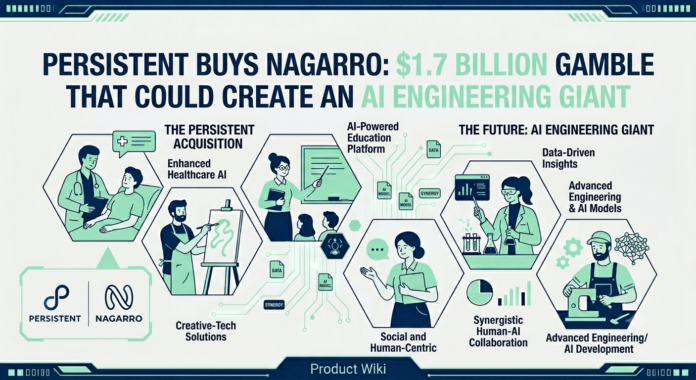
The Bold Acquisition That Could Shape the Next Era of AI Driven IT Services
The global IT services industry has witnessed countless mergers and acquisitions over the last two decades, but only a handful have genuinely changed the competitive landscape. Persistent Systems’ decision to acquire European digital engineering firm Nagarro is one such move that has captured the attention of investors, enterprise customers, and technology analysts across the world.
At first glance, many viewed the acquisition through the lens of its hefty price tag. Persistent agreed to pay a substantial premium over Nagarro’s prevailing market value, raising immediate questions across financial markets. Was the company overpaying? Could the deal put pressure on profitability? Would integrating two large organizations spread across multiple continents become a challenge?
While these questions are valid, they only tell one side of the story.
Behind the numbers lies a much bigger vision. This acquisition is less about buying revenue and far more about positioning Persistent Systems as one of the world’s leading AI first digital engineering companies. It represents an attempt to combine complementary strengths rather than simply increasing scale.
As enterprises worldwide begin preparing for an AI driven future, software engineering, cloud modernization, cybersecurity, intelligent automation, and enterprise transformation are becoming more interconnected than ever. Companies capable of delivering all these services under one roof are likely to gain a significant competitive advantage.
Persistent believes this transaction gives it precisely that opportunity.
This article explores why this acquisition matters, what each company brings to the table, why the premium may not be as surprising as it initially appeared, and how the combined organization could reshape the future of digital engineering.
Understanding the Two Companies
Although both companies operate in the technology services industry, their growth journeys have been remarkably different.
Persistent Systems has steadily transformed itself from an engineering focused organization into a globally recognized digital transformation partner. Over the past several years, the company has strengthened its expertise across cloud computing, enterprise modernization, banking technology, healthcare, software engineering, artificial intelligence, and platform development.
Its consistent execution has helped it become one of India’s fastest growing mid tier IT services companies.
Nagarro, meanwhile, has quietly built an impressive reputation in Europe and several international markets through a different strategy.
Rather than chasing massive outsourcing contracts, Nagarro focused on solving highly specialized engineering challenges for enterprise customers. It established deep relationships with global brands by working on mission critical digital transformation initiatives that required high levels of technical expertise.
This approach helped the company build an enviable customer portfolio despite operating with a relatively unconventional organizational structure.
Comparing the Companies
| Category | Persistent Systems | Nagarro |
|---|---|---|
| Headquarters | India | Germany |
| Core Strength | Digital Transformation and Enterprise IT | Digital Engineering and Custom Software |
| Geographic Leadership | North America and India | Europe and Global Markets |
| Industry Focus | BFSI, Healthcare, Software, Cloud | Automotive, Manufacturing, Retail, Logistics |
| AI Focus | Enterprise AI Solutions | AI Driven Engineering and Product Development |
| Growth Strategy | Large Digital Transformation Programs | Specialized Engineering Engagements |
Although their service offerings overlap in certain areas, their customer mix, regional presence, and delivery capabilities are surprisingly complementary.
That complementary nature forms the foundation of this acquisition.
Why Did Persistent Want Nagarro?
Every acquisition generally serves one or more strategic purposes.
Companies acquire competitors to eliminate competition.
They acquire startups to gain innovative technology.
Sometimes they acquire businesses simply to increase revenue.
Persistent’s acquisition of Nagarro appears to pursue a broader objective.
Instead of buying similar capabilities, Persistent is combining two organizations that have developed expertise in different parts of the technology ecosystem.
Several strategic advantages immediately become visible.
Stronger Presence Across Europe
One of Persistent’s biggest opportunities has always been expanding deeper into Europe.
Although the company has built an impressive client base in North America, Europe remains one of the largest enterprise technology markets globally.
Nagarro has spent decades building relationships with European enterprises across manufacturing, automotive, retail, logistics, and industrial sectors.
Instead of building those relationships from scratch, Persistent now gains immediate access to an established customer network.
This dramatically shortens its expansion timeline.
A Larger Portfolio of Enterprise Customers
Enterprise technology today is increasingly relationship driven.
Winning a new Fortune 500 customer often takes years of investment.
Nagarro reportedly serves hundreds of enterprise clients, many of whom have remained with the company for extended periods.
Long term customer relationships often indicate something more valuable than revenue.
They indicate trust.
Persistent can now introduce its own broader portfolio of services to many of these existing customers.
Likewise, Nagarro customers gain access to Persistent’s capabilities across cloud migration, enterprise modernization, cybersecurity, AI implementation, and managed services.
This creates significant cross selling opportunities.
Customer Synergies
| Persistent Can Offer Nagarro Clients | Nagarro Can Offer Persistent Clients |
| Cloud Modernization | Digital Engineering |
| Platform Engineering | Product Development |
| Enterprise AI | European Delivery Expertise |
| Banking Solutions | Automotive Engineering |
| Healthcare Technology | Manufacturing Transformation |
| Large Scale Delivery | Custom Software Innovation |
Rather than replacing each other’s services, both companies expand what the other can offer.
The Engineering First Philosophy
Perhaps the most fascinating aspect of this acquisition is the cultural similarity between the two organizations.
Many technology companies eventually become sales driven.
Engineering often becomes secondary.
Both Persistent and Nagarro have attempted to maintain engineering at the center of decision making.
This matters significantly in today’s AI era.
Artificial intelligence is changing software development at an unprecedented pace.
However, contrary to popular belief, AI is not eliminating the need for skilled engineers.
Instead, it is increasing demand for engineers capable of designing intelligent systems, integrating AI into enterprise workflows, ensuring security, maintaining governance, and modernizing legacy applications.
Organizations that retain strong engineering cultures may therefore possess an advantage over firms primarily optimized for traditional outsourcing.
Persistent appears to recognize this shift.
Rather than acquiring a company with identical capabilities, it is strengthening its engineering DNA.
Why Was Nagarro Growing More Slowly?
One of the biggest concerns raised after the acquisition announcement involved Nagarro’s recent growth trajectory.
Compared to Persistent, Nagarro’s revenue expansion had slowed.
Naturally, investors questioned whether Persistent was buying a business that had already passed its peak.
However, slower growth does not necessarily imply weaker fundamentals.
Several factors appear to have contributed.
Possible Reasons Behind Slower Growth
| Factor | Impact |
| Focus on specialized engineering | Limited large outsourcing deals |
| Conservative commercial strategy | Fewer aggressive sales initiatives |
| Smaller large deal pipeline | Slower revenue acceleration |
| European macroeconomic conditions | Reduced enterprise spending |
| Selective customer engagement | Higher quality but slower expansion |
Interestingly, Nagarro’s leadership has repeatedly emphasized that the company intentionally prioritized engineering excellence over commercial expansion.
That distinction is important.
A business with satisfied customers but an underdeveloped sales engine presents a different opportunity than a company losing customers because of weak execution.
Persistent appears to believe the former describes Nagarro.
If that assessment proves correct, improving commercial execution could unlock additional growth without fundamentally changing the underlying business.
The AI Opportunity Is Bigger Than Most Investors Realize
Much of the discussion surrounding artificial intelligence has focused on automation replacing human work.
Within IT services, this has created concerns that software development revenue may decline as AI becomes more capable.
Yet another school of thought is rapidly gaining acceptance.
Artificial intelligence is not simply automating software development.
It is creating entirely new categories of enterprise transformation.
Organizations worldwide are now asking questions that barely existed three years ago.
How should AI interact with customer data?
Which models should be deployed internally?
How can governance be maintained?
How should cybersecurity evolve?
How can legacy applications be modernized?
How should AI agents integrate with existing enterprise software?
Every one of these questions requires experienced engineers.
The implementation challenge may ultimately become much larger than the AI tools themselves.
This is precisely where companies like Persistent and Nagarro expect demand to accelerate.
Instead of competing for shrinking traditional outsourcing work, they aim to become strategic partners helping enterprises redesign technology for the AI era.
Why Investors Initially Became Nervous
Despite the long term strategic narrative, financial markets often react first to immediate risks.
Persistent’s acquisition naturally triggered concerns.
Some analysts worried about the size of the acquisition.
Others questioned whether the premium paid was justified.
There were also concerns regarding debt financing, integration complexity, and possible pressure on operating margins during the initial years.
These concerns are not unique.
Almost every major acquisition faces similar scrutiny.
Investor Concerns
| Concern | Why It Matters |
| High Acquisition Premium | Could reduce shareholder returns if synergies disappoint |
| Integration Risk | Combining global workforces takes time |
| Margin Pressure | Initial costs may affect profitability |
| Financing Structure | Debt increases financial obligations |
| Execution Risk | Cross selling benefits may take longer than expected |
At the same time, acquisitions should rarely be judged solely by their first year.
The true value often emerges through stronger customer relationships, expanded service portfolios, improved delivery capabilities, and accelerated revenue growth over several years.
That is the bet Persistent is making.
Looking Beyond the Headlines
The easiest way to evaluate an acquisition is by looking at the purchase price.
The harder, and often more meaningful, approach is to examine the strategic direction behind it.
Persistent is not merely acquiring additional employees or customer contracts.
It is attempting to position itself for the next decade of enterprise technology, where AI, cloud computing, digital engineering, cybersecurity, and intelligent automation will increasingly converge.
If the company successfully integrates Nagarro while preserving its engineering culture and leveraging its commercial strengths, the acquisition could eventually be remembered as one of the defining moments in Persistent’s history.
However, success is far from guaranteed.
Execution will determine whether this bold move becomes a case study in value creation or another ambitious acquisition that struggled to deliver expected synergies.
Can Persistent Turn an Expensive Acquisition into a Long Term Growth Engine?
Every major acquisition eventually reaches a point where the headlines fade and execution takes center stage.
For Persistent Systems, acquiring Nagarro is only the beginning of a much larger journey. Investors may have debated the valuation, analysts may continue discussing financing costs, and competitors may watch closely from the sidelines, but ultimately the success of this deal will depend on one simple question.
Can the combined organization create more value together than they could have independently?
That question will likely take several years to answer, but early indicators suggest the opportunity extends well beyond increasing revenue. If managed effectively, this acquisition could reshape Persistent’s global positioning, strengthen its AI capabilities, deepen customer relationships, and unlock growth opportunities that neither company could have achieved alone.
AI Is Creating a New Era of Enterprise Technology
Artificial intelligence is no longer an experimental technology reserved for innovation labs. It has become a boardroom priority across virtually every industry.
Banks are exploring AI driven fraud detection.
Hospitals are investing in intelligent patient care systems.
Manufacturers are implementing predictive maintenance powered by machine learning.
Retailers are building personalized shopping experiences.
Governments are modernizing public services through automation.
These initiatives require much more than deploying an AI model.
Organizations need to redesign their technology architecture, modernize legacy applications, secure sensitive data, establish governance frameworks, and ensure regulatory compliance. Every stage of this transformation demands engineering expertise.
This is precisely where Persistent and Nagarro believe the future lies.
Rather than focusing solely on traditional outsourcing, the combined company aims to become a strategic technology partner capable of designing, building, integrating, and managing AI driven enterprise platforms.
The AI Transformation Journey
| Enterprise Challenge | How the Combined Company Can Help |
|---|---|
| Legacy Application Modernization | Rebuild applications for AI readiness |
| Data Management | Organize and prepare enterprise data |
| AI Integration | Deploy AI into business workflows |
| Cybersecurity | Protect AI systems and sensitive information |
| Cloud Migration | Create scalable AI infrastructure |
| Governance | Ensure responsible AI deployment |
This broader approach positions the company to benefit from long term enterprise spending rather than isolated AI pilot projects.
The Power of Cross Selling
One of the most attractive aspects of this acquisition is the opportunity to generate additional business from existing customers.
Winning a new enterprise customer is expensive and time consuming. Building trust often takes years.
Once that trust exists, however, expanding the relationship becomes significantly easier.
Persistent and Nagarro each bring customer portfolios that complement one another remarkably well.
For example, a European automotive manufacturer working with Nagarro on digital engineering projects may now gain access to Persistent’s expertise in cloud modernization, cybersecurity, enterprise integration, and managed services.
Similarly, a North American healthcare client working with Persistent could benefit from Nagarro’s engineering capabilities in product development and digital innovation.
These opportunities increase customer lifetime value without requiring entirely new client acquisition.
Cross Selling Opportunities
| Existing Customer | Additional Services Available |
| Manufacturing | AI, Cloud, Cybersecurity |
| Banking | Digital Engineering, Automation |
| Healthcare | Product Engineering, AI Platforms |
| Automotive | Enterprise Modernization |
| Retail | Intelligent Customer Experience Solutions |
This ability to expand wallet share often becomes one of the largest drivers of acquisition success.
Europe Becomes a Strategic Growth Market
For years, many Indian IT companies have relied heavily on North America for revenue growth.
While the United States remains an important market, Europe offers equally significant long term opportunities.
European enterprises continue investing heavily in digital transformation, sustainability initiatives, Industry 4.0 technologies, connected manufacturing, and intelligent automation.
Nagarro has spent decades building credibility within these markets.
Its strong relationships across Germany and other European regions give Persistent immediate access to industries where building trust independently could have taken years.
Regional Strength Comparison
| Region | Persistent Before Deal | Combined Company After Acquisition |
| North America | Strong | Stronger |
| India | Strong | Strong |
| Europe | Moderate | Significantly Expanded |
| Middle East | Growing | Expanded Opportunities |
| Asia Pacific | Strong Delivery Presence | Enhanced Reach |
Geographic diversification also reduces dependence on any single market, making future revenue streams more resilient.
Can Margins Improve Over Time?
One of the most closely watched metrics after the acquisition will be operating margins.
Large acquisitions often place temporary pressure on profitability due to integration costs, financing expenses, and organizational restructuring.
However, management appears optimistic that margins could gradually improve.
Several factors support this possibility.
First, combining delivery capabilities allows projects to be executed more efficiently.
Second, cross selling higher value services can improve revenue quality.
Third, stronger commercial execution may help Nagarro monetize its engineering expertise more effectively.
Finally, increased scale often creates operational efficiencies across support functions.
Potential Margin Improvement Drivers
| Opportunity | Expected Impact |
| Larger Deal Sizes | Higher Revenue Per Client |
| Cross Selling | Better Revenue Mix |
| Operational Efficiency | Lower Delivery Costs |
| Shared Resources | Reduced Overhead |
| AI Assisted Development | Improved Productivity |
These improvements are unlikely to appear overnight, but they represent meaningful long term opportunities.
Integration Will Be the Real Test
While strategic logic appears compelling, integration remains the most critical challenge.
History is filled with acquisitions that looked perfect on paper but failed during execution.
Technology companies often struggle with cultural differences, leadership transitions, customer uncertainty, and employee retention.
Persistent and Nagarro may be better positioned than many previous mergers because both organizations share an engineering focused philosophy.
Rather than emphasizing hierarchy, both companies have historically empowered technical talent.
That cultural alignment could simplify integration considerably.
Still, several challenges remain.
Key Integration Risks
| Risk | Potential Impact | Possible Mitigation |
| Employee Attrition | Loss of critical talent | Transparent communication and retention programs |
| Customer Uncertainty | Delayed projects | Early engagement with enterprise clients |
| Operational Complexity | Slower execution | Gradual integration strategy |
| Cultural Differences | Lower collaboration | Shared leadership and engineering culture |
| Technology Integration | Delayed synergies | Standardized delivery processes |
Managing these challenges carefully will be essential for realizing the acquisition’s full value.
How the Combined Company Compares Globally
The acquisition also changes Persistent’s competitive positioning.
Rather than competing primarily as a mid sized technology services provider, the company begins moving closer to the league of larger global digital engineering specialists.
Competitive Positioning
| Company | Core Strength | Relative Position After Deal |
| Accenture | End to End Consulting | Larger Global Competitor |
| Cognizant | Enterprise IT Services | Broad Competitor |
| Capgemini | European Digital Transformation | Strong European Benchmark |
| EPAM Systems | Digital Engineering | Direct Engineering Competitor |
| Globant | AI and Digital Innovation | Innovation Focused Competitor |
| Persistent + Nagarro | AI Driven Engineering and Enterprise Transformation | Emerging Global Challenger |
Although the combined entity will still be smaller than some industry giants, it strengthens its ability to compete for larger, more complex digital transformation projects.
What This Means for Customers
Enterprise clients are increasingly seeking partners capable of delivering complete technology solutions rather than isolated services.
Instead of managing multiple vendors for cloud, AI, cybersecurity, engineering, and modernization, organizations increasingly prefer strategic partners with broader capabilities.
The Persistent Nagarro combination moves closer to fulfilling that expectation.
Customers stand to benefit through:
- Broader technology expertise
- Larger global delivery capabilities
- Faster innovation cycles
- Access to specialized engineering talent
- Expanded AI implementation services
- Greater regional support
This broader portfolio may improve customer retention while attracting larger transformation programs.
What Investors Should Watch Over the Next Few Years
While the strategic rationale appears compelling, investors should focus on measurable indicators rather than promises.
Some of the most important metrics include:
| Indicator | Why It Matters |
| Revenue Growth | Shows whether cross selling is working |
| Operating Margin | Indicates successful integration |
| Large Deal Wins | Demonstrates stronger market positioning |
| Client Retention | Reflects customer confidence |
| Employee Attrition | Measures cultural integration |
| AI Revenue Contribution | Highlights future growth potential |
Strong performance across these indicators would reinforce confidence that the acquisition is delivering its intended benefits.
The Bigger Picture
This transaction reflects a broader shift occurring throughout the global technology industry.
For years, IT services firms competed primarily on cost efficiency and workforce scale.
The next decade is likely to reward different capabilities.
Engineering excellence.
AI integration.
Industry expertise.
Cloud native development.
Cybersecurity.
Enterprise modernization.
Digital product innovation.
Persistent appears to be positioning itself around these future growth drivers rather than relying solely on traditional outsourcing models.
That strategic direction may ultimately prove more important than the acquisition itself.
Final Verdict
Large acquisitions are rarely judged accurately in their first few months.
Initial market reactions often focus on valuation, financing, and short term earnings impact.
The true measure of success emerges over years through stronger customer relationships, improved innovation, sustainable revenue growth, and enhanced competitive positioning.
Persistent’s acquisition of Nagarro represents a bold attempt to accelerate its evolution from a successful Indian IT services company into a globally recognized digital engineering powerhouse.
The premium paid may continue to generate debate, and integration challenges will undoubtedly require careful management. However, if Persistent successfully combines Nagarro’s engineering excellence with its own commercial execution, global delivery capabilities, and enterprise relationships, the acquisition could become one of the defining strategic moves in the company’s history.
As artificial intelligence reshapes industries and enterprises rethink their technology foundations, organizations capable of delivering end to end digital engineering solutions are likely to become increasingly valuable.
Persistent is making a calculated bet that this future is arriving faster than many expect.
Whether that vision translates into shareholder value will depend not on the acquisition announcement itself, but on disciplined execution, thoughtful integration, and the ability to help enterprises navigate one of the most significant technology transformations of our time.
Only time will reveal whether this becomes simply another large acquisition or the moment that transforms Persistent Systems into one of the world’s leading AI driven digital engineering companies.
Frequently Asked Questions (FAQs)
1. Why did Persistent Systems acquire Nagarro?
Persistent Systems acquired Nagarro to strengthen its global digital engineering capabilities, expand its presence in Europe, enhance its AI services portfolio, and create new growth opportunities through complementary customer relationships and technology expertise.
2. What is the main objective behind the Persistent Nagarro acquisition?
The primary objective is to build a stronger global digital engineering company capable of delivering AI driven enterprise transformation, cloud modernization, software engineering, and intelligent automation solutions across multiple industries.
3. Why did Persistent pay a premium to acquire Nagarro?
Persistent believes Nagarro offers long term strategic value through its engineering talent, European customer base, and strong digital transformation capabilities. The premium reflects the expected future growth and business synergies rather than just the company’s current financial performance.
4. How will the acquisition benefit Persistent Systems?
The acquisition gives Persistent access to new enterprise customers, stronger European operations, deeper digital engineering expertise, expanded AI capabilities, and opportunities to cross sell services across both customer bases.
5. Why is Nagarro considered an attractive acquisition?
Nagarro has built a strong reputation in digital engineering with long standing relationships across industries such as automotive, manufacturing, retail, and logistics. Its engineering focused culture complements Persistent’s long term growth strategy.
6. How does this acquisition strengthen Persistent’s AI strategy?
The combined company can help enterprises modernize legacy systems, integrate artificial intelligence into business operations, build intelligent applications, and manage AI governance, security, and cloud infrastructure more effectively.
7. Will the Persistent Nagarro acquisition improve the company’s presence in Europe?
Yes. Nagarro has a well established presence across Europe, particularly in Germany and other key markets. This gives Persistent immediate access to a larger regional customer base and strengthens its international footprint.
8. What industries will benefit the most from this acquisition?
Industries such as banking, healthcare, automotive, manufacturing, retail, logistics, and software development are expected to benefit from the expanded technology capabilities of the combined organization.
9. What are the biggest synergies expected from the deal?
The major synergies include cross selling services, expanding customer relationships, sharing engineering expertise, improving global delivery capabilities, and pursuing larger digital transformation projects.
10. Why was Nagarro’s growth slower than Persistent’s?
Nagarro focused primarily on specialized digital engineering rather than aggressively pursuing large outsourcing contracts. Its leadership emphasized engineering excellence over rapid commercial expansion, which contributed to slower but more focused growth.
11. Does this acquisition mean AI is replacing software engineers?
No. The acquisition reflects the growing demand for highly skilled engineers who can design, build, integrate, and manage AI powered enterprise systems rather than replace human expertise.
12. What challenges could Persistent face after acquiring Nagarro?
The company may face challenges related to organizational integration, employee retention, cultural alignment, customer transition, and achieving the expected financial synergies over time.
13. Will Persistent and Nagarro continue serving their existing customers?
Yes. Both companies are expected to continue supporting their existing customers while introducing additional services through the combined portfolio, creating greater value for enterprise clients.
14. How could customers benefit from the combined company?
Customers will gain access to broader digital transformation services, stronger AI capabilities, cloud modernization expertise, engineering excellence, global delivery support, and a wider range of technology solutions under one organization.
15. How does this acquisition compare with other IT industry mergers?
Unlike acquisitions focused solely on increasing revenue or market share, this transaction emphasizes complementary engineering capabilities, AI readiness, geographic expansion, and long term enterprise transformation opportunities.
16. Could Persistent’s profitability improve after the acquisition?
While short term integration costs may temporarily affect margins, long term profitability could improve through operational efficiencies, larger projects, stronger commercial execution, and increased cross selling opportunities.
17. Why is digital engineering becoming more important in the AI era?
As organizations adopt artificial intelligence, they need to modernize software, redesign business processes, integrate AI into existing systems, and improve cybersecurity. Digital engineering plays a central role in enabling these transformations.
18. What should investors monitor after the acquisition?
Investors should watch revenue growth, operating margins, customer retention, large deal wins, employee retention, AI related business growth, and the successful integration of both organizations over the coming years.
19. Could this acquisition change Persistent’s global market position?
Yes. If successfully integrated, the acquisition could strengthen Persistent’s position as a leading global digital engineering and AI services provider, allowing it to compete more effectively for large international transformation projects.
20. Is Persistent’s acquisition of Nagarro a long term strategic investment?
Yes. The acquisition is designed as a long term growth strategy focused on expanding global capabilities, accelerating AI adoption, strengthening customer relationships, and preparing for the next generation of enterprise technology transformation.

