Every successful product begins with a plan.
Whether a company is launching a new software platform, expanding into a new country, introducing a feature, or retiring an outdated product, the outcome is rarely determined by luck. Behind every successful product is a carefully structured product plan that aligns business goals, customer needs, market realities, and execution strategies.
Many businesses make the mistake of treating product planning as a simple roadmap document. In reality, product planning is much broader. It involves defining objectives, allocating resources, identifying opportunities, minimizing risks, and creating a clear path from idea to execution.
Different business situations require different types of product plans. A startup launching its first product faces very different challenges than an established company entering a new market. Likewise, a company introducing a new feature needs a different planning approach than a business repositioning its brand.
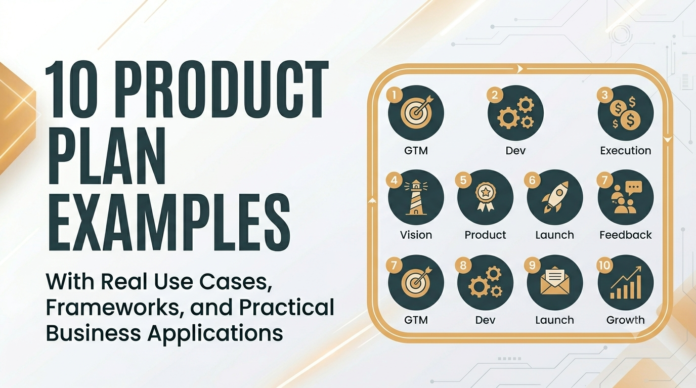
In this guide, we will explore 10 product plan examples, when to use them, their key components, real-world applications, and common mistakes to avoid.
What Is a Product Plan?
A product plan is a structured document or framework that outlines how a product will achieve its goals.
It acts as a bridge between product strategy and execution.
A product plan helps organizations answer important questions:
- What are we building?
- Why are we building it?
- Who is it for?
- How will it generate value?
- What resources are required?
- How will success be measured?
Without a product plan, teams often operate with conflicting priorities, unclear objectives, and inefficient decision-making processes.
Core Elements of a Product Plan
| Component | Purpose |
|---|---|
| Product Vision | Long-term direction |
| Target Audience | Defines ideal customers |
| Objectives | Business and customer goals |
| Features | Key capabilities |
| Timeline | Execution schedule |
| Metrics | Success measurement |
| Resources | Team and budget allocation |
| Risks | Potential obstacles |
Why Different Product Plans Matter
Not every business challenge requires the same approach.
For example:
| Situation | Appropriate Product Plan |
| Launching a new product | New Product Launch Plan |
| Improving customer experience | Product Improvement Plan |
| Entering new markets | Market Expansion Plan |
| Testing an idea | MVP Product Plan |
| Increasing adoption | Go-to-Market Plan |
Understanding which product plan fits a particular objective helps organizations make better decisions and avoid unnecessary complexity.
1. New Product Launch Plan
What Is a New Product Launch Plan?
A new product launch plan is used when a company introduces an entirely new product into the market.
This plan focuses on transforming an idea into a commercial offering while ensuring customers are aware of the product and understand its value.
A successful launch plan coordinates multiple departments including product management, engineering, marketing, sales, customer success, and operations.
When Should You Use It?
A launch plan is appropriate when:
- Introducing a completely new product
- Entering a new category
- Launching a startup’s first product
- Creating a new revenue stream
Key Components
| Component | Purpose |
| Market Research | Understand demand |
| Customer Analysis | Identify target users |
| Pricing Strategy | Determine value and profitability |
| Marketing Campaigns | Generate awareness |
| Launch Timeline | Coordinate activities |
| Success Metrics | Measure performance |
Real Example
Imagine a startup creating a smart water bottle that tracks hydration levels and connects with a mobile application.
The company must determine:
- Who will buy it
- What price customers will accept
- Which channels will generate sales
- How the product differs from competitors
The launch plan becomes the blueprint for bringing the product to market successfully.
Common Mistake to Avoid
Many companies spend months perfecting the product while neglecting customer awareness.
A great product without visibility often struggles to gain traction.
2. Product Improvement Plan
What Is a Product Improvement Plan?
A product improvement plan focuses on enhancing an existing product.
Instead of creating something entirely new, the goal is to improve customer satisfaction, usability, performance, reliability, or functionality.
This is one of the most common product plans used by mature companies.
When Should You Use It?
A product improvement plan is valuable when:
- Customer complaints increase
- Retention rates decline
- Competitors offer better experiences
- Product performance falls behind expectations
Key Components
| Component | Purpose |
| User Feedback | Identify issues |
| Usage Analytics | Understand behavior |
| Improvement Priorities | Focus resources effectively |
| Testing Plan | Validate changes |
| Performance Metrics | Measure success |
Real Example
Consider a food delivery application receiving complaints about a complicated checkout process.
Users abandon orders before payment because too many steps are required.
The company develops a product improvement plan focused on:
- Simplifying checkout
- Improving page speed
- Reducing clicks required for purchase
- Enhancing payment reliability
These improvements directly increase customer satisfaction and revenue.
Common Mistake to Avoid
Many organizations improve features based on internal opinions rather than customer evidence.
Improvements should always be guided by data and feedback.
3. Market Expansion Plan
What Is a Market Expansion Plan?
A market expansion plan is used when an existing product enters a new geographic market, customer segment, or industry.
Rather than building a new product, the organization adapts an existing offering for new opportunities.
When Should You Use It?
This plan works best when:
- Expanding internationally
- Entering a new industry vertical
- Targeting a different demographic group
- Reaching previously underserved customers
Key Components
| Component | Purpose |
| Market Research | Understand local demand |
| Localization Strategy | Adapt product for market |
| Distribution Channels | Reach customers effectively |
| Regulatory Compliance | Meet legal requirements |
| Marketing Adaptation | Align messaging with audience |
Real Example
A skincare company that succeeds in Europe decides to enter the Indian market.
The company must evaluate:
- Local skin care preferences
- Pricing expectations
- Cultural influences
- Distribution networks
- Regulatory requirements
The expansion plan helps reduce risk while increasing the chances of market success.
Common Mistake to Avoid
Many businesses assume what worked in one market will automatically work in another.
Customer behavior often differs significantly between regions.
4. Feature Release Plan
What Is a Feature Release Plan?
A feature release plan focuses on introducing new functionality within an existing product.
The objective is to improve customer value while minimizing disruption.
Feature releases often require coordination between product, engineering, marketing, and support teams.
When Should You Use It?
A feature release plan is appropriate when:
- Launching new functionality
- Introducing AI capabilities
- Enhancing existing workflows
- Addressing customer requests
Key Components
| Component | Purpose |
| Feature Definition | Clarify functionality |
| Rollout Strategy | Control deployment |
| Testing Plan | Ensure quality |
| User Education | Improve adoption |
| Support Preparation | Handle questions |
Real Example
A project management software company introduces AI-generated meeting summaries.
The release plan includes:
- Beta testing
- User feedback collection
- Documentation updates
- Customer communication
- Performance monitoring
This approach ensures a smooth rollout while reducing potential issues.
Common Mistake to Avoid
Releasing a feature without educating users often results in poor adoption, even when the feature provides significant value.
5. MVP Product Plan
What Is an MVP Product Plan?
An MVP Product Plan focuses on creating the smallest possible version of a product that still delivers meaningful value.
The goal is learning rather than perfection.
MVP planning allows companies to validate demand before investing heavily in development.
When Should You Use It?
An MVP plan is ideal when:
- Testing a new idea
- Validating market demand
- Operating with limited resources
- Reducing investment risk
Key Components
| Component | Purpose |
| Core Problem | Define value |
| Minimum Features | Reduce complexity |
| Validation Goals | Guide learning |
| User Feedback Plan | Collect insights |
| Success Metrics | Measure demand |
Real Example
A startup building a ride-sharing application launches only in one city.
The first version includes:
- Ride booking
- Driver matching
- Payments
Features such as loyalty programs, subscriptions, and advanced analytics are postponed until demand is validated.
Common Mistake to Avoid
Many teams build too many features into an MVP.
The purpose of an MVP is learning quickly, not launching a finished product.
6. Pricing Strategy Plan
What Is a Pricing Strategy Plan?
Pricing influences customer acquisition, profitability, positioning, and long-term growth.
A pricing strategy plan helps businesses determine how much customers should pay and why.
Choosing the wrong pricing model can significantly impact product performance.
When Should You Use It?
A pricing strategy plan becomes important when:
- Launching a new product
- Entering a new market
- Increasing profitability
- Introducing subscription models
- Repositioning products
Key Components
| Component | Purpose |
| Customer Research | Understand willingness to pay |
| Competitor Analysis | Compare market pricing |
| Revenue Modeling | Forecast outcomes |
| Pricing Structure | Define model |
| Testing Strategy | Validate assumptions |
Common Pricing Models
| Model | Description |
| Subscription | Recurring monthly or annual fees |
| Freemium | Free basic version with upgrades |
| Tiered Pricing | Multiple pricing levels |
| Usage-Based | Pay according to usage |
| Premium Pricing | Higher price for premium positioning |
Real Example
A SaaS company launching a project management platform evaluates whether to use:
- Freemium pricing
- Monthly subscriptions
- Enterprise licensing
The pricing strategy plan helps determine which approach maximizes both adoption and revenue.
Common Mistake to Avoid
Pricing based solely on costs rather than customer value often leaves revenue opportunities untapped.
7. Go to Market Plan
What Is a Go to Market Plan?
A Go to Market (GTM) plan is a comprehensive strategy that explains how a company will introduce a product to customers, generate awareness, acquire users, and drive sales.
Unlike a product launch plan that focuses on launching the product itself, a Go to Market plan focuses on how customers will discover, evaluate, purchase, and continue using the product.
It brings together marketing, sales, customer success, pricing, and distribution into one coordinated strategy.
When Should You Use It?
A Go to Market plan is useful when:
- Launching a new product
- Entering a new market
- Launching a major feature
- Rebranding an existing product
- Expanding into enterprise customers
Key Components
| Component | Purpose |
|---|---|
| Target Audience | Identify ideal buyers |
| Positioning | Define product messaging |
| Marketing Channels | Reach potential customers |
| Sales Strategy | Convert prospects into customers |
| Customer Onboarding | Improve product adoption |
| Success Metrics | Measure campaign performance |
Real Example
A company developing ergonomic laptop accessories plans to launch a wireless ergonomic mouse.
Its Go to Market plan includes:
- Social media campaigns
- Influencer partnerships
- Amazon marketplace listings
- Retail partnerships
- Product launch discounts
- Email marketing campaigns
Instead of simply making the product available, the company creates demand before and after launch.
Common Mistake to Avoid
Many businesses invest heavily in product development but spend very little time planning customer acquisition.
Without an effective Go to Market strategy, even outstanding products can struggle to generate sales.
8. Product Roadmap Plan
What Is a Product Roadmap Plan?
A Product Roadmap Plan provides a high level timeline of product initiatives, major features, strategic goals, and future improvements.
It helps stakeholders understand where the product is heading over the coming months or years.
Unlike detailed project plans, roadmaps focus on direction rather than individual tasks.
When Should You Use It?
A roadmap plan is valuable when:
- Planning long term product growth
- Communicating priorities to stakeholders
- Coordinating multiple development teams
- Managing customer expectations
- Aligning product strategy with execution
Key Components
| Component | Purpose |
| Product Vision | Long term direction |
| Strategic Goals | Business objectives |
| Major Features | Planned improvements |
| Release Timeline | Expected delivery periods |
| Milestones | Key achievements |
Real Example
A project management software company develops a twelve month roadmap.
Quarter One focuses on AI automation.
Quarter Two introduces advanced reporting.
Quarter Three launches mobile enhancements.
Quarter Four expands enterprise security.
Instead of overwhelming teams with hundreds of tasks, the roadmap communicates strategic priorities.
Common Mistake to Avoid
Many organizations treat roadmaps as fixed promises.
Product roadmaps should evolve as customer feedback, market conditions, and business priorities change.
9. Repositioning Plan
What Is a Repositioning Plan?
A repositioning plan changes how customers perceive a product within the marketplace.
Sometimes products fail not because they lack quality, but because customers misunderstand their value.
Repositioning helps organizations redefine their identity without necessarily changing the product itself.
When Should You Use It?
A repositioning plan becomes useful when:
- Customer perception is weak
- Competitors dominate the category
- The target audience changes
- Premium positioning is desired
- Sales begin to decline
Key Components
| Component | Purpose |
| Market Perception Analysis | Understand current positioning |
| Brand Messaging | Communicate new identity |
| Pricing Review | Match positioning |
| Visual Identity | Refresh branding |
| Marketing Campaign | Reinforce new perception |
Real Example
A software company originally marketed its application as a low cost solution for small businesses.
As enterprise capabilities improved, the company repositioned the product as a premium business platform.
The strategy included:
- Updated branding
- Higher pricing
- Professional website redesign
- Enterprise focused messaging
- Customer success stories
The product remained largely unchanged, but customer perception improved significantly.
Common Mistake to Avoid
Repositioning without improving customer experience often creates unrealistic expectations.
Brand promises must align with actual product quality.
10. Sunset or Exit Plan
What Is a Sunset Plan?
Every product eventually reaches the end of its lifecycle.
A Sunset Plan, sometimes called an Exit Plan, defines how an organization will discontinue a product while minimizing disruption for customers and internal teams.
A carefully managed retirement protects brand reputation and customer trust.
When Should You Use It?
A Sunset Plan is appropriate when:
- Customer demand declines
- Maintenance costs become too high
- Better replacement products exist
- Technology becomes outdated
- Strategic priorities shift
Key Components
| Component | Purpose |
| Customer Communication | Inform users early |
| Migration Strategy | Help customers transition |
| Support Timeline | Define final support dates |
| Data Export | Protect customer information |
| Product Shutdown | Complete retirement smoothly |
Real Example
A software company decides to discontinue an outdated accounting application.
Instead of immediately shutting it down, the company:
- Announces the retirement schedule
- Provides migration tools
- Offers discounts for replacement products
- Extends customer support
- Helps customers transfer their data
This approach maintains customer trust while reducing operational costs.
Common Mistake to Avoid
Ending a product without sufficient notice often frustrates customers and damages long term brand credibility.
Comparison of the 10 Product Plan Examples
| Product Plan | Primary Goal | Best Used For |
| New Product Launch Plan | Introduce a new product | New businesses and innovations |
| Product Improvement Plan | Improve existing products | Customer satisfaction |
| Market Expansion Plan | Reach new customers | Geographic or demographic growth |
| Feature Release Plan | Launch new functionality | Existing products |
| MVP Product Plan | Validate ideas | Startups and innovation |
| Pricing Strategy Plan | Maximize revenue | Product monetization |
| Go to Market Plan | Acquire customers | Product launches |
| Product Roadmap Plan | Guide future development | Strategic planning |
| Repositioning Plan | Change market perception | Brand transformation |
| Sunset Plan | Retire products smoothly | Product lifecycle management |
How to Choose the Right Product Plan
Selecting the appropriate product plan depends entirely on your business objective.
Ask yourself the following questions before choosing a planning approach.
| Business Situation | Recommended Product Plan |
| Building something entirely new | New Product Launch Plan |
| Existing customers are unhappy | Product Improvement Plan |
| Expanding internationally | Market Expansion Plan |
| Testing a new business idea | MVP Product Plan |
| Unsure about pricing | Pricing Strategy Plan |
| Preparing for launch | Go to Market Plan |
| Planning future releases | Product Roadmap Plan |
| Changing customer perception | Repositioning Plan |
| Ending an outdated product | Sunset Plan |
Common Product Planning Mistakes
Even experienced product managers make planning mistakes that delay launches, increase costs, or reduce customer satisfaction.
Some of the most common include:
Skipping Market Research
Assuming customer needs without validation often leads to poor product market fit.
Ignoring Customer Feedback
The best product decisions come from real customer insights rather than internal assumptions.
Building Too Many Features
Trying to satisfy everyone usually results in unnecessary complexity.
Focus on solving one important problem exceptionally well.
Poor Cross Functional Collaboration
Successful product planning requires collaboration between product, engineering, marketing, sales, finance, and customer support.
Working in silos creates inconsistent execution.
Measuring the Wrong Metrics
Tracking vanity metrics instead of meaningful business outcomes can create misleading success indicators.
Focus on metrics such as customer retention, revenue growth, adoption rate, and lifetime value.
Best Practices for Effective Product Planning
Organizations with successful products generally follow several consistent practices.
Start With Customer Problems
Every product plan should begin by understanding customer pain points rather than brainstorming features.
Validate Before Building
Testing ideas early reduces risk and prevents unnecessary investment.
Align Teams Around Shared Goals
Product planning succeeds when everyone understands the same vision and objectives.
Prioritize Ruthlessly
Resources are always limited.
Focus on initiatives that create the greatest business and customer value.
Treat Product Plans as Living Documents
Markets evolve continuously.
Product plans should be reviewed regularly and adjusted based on customer feedback, competitive changes, and business priorities.
Product Planning Framework
The entire product planning process can be summarized into a practical framework.
| Stage | Outcome |
| Understand Business Goals | Strategic direction |
| Research Customers | Market insights |
| Choose Appropriate Product Plan | Clear execution path |
| Define Objectives | Measurable outcomes |
| Build Execution Timeline | Organized delivery |
| Monitor Performance | Continuous improvement |
| Gather Feedback | Customer validation |
| Improve and Iterate | Long term success |
Final Thoughts
Every successful product follows a plan, but not every product requires the same type of planning.
A startup validating an idea, a SaaS company launching AI features, a retail brand entering a new country, and an enterprise software company retiring an outdated product all face different challenges. Choosing the right product plan allows businesses to allocate resources effectively, reduce risks, improve collaboration, and deliver greater value to customers.
The ten product plan examples covered in this guide demonstrate that product planning is far more than scheduling tasks or creating roadmaps. It is a strategic process that connects customer needs with business goals and transforms ideas into successful products.
Whether you are launching a completely new product, improving an existing one, expanding into new markets, introducing innovative features, optimizing pricing, planning a go to market strategy, or managing the end of a product’s lifecycle, selecting the appropriate product plan gives your team a clear direction and significantly improves the likelihood of long term success.
Organizations that invest time in thoughtful product planning consistently make better decisions, adapt more quickly to changing markets, and build products that customers continue to value for years to come.

