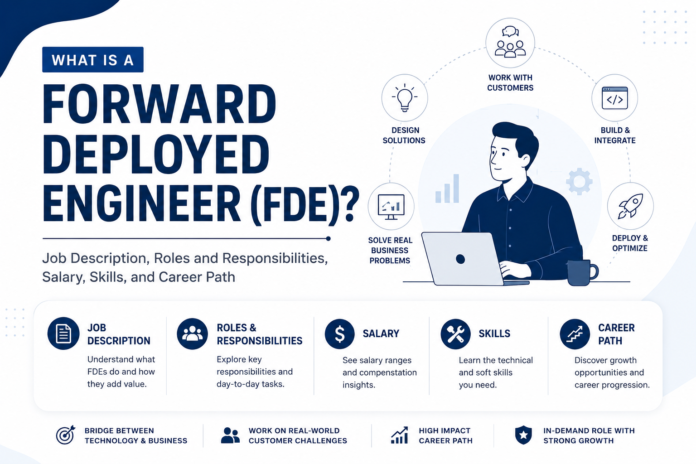
Artificial Intelligence is changing the technology industry faster than almost any innovation before it. New AI models appear every week, companies are investing billions into automation, and businesses everywhere are trying to figure out how to turn AI from an interesting experiment into something that creates real value.
But there is a problem.
Building an AI model is one thing.
Getting that model to work inside a real company is something completely different.
Many organizations discover that deploying AI successfully is far more difficult than creating a prototype. Teams struggle with integrations, infrastructure, data pipelines, cloud services, APIs, security requirements, compliance rules, and user adoption.
This challenge has created one of the fastest-growing job roles in modern technology.
The role is called a Forward Deployed Engineer, commonly known as an FDE.
Over the last few years, companies such as OpenAI, Palantir, Scale AI, Databricks, Snowflake, Google, AWS, and many other technology organizations have significantly increased hiring for this position. The reason is simple.
Businesses do not just need software anymore.
They need people who can bridge the gap between technology and real-world business outcomes.
That is exactly where Forward Deployed Engineers thrive. The role focuses on taking complex technical solutions and making them work inside real organizations with real users, real systems, and real challenges. This role is increasingly being viewed as one of the most exciting career opportunities in the AI era because it combines engineering, architecture, consulting, product thinking, deployment expertise, and customer interaction into a single profession.
Forward Deployed Engineer Job Description
A Forward Deployed Engineer is a technical professional who works closely with customers, stakeholders, product teams, and engineering teams to deploy, customize, integrate, and scale technology solutions.
Unlike traditional software engineers who primarily focus on building software products, Forward Deployed Engineers focus on implementing those products in real-world environments.
Think about a company that wants to deploy an AI assistant across thousands of employees.
The AI model itself may already exist.
The challenge is integrating it into company databases, connecting it to internal workflows, ensuring security compliance, training employees, monitoring performance, and solving unexpected problems after deployment.
A Forward Deployed Engineer is often the person responsible for making all of that happen.
The role sits at the intersection of software engineering, solutions architecture, cloud engineering, product management, and customer success.
One of the best ways to understand the role is through a simple comparison.
A software engineer builds the engine.
A solutions engineer explains how the engine works.
A Forward Deployed Engineer takes the engine onto a real road, drives it through difficult terrain, and makes sure it keeps running successfully.
Why Forward Deployed Engineers Are Suddenly in High Demand
For years, companies focused heavily on software development.
Today, the focus has shifted toward implementation and adoption.
Many organizations already have access to powerful AI tools. What they lack is the expertise needed to deploy those tools successfully across their business operations.
This shift is one of the main reasons Forward Deployed Engineer hiring has accelerated dramatically in recent years. Industry discussions increasingly point to AI adoption, workflow transformation, and customer implementation as major bottlenecks for organizations.
Modern businesses need professionals who can:
• Understand customer requirements
• Design technical solutions
• Build integrations
• Deploy cloud infrastructure
• Resolve production issues
• Guide organizational adoption
• Deliver measurable business outcomes
That combination of skills is rare.
And whenever a skill becomes rare and valuable, demand increases.
Forward Deployed Engineer Roles and Responsibilities
The responsibilities of an FDE extend far beyond coding.
A large portion of the role revolves around solving business problems using technology.
Understanding Customer Requirements
One of the first responsibilities of a Forward Deployed Engineer is understanding what the customer actually needs.
This may sound simple, but it often isn’t.
Many organizations know they have a problem but struggle to define the exact technical requirements needed to solve it.
An FDE spends significant time asking questions, gathering information, and identifying the root cause of challenges.
This process often involves speaking with executives, product managers, developers, analysts, and operational teams.
The ability to turn unclear requirements into actionable technical plans is one of the most valuable skills an FDE can develop.
Designing Technical Solutions
After understanding the problem, the next step is designing a solution.
This may involve:
| Design Area | Example Responsibilities |
| Cloud Architecture | AWS, Azure, Google Cloud |
| Data Pipelines | ETL systems, data processing |
| AI Infrastructure | Model deployment and monitoring |
| APIs | System integrations |
| Security | Authentication and compliance |
| Databases | Data storage strategies |
Unlike traditional engineering roles, FDEs must constantly evaluate trade-offs between speed, cost, scalability, reliability, and complexity.
Building and Deploying Solutions
Forward Deployed Engineers are not just planners.
They are builders.
Many organizations expect FDEs to write production-ready code across both frontend and backend environments.
Depending on the company, this may include:
• Python
• JavaScript
• TypeScript
• FastAPI
• React
• Node.js
• SQL
• Cloud Infrastructure as Code
The goal is not simply creating prototypes.
The goal is deploying stable solutions that customers can rely on.
Managing Production Systems
One of the most challenging aspects of the role occurs after deployment.
Real-world systems encounter unexpected issues.
APIs fail.
Data pipelines break.
Cloud services experience outages.
Monitoring alerts trigger unexpectedly.
Customers require urgent fixes.
Forward Deployed Engineers are often responsible for diagnosing and resolving these issues quickly.
This makes operational thinking a critical part of the job.
Forward Deployed Engineer Skills Required
The skill set required for success is broader than many traditional technology roles.
Technical Skills
Strong technical foundations are essential.
Common technical skills include:
| Technical Area | Importance |
| Python | High |
| JavaScript | High |
| Cloud Computing | High |
| APIs | High |
| Databases | High |
| Docker | Medium to High |
| Kubernetes | Medium to High |
| Data Engineering | High |
| MLOps | Medium |
| System Design | High |
The exact technology stack varies between companies, but the ability to learn new tools quickly is often more important than expertise in a specific framework.
Communication Skills
Many people underestimate how important communication is in this role.
A Forward Deployed Engineer spends a significant amount of time explaining technical concepts to non-technical stakeholders.
This includes:
• Executives
• Product managers
• Customers
• Business leaders
• Project sponsors
Strong communication often separates average FDEs from exceptional ones.
Problem Solving Skills
FDEs frequently operate in situations where requirements are unclear.
There may not be an obvious answer.
There may not even be a defined problem.
The ability to work through ambiguity and create structure from chaos is one of the defining characteristics of successful Forward Deployed Engineers.
Forward Deployed Engineer Salary
One reason the role receives so much attention is compensation.
Because the role combines multiple disciplines, organizations are willing to pay premium salaries for professionals who can perform effectively.
Forward Deployed Engineer Salary in the United States
| Experience Level | Average Salary |
| Entry Level | $95,000 – $130,000 |
| Mid Level | $130,000 – $175,000 |
| Senior Level | $175,000 – $240,000+ |
| Leadership | $250,000+ plus equity |
Many AI-focused organizations also provide stock options and performance bonuses.
Forward Deployed Engineer Salary in India
| Experience Level | Average Salary |
| Junior | ₹8–18 LPA |
| Mid Level | ₹20–40 LPA |
| Senior | ₹40–80+ LPA |
| Top AI Companies | ₹1 Crore+ possible |
Compensation varies significantly depending on technical expertise, customer-facing experience, cloud skills, and AI deployment knowledge.
Forward Deployed Engineer Career Path
One of the most attractive aspects of the profession is flexibility.
There is no single path into the role.
Many successful FDEs come from different backgrounds.
Common starting points include:
• Software Engineering
• Solutions Architecture
• Cloud Engineering
• Data Engineering
• DevOps
• Site Reliability Engineering
• Technical Consulting
• AI Engineering
The transition is often easier than people expect because many existing technology roles already develop overlapping skills.
For example, Solutions Architects already work with customers, design systems, evaluate trade-offs, and guide implementation efforts. These responsibilities closely resemble many Forward Deployed Engineering responsibilities.
Is Forward Deployed Engineering a Good Career?
For many professionals, the answer is yes.
The role offers:
• High salaries
• Strong demand
• Exposure to AI technologies
• Business impact
• Diverse projects
• Continuous learning opportunities
It is particularly attractive for people who enjoy both technical work and human interaction.
Someone who wants to spend all day writing code may prefer traditional software engineering.
Someone who enjoys solving technical problems while working directly with customers may find FDE work incredibly rewarding.
Forward Deployed Engineer vs Solutions Architect
One of the most common questions people ask after learning about Forward Deployed Engineering is whether it is simply a new name for a Solutions Architect.
The answer is both yes and no.
The two roles share many similarities, but there are also important differences.
A Solutions Architect is primarily responsible for understanding business requirements and designing technical solutions. They help organizations choose the right architecture, cloud services, integrations, and deployment strategies.
A Forward Deployed Engineer does all of that, but goes one step further.
Instead of stopping at architecture recommendations, an FDE actively participates in implementation, deployment, coding, debugging, and production support.
You can think of it like this.
A Solutions Architect designs the blueprint.
A Forward Deployed Engineer helps build the house and ensures people can actually live in it.
| Area | Solutions Architect | Forward Deployed Engineer |
| Customer Interaction | High | High |
| System Design | High | High |
| Coding | Medium | High |
| Deployment | Medium | High |
| Production Support | Medium | High |
| AI Integration | Medium | High |
| Business Strategy | High | High |
| Technical Ownership | Medium | Very High |
Many experienced Solutions Architects find transitioning into FDE roles relatively natural because much of the customer-facing and architecture experience already transfers successfully. The biggest gap is usually hands-on coding and deployment experience.
How to Become a Forward Deployed Engineer
The path to becoming a Forward Deployed Engineer is not identical for everyone.
However, most successful FDEs develop expertise in five core areas.
Step 1: Build Strong Software Engineering Fundamentals
Before learning advanced AI systems or cloud architecture, you need a strong foundation.
Focus on:
• Python
• JavaScript or TypeScript
• SQL
• Data Structures
• APIs
• Git and Version Control
• Backend Development
You do not need to become a world-class competitive programmer.
Instead, focus on building real applications that solve practical problems.
Step 2: Learn Cloud Platforms
Most modern AI systems run in the cloud.
Popular platforms include:
| Cloud Platform | Usage |
| AWS | Most popular enterprise cloud |
| Azure | Strong Microsoft ecosystem |
| Google Cloud | Popular for AI workloads |
Learn how to:
• Deploy applications
• Configure networking
• Manage storage
• Monitor systems
• Secure cloud environments
Cloud skills significantly increase your value as an FDE candidate.
Step 3: Understand System Design
FDEs spend a large portion of their careers designing systems.
You should understand:
• Microservices
• Event-driven architecture
• API design
• Databases
• Caching
• Message queues
• Distributed systems
Companies often evaluate system design skills heavily during interviews.
Step 4: Learn AI and Machine Learning Basics
The good news is that you do not need a PhD in Machine Learning.
Many successful FDEs come from cloud engineering, software engineering, or solutions architecture backgrounds.
Focus on understanding:
• LLMs
• AI agents
• Embeddings
• Vector databases
• Retrieval systems
• Prompt engineering
• AI deployment
The goal is understanding how AI systems work and how businesses use them.
Step 5: Develop Customer-Facing Skills
This is where many engineers struggle.
You need experience:
• Running meetings
• Presenting ideas
• Handling objections
• Managing stakeholders
• Leading discussions
• Explaining technical concepts
Communication often becomes the deciding factor between a good FDE and a great FDE.
90-Day Forward Deployed Engineer Roadmap
If you want to break into the field, a structured roadmap can help.
Days 1–30: Foundations
Focus on technical basics.
Learn:
• Python
• APIs
• SQL
• Cloud fundamentals
• Git
• Docker
Build small projects.
Examples:
• Weather API app
• Task management system
• AI chatbot
• Simple dashboard
Days 31–60: Infrastructure and Deployment
Expand into deployment skills.
Learn:
• AWS or Azure
• Kubernetes basics
• Monitoring tools
• Logging
• Security fundamentals
Create projects that can actually be deployed online.
Employers care more about deployed projects than local projects.
Days 61–90: Portfolio and Interview Preparation
Build complete projects.
Examples include:
| Project | Skills Demonstrated |
| AI Customer Support Agent | AI + APIs |
| ETL Data Pipeline | Data Engineering |
| Cloud Monitoring Dashboard | Observability |
| Recommendation Engine | Machine Learning |
| Document Search Tool | Vector Databases |
Document everything.
Create architecture diagrams.
Explain technical decisions.
Add screenshots.
Host projects publicly.
The goal is demonstrating that you can deliver solutions from start to finish.
Best Certifications for Forward Deployed Engineers
Certifications alone will not get you hired.
However, they can strengthen your profile.
Popular certifications include:
Cloud Certifications
• AWS Solutions Architect Associate
• AWS Developer Associate
• Azure Solutions Architect Expert
• Google Professional Cloud Architect
AI Certifications
• Google Generative AI Courses
• Microsoft AI Engineer Associate
• AWS Machine Learning Specialty
Kubernetes Certifications
• Certified Kubernetes Application Developer
• Certified Kubernetes Administrator
Remember that certifications should complement projects, not replace them.
Forward Deployed Engineer Interview Questions
Interview preparation should focus on practical problem solving.
Common topics include:
Technical Questions
• Design a scalable AI chatbot system.
• Explain API authentication methods.
• Design a customer analytics pipeline.
• How would you deploy an LLM application?
• Explain Kubernetes in simple terms.
Customer-Facing Questions
• How would you handle conflicting stakeholder requirements?
• Describe a difficult customer conversation.
• How would you explain AI to a non-technical executive?
• Tell us about a project that failed.
Behavioral Questions
• Describe a situation with ambiguity.
• Explain a major technical trade-off.
• Tell us about a leadership experience.
Many candidates prepare heavily for coding interviews but underestimate communication assessments.
For FDE roles, communication is often equally important.
Best Companies Hiring Forward Deployed Engineers
The role is becoming increasingly common across the technology industry.
Popular employers include:
| Company | Known For |
| OpenAI | AI deployment and adoption |
| Palantir | Forward Deployed Engineering pioneer |
| Databricks | Data and AI platforms |
| Snowflake | Cloud data systems |
| Scale AI | Enterprise AI deployment |
| AWS | Cloud transformation |
| AI infrastructure | |
| Microsoft | Enterprise AI solutions |
| Accenture | Digital transformation |
| Deloitte | Enterprise consulting |
Demand is also growing rapidly across healthcare, finance, logistics, manufacturing, retail, and government sectors.
Future of Forward Deployed Engineering
Many people wonder whether this role is temporary.
Current evidence suggests the opposite.
AI models are becoming easier to create.
Deployment remains difficult.
Every organization has unique systems, processes, workflows, regulations, and customer requirements.
Someone must connect AI capabilities with those real-world business environments.
That is exactly what Forward Deployed Engineers do.
As AI adoption expands, the need for professionals who can bridge technology and business will likely increase.
Many industry leaders view deployment, implementation, and adoption as the biggest challenges in enterprise AI today.
This means the role may become even more valuable over the next decade.
Is Forward Deployed Engineering Better Than Software Engineering?
Neither role is objectively better.
They simply serve different personalities.
Software Engineering may be a better fit if you:
• Love coding all day
• Prefer deep technical specialization
• Enjoy building products
• Prefer limited customer interaction
Forward Deployed Engineering may be a better fit if you:
• Enjoy solving business problems
• Like interacting with customers
• Want broader technical exposure
• Enjoy ownership and responsibility
• Like seeing immediate business impact
Many professionals eventually move between both paths during their careers.
Final Thoughts
Forward Deployed Engineering has emerged as one of the most exciting technology careers of the AI era.
The role combines software engineering, cloud architecture, AI deployment, customer interaction, product thinking, and operational excellence into a single career path.
Organizations no longer need people who simply build technology.
They need professionals who can take technology into the real world, adapt it to customer needs, solve unexpected problems, and drive measurable outcomes.
That is exactly what Forward Deployed Engineers do.
If you enjoy technology, communication, problem solving, leadership, and continuous learning, this career path offers tremendous opportunities. The compensation is strong, demand continues to grow, and the skills developed in the role are valuable across almost every modern industry.
As AI continues transforming businesses worldwide, Forward Deployed Engineers will likely remain among the professionals responsible for turning ambitious ideas into real-world results.
For many engineers looking toward the future, that makes FDE one of the most promising career paths available today.

