Artificial Intelligence has created a new category of engineering jobs that barely existed a few years ago.
For decades, most technical professionals followed familiar career paths. You became a Software Engineer, moved into Senior Engineering positions, specialized in architecture, or eventually entered management.
Today, a new role is changing that equation.
Forward Deployed Engineers, commonly called FDEs, are becoming some of the most sought-after professionals in AI, cloud computing, enterprise software, and digital transformation projects.
Many professionals are now asking a simple question:
Should I become a Software Engineer or a Forward Deployed Engineer?
At first glance, both jobs appear similar. Both involve technology. Both require problem-solving. Both often involve coding.
But when you look deeper, these careers are surprisingly different.
One focuses primarily on building products.
The other focuses on delivering business outcomes.
One typically works inside engineering teams.
The other operates directly with customers, stakeholders, executives, and deployment environments.
Understanding these differences is becoming increasingly important because companies are hiring aggressively for both positions, and the long-term career paths can look very different.
In this guide, we’ll compare Forward Deployed Engineers and Software Engineers across responsibilities, salary, skills, daily work, growth opportunities, job security, AI impact, and future demand.
What Is a Forward Deployed Engineer?
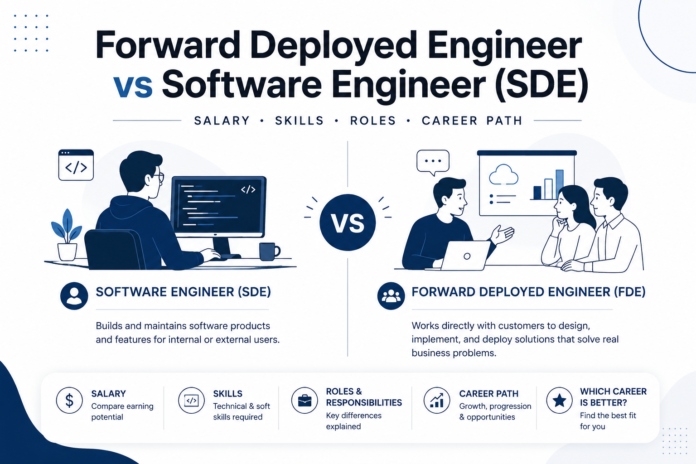
A Forward Deployed Engineer is a technical professional who works directly with customers to implement, customize, deploy, optimize, and maintain technology solutions in real-world environments.
Think of an FDE as the person responsible for ensuring technology actually works after it leaves the development team.
Many AI systems fail not because the model is bad, but because implementation becomes difficult.
The FDE sits in the middle of that challenge.
Their responsibilities often include:
• Understanding customer requirements
• Designing technical solutions
• Building prototypes
• Deploying production systems
• Troubleshooting issues
• Managing integrations
• Supporting adoption
• Communicating with stakeholders
Forward Deployed Engineers frequently operate in environments where requirements are incomplete, timelines are aggressive, and business expectations are high.
Instead of waiting for perfect instructions, they often create clarity from ambiguity.
That ability is one of the biggest reasons companies value them so highly.
What Is a Software Engineer (SDE)?
A Software Engineer is responsible for designing, developing, testing, and maintaining software applications.
Software Engineers typically focus on building products and features.
Their daily work often includes:
• Writing code
• Fixing bugs
• Building APIs
• Reviewing pull requests
• Designing software architecture
• Testing applications
• Improving performance
• Collaborating with product teams
The primary goal of a Software Engineer is to create reliable software that solves user problems.
Unlike Forward Deployed Engineers, Software Engineers may not spend much time interacting directly with customers.
Instead, they focus on creating systems that can be used by many customers at scale.
Forward Deployed Engineer vs Software Engineer: The Simple Explanation
The easiest way to understand the difference is through a real-world analogy.
Imagine a car company.
The Software Engineer builds the engine.
The Product Team designs the vehicle.
The Forward Deployed Engineer takes the car onto actual roads, drives it through difficult terrain, solves problems, customizes it for specific users, and ensures it performs successfully under real-world conditions.
Both jobs are essential.
But the focus is very different.
| Category | Software Engineer | Forward Deployed Engineer |
| Main Goal | Build products | Deliver outcomes |
| Customer Interaction | Low to Medium | Very High |
| Coding Requirement | Very High | High |
| Business Exposure | Medium | Very High |
| Deployment Responsibility | Shared | Direct |
| Problem Type | Product problems | Business and technical problems |
| Communication Importance | Medium | Extremely High |
Forward Deployed Engineer vs Software Engineer Roles and Responsibilities
This is where the biggest distinction becomes visible.
Software Engineer Responsibilities
Most Software Engineers spend their time building and improving products.
Typical responsibilities include:
• Developing features
• Writing production code
• Fixing software defects
• Conducting code reviews
• Creating technical documentation
• Improving scalability
• Enhancing application performance
• Collaborating with engineering teams
Their focus is usually internal.
They are improving the product itself.
Forward Deployed Engineer Responsibilities
Forward Deployed Engineers often spend their time helping customers successfully use the product.
Typical responsibilities include:
• Gathering requirements
• Understanding business goals
• Designing custom solutions
• Building integrations
• Deploying systems
• Troubleshooting customer issues
• Managing technical implementations
• Supporting enterprise adoption
Their focus is usually external.
They are helping organizations achieve outcomes using technology.
Forward Deployed Engineer vs Software Engineer Skills Comparison
Both roles require technical ability, but the skill mix differs significantly.
Software Engineer Skills
Core Software Engineering skills include:
• Data Structures
• Algorithms
• Object-Oriented Programming
• Database Design
• System Design
• Programming Languages
• Software Architecture
• Testing Frameworks
These skills help engineers build reliable software systems.
Forward Deployed Engineer Skills
FDEs require many of the same technical skills, but they also need additional business and deployment capabilities.
Common FDE skills include:
• Cloud Platforms
• APIs
• AI Integrations
• Data Pipelines
• Customer Communication
• Technical Consulting
• Infrastructure Deployment
• Solution Architecture
• Stakeholder Management
• Production Troubleshooting
The technical breadth is often wider because FDEs interact with many systems simultaneously.
Forward Deployed Engineer vs Software Engineer Coding Requirements
A common misconception is that Forward Deployed Engineers do not code.
That is not true.
Most FDE roles require significant coding ability.
However, the purpose of the coding differs.
Software Engineers
Software Engineers primarily write code to build products.
Examples include:
• Mobile applications
• Backend services
• APIs
• Databases
• Enterprise platforms
Coding is the core activity.
Forward Deployed Engineers
Forward Deployed Engineers write code to solve implementation problems.
Examples include:
• Integration scripts
• AI workflows
• Automation tools
• Deployment systems
• Data pipelines
• Customer-specific solutions
Coding remains important, but it is part of a broader objective.
Forward Deployed Engineer vs Software Engineer Salary Comparison
One reason this comparison has become so popular is compensation.
Software Engineer Salary in India
| Experience | Average Salary |
| Fresher | ₹4 LPA – ₹10 LPA |
| Mid-Level | ₹12 LPA – ₹25 LPA |
| Senior | ₹25 LPA – ₹50 LPA+ |
| Staff Engineer | ₹50 LPA – ₹1 Crore+ |
Top companies often pay significantly higher packages.
Examples include:
• Microsoft
• Amazon
• Atlassian
• Uber
• Airbnb
Forward Deployed Engineer Salary in India
Because FDE roles are newer and often tied to AI initiatives, compensation can be surprisingly strong.
| Experience | Average Salary |
| Entry-Level | ₹10 LPA – ₹20 LPA |
| Mid-Level | ₹20 LPA – ₹45 LPA |
| Senior | ₹45 LPA – ₹80 LPA+ |
| Principal FDE | ₹1 Crore+ possible |
Internationally, FDE compensation can exceed $200,000 annually with stock options.
That is one reason many professionals are exploring this path.
Forward Deployed Engineer vs Software Engineer Career Growth
Career progression looks very different for each role.
Software Engineer Career Path
Software Engineer
↓
Senior Software Engineer
↓
Staff Engineer
↓
Principal Engineer
↓
Engineering Manager or Architect
This path rewards deep technical specialization.
Forward Deployed Engineer Career Path
Forward Deployed Engineer
↓
Senior Forward Deployed Engineer
↓
Lead FDE
↓
Principal FDE
↓
Solutions Architecture Leadership
↓
Product Leadership
↓
Consulting Leadership
↓
Startup Founder
This path rewards both technical depth and business influence.
Many FDEs eventually move into strategic leadership roles because of their customer exposure.
Forward Deployed Engineer vs Software Engineer Daily Work Comparison
One of the biggest differences between these careers becomes obvious when you look at a typical workday.
While both professionals solve technical problems, they spend their time very differently.
A Typical Day for a Software Engineer
Most Software Engineers spend a large portion of their day inside engineering environments.
A typical day may include:
• Attending stand-up meetings
• Reviewing code
• Writing new features
• Fixing bugs
• Running tests
• Collaborating with product managers
• Updating technical documentation
The work is usually focused on improving products, systems, or applications.
The majority of communication happens within engineering teams.
A Typical Day for a Forward Deployed Engineer
A Forward Deployed Engineer often moves between technical work and business conversations.
A typical day may include:
• Customer meetings
• Requirements gathering
• Architecture discussions
• Building integrations
• Debugging deployments
• Presenting prototypes
• Working with executives
• Solving production issues
An FDE may spend the morning discussing business goals with stakeholders and the afternoon debugging APIs or cloud infrastructure.
That variety is one of the reasons many professionals find the role exciting.
Forward Deployed Engineer vs Software Engineer: Which Role Is Harder?
There is no universal answer because the difficulty depends on your strengths.
Why Software Engineering Can Be Harder
Software Engineers often need deep expertise in:
• Algorithms
• System design
• Distributed systems
• Performance optimization
• Scalable architecture
• Complex codebases
The technical depth can be extremely demanding.
Why Forward Deployed Engineering Can Be Harder
FDEs face a different challenge.
They must balance:
• Technical complexity
• Customer expectations
• Tight deadlines
• Ambiguous requirements
• Production incidents
• Executive communication
Many engineers can solve technical problems.
Fewer engineers can solve technical problems while communicating with customers, handling pressure, and managing business priorities.
That is why FDEs are often described as hybrid professionals.
Forward Deployed Engineer vs Software Engineer for AI Careers
Artificial Intelligence is changing both career paths.
However, the impact is not identical.
Software Engineers in the AI Era
Software Engineers increasingly work on:
• AI applications
• AI integrations
• Backend systems
• Infrastructure
• AI-powered products
The demand remains extremely strong.
Forward Deployed Engineers in the AI Era
FDEs are becoming critical because organizations need help deploying AI systems successfully.
Most businesses do not struggle with finding AI models.
They struggle with:
• Integration
• Deployment
• Adoption
• Governance
• Monitoring
• Scalability
Forward Deployed Engineers solve these challenges.
This is one reason many analysts believe FDE roles will continue growing rapidly over the next decade.
Forward Deployed Engineer vs Software Engineer Job Security
Many professionals worry about job security in the age of AI.
Let’s look at both careers.
Software Engineer Job Security
Software Engineers remain essential because software continues to power every modern business.
However, AI coding assistants are increasing productivity.
Developers who continuously learn new technologies will remain highly valuable.
Forward Deployed Engineer Job Security
FDEs combine technical expertise with human interaction.
Their work requires:
• Communication
• Negotiation
• Strategic thinking
• Customer relationships
• Deployment expertise
These responsibilities are difficult to automate.
As AI adoption grows, many experts believe FDEs may become even more important.
Forward Deployed Engineer vs Software Engineer Education Requirements
Many people assume advanced degrees are mandatory.
That is not always true.
Software Engineer Education
Common backgrounds include:
• Computer Science
• Information Technology
• Software Engineering
• Mathematics
• Self-taught developers
Today, strong projects often matter more than degrees.
Forward Deployed Engineer Education
FDEs come from diverse backgrounds:
• Software Engineering
• Solutions Architecture
• DevOps
• Data Engineering
• Cloud Engineering
• Technical Consulting
Practical experience often carries more weight than academic credentials.
Forward Deployed Engineer vs Software Engineer Certifications
Useful Certifications for Software Engineers
• AWS Developer Associate
• Microsoft Azure Developer
• Oracle Java Certification
• Google Associate Cloud Engineer
Useful Certifications for Forward Deployed Engineers
• AWS Solutions Architect
• Google Professional Cloud Architect
• Kubernetes Certifications
• Databricks Certifications
• Snowflake Certifications
• AI Certifications
The emphasis is often more infrastructure and deployment focused.
Forward Deployed Engineer vs Software Engineer Interview Comparison
Software Engineer Interviews
Typically focus on:
• Data structures
• Algorithms
• Coding challenges
• System design
• Object-oriented programming
Forward Deployed Engineer Interviews
Typically focus on:
• Coding
• Architecture
• Customer communication
• Deployment strategy
• Technical troubleshooting
• Business understanding
Many candidates underestimate the communication portion of FDE interviews.
That is often where hiring decisions are made.
Forward Deployed Engineer vs Software Engineer Portfolio Projects
Projects can dramatically improve your chances of getting hired.
Strong Software Engineer Projects
• Full-stack applications
• SaaS products
• Mobile apps
• Distributed systems
• Open-source contributions
Strong Forward Deployed Engineer Projects
• AI deployment platforms
• Customer-facing dashboards
• End-to-end ETL pipelines
• Cloud infrastructure projects
• LLM applications
• Monitoring systems
• AI workflow automation
The best FDE portfolios show complete solutions rather than isolated coding exercises.
Forward Deployed Engineer vs Software Engineer Pros and Cons
Software Engineer Pros
• Strong demand
• Clear career path
• High salaries
• Deep technical specialization
• Large number of opportunities
Software Engineer Cons
• Can become highly specialized
• Less customer exposure
• Limited business visibility in some organizations
Forward Deployed Engineer Pros
• Strong compensation
• High visibility
• Customer interaction
• Exposure to AI initiatives
• Fast career growth
• Business influence
Forward Deployed Engineer Cons
• Higher pressure
• Greater responsibility
• More ambiguity
• Frequent context switching
• Customer-facing challenges
Who Should Become a Software Engineer?
Software Engineering may be ideal if:
• You enjoy coding all day
• You love building products
• You enjoy technical depth
• You prefer predictable workflows
• You want to become a technical specialist
Many world-class engineers spend decades building incredible careers without ever becoming customer-facing professionals.
Who Should Become a Forward Deployed Engineer?
Forward Deployed Engineering may be ideal if:
• You enjoy coding and communication
• You like solving business problems
• You enjoy customer interaction
• You thrive under pressure
• You enjoy variety
• You like architecture and deployment work
Many Solutions Architects, Technical Consultants, DevOps Engineers, and Senior Software Engineers naturally transition into FDE roles because their existing skills already align with the position.
Forward Deployed Engineer vs Software Engineer Salary Comparison in India
| Factor | Software Engineer | Forward Deployed Engineer |
| Fresher Salary | ₹4–10 LPA | ₹10–20 LPA |
| Mid-Level Salary | ₹12–25 LPA | ₹20–45 LPA |
| Senior Salary | ₹25–50+ LPA | ₹45–80+ LPA |
| Leadership Salary | ₹50 LPA–1 Cr+ | ₹1 Cr+ possible |
| Bonus Potential | Medium | High |
| Equity Opportunities | Moderate | High in AI startups |
While salaries vary significantly, FDE compensation is often higher because organizations pay a premium for professionals who can combine engineering, architecture, deployment, and customer-facing skills.
The Future of Forward Deployed Engineer vs Software Engineer
Both careers have excellent futures.
Software Engineers will continue building the products that power modern businesses.
Forward Deployed Engineers will increasingly become responsible for ensuring those products create real-world impact.
As AI becomes more widespread, the gap between building technology and successfully deploying technology will continue to grow.
That gap is exactly where FDEs thrive.
Many technology leaders believe the future belongs to professionals who can combine:
• Engineering
• Communication
• Business understanding
• Deployment expertise
• AI knowledge
Forward Deployed Engineers sit directly at that intersection.
Final Verdict: Forward Deployed Engineer vs Software Engineer
The reality is that neither role is universally better.
The right choice depends on your strengths and interests.
Choose Software Engineering if you want to become an exceptional builder and enjoy spending most of your time creating products.
Choose Forward Deployed Engineering if you want to combine technical expertise with business impact, customer interaction, AI implementation, and strategic problem-solving.
The most successful professionals of the next decade will likely understand both worlds.
They will know how to build technology.
They will also know how to deploy it, scale it, and create measurable business value.
That combination is exactly why Forward Deployed Engineers have become one of the fastest-growing and most exciting careers in modern technology.

