Why Information Is No Longer the Problem
For most of human history, knowledge was scarce.
People spent years searching for information hidden inside books, libraries, archives, and experts’ minds. Finding the right information was often the hardest part of learning.
Today, the opposite is true.
Information is everywhere.
Every day, millions of articles are published. Thousands of videos appear on YouTube. Research papers, newsletters, podcasts, emails, Slack conversations, and social media updates compete for our attention.
The challenge is no longer finding information.
The challenge is organizing it, understanding it, and turning it into useful knowledge.
This is where the idea of the LLM Wiki becomes incredibly powerful.
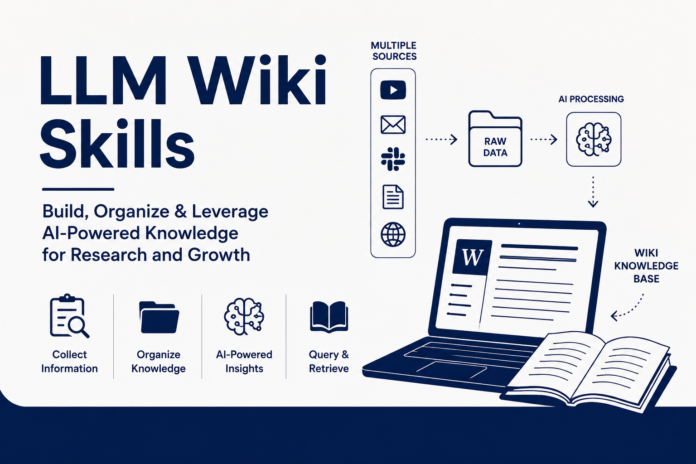
Popularized through concepts discussed by AI researcher Andrej Karpathy, the LLM Wiki represents a new way of thinking about knowledge management in the age of artificial intelligence. Rather than treating AI as a simple chatbot, it encourages us to build systems that collect information, organize it, summarize it, and transform it into a structured knowledge base that can be searched, explored, and expanded over time.
At the center of this approach lies a new set of capabilities known as LLM Wiki Skills.
These are not programming skills.
They are not prompt engineering tricks.
They are the practical skills needed to build, manage, and benefit from AI-powered knowledge systems.
As artificial intelligence becomes deeply integrated into work, research, education, and business, these skills may become as important as digital literacy itself.
What Is an LLM Wiki?
Imagine having a personal research assistant that never forgets anything.
Every article you read.
Every video you watch.
Every meeting note you create.
Every report you download.
Every insight you discover.
Instead of disappearing into folders, bookmarks, browser tabs, or forgotten documents, all of that information becomes part of a structured knowledge system.
The raw information is collected first.
Then artificial intelligence organizes it.
Important concepts are extracted.
Connections are identified.
Summaries are generated.
Topics are grouped together.
Finally, the information becomes part of a searchable wiki that continuously grows over time.
This is the essence of an LLM Wiki.
Rather than repeatedly searching the internet, you begin searching your own knowledge base.
Instead of consuming information passively, you actively build an intelligence system around your interests and goals.
Why LLM Wiki Skills Matter
Artificial intelligence is changing how people work.
However, many professionals still use AI only for simple tasks such as writing emails, summarizing text, or generating ideas.
While these use cases are valuable, they represent only a small fraction of AI’s potential.
The real opportunity lies in creating systems that help individuals and organizations accumulate knowledge over time.
This shift creates demand for a completely new skill set.
The people who understand how to build, organize, and maintain AI-powered knowledge systems will have a significant advantage in research, decision-making, learning, and innovation.
These capabilities form the foundation of LLM Wiki Skills.
Skill 1: Information Collection
Every knowledge system begins with inputs.
Before intelligence can emerge, information must first be captured.
One of the most important LLM Wiki Skills is developing the ability to identify valuable sources of information.
These sources may include:
- Research papers
- Industry reports
- YouTube videos
- Podcasts
- News articles
- Meeting notes
- Internal documents
- Customer feedback
- Emails
- Team discussions
The goal is not to collect everything.
The goal is to collect information that aligns with your objectives.
A product manager may focus on customer insights and market trends.
A founder may track competitors and industry developments.
A researcher may monitor academic publications.
A student may organize learning materials.
The quality of the knowledge system depends heavily on the quality of the information entering it.
Skill 2: Knowledge Organization
Collecting information is only the beginning.
Without organization, information becomes digital clutter.
This is where the second skill becomes critical.
Knowledge organization involves structuring information in ways that make it useful later.
Traditional folders often fail because information exists across multiple topics simultaneously.
A single article may relate to AI, product management, marketing, leadership, and business strategy.
Modern knowledge systems focus on relationships rather than rigid hierarchies.
Instead of asking where information belongs, they focus on how information connects.
Artificial intelligence helps identify these connections automatically.
As a result, users can discover patterns that would otherwise remain hidden.
Skill 3: Knowledge Synthesis
One of the most powerful capabilities of modern AI is synthesis.
Humans often struggle to process hundreds of documents efficiently.
Large language models excel at finding themes across large amounts of information.
Knowledge synthesis involves transforming raw information into meaningful understanding.
For example:
Ten research papers become a summary.
One hundred customer reviews become a list of common complaints.
Dozens of industry reports become a market analysis.
Hundreds of meeting notes become organizational insights.
This skill allows professionals to move from information overload to clarity.
Rather than drowning in data, they gain understanding.
Skill 4: Context Building
Context is one of the most valuable assets in artificial intelligence.
Large language models produce significantly better results when they have access to relevant background information.
An LLM Wiki becomes a source of context.
Instead of relying solely on information from the internet, AI can reference your documents, research, notes, and observations.
This creates highly personalized intelligence.
The AI begins understanding your goals, interests, projects, and areas of expertise.
As the knowledge base grows, the quality of AI responses improves.
Context becomes a competitive advantage.
Skill 5: Asking Better Questions
Many people assume AI is primarily about answers.
In reality, successful AI users become experts at asking questions.
An LLM Wiki transforms how questions are asked.
Instead of asking generic questions to a public model, users can ask questions based on their own knowledge base.
Examples include:
- What trends are emerging across the last six months of industry reports?
- Which competitors are gaining momentum based on collected data?
- What recurring themes appear in customer feedback?
- Which topics have I researched most frequently this year?
These questions generate insights that generic internet searches cannot provide.
Skill 6: Knowledge Retrieval
Information has little value if it cannot be found when needed.
Knowledge retrieval focuses on accessing the right information at the right moment.
Traditional search systems rely heavily on keywords.
Modern AI systems understand meaning.
This means users can search naturally.
Instead of remembering exact document names, they can ask questions conversationally.
The result feels less like searching files and more like having a conversation with accumulated knowledge.
Skill 7: Continuous Learning Systems
One of the most exciting aspects of the LLM Wiki concept is its ability to evolve.
Unlike static documentation, an AI-powered wiki can continuously grow.
New information enters the system.
Existing knowledge is updated.
Summaries improve.
Relationships expand.
Over time, the wiki becomes increasingly valuable.
It transforms from a collection of notes into a living intelligence system.
Professionals who build these systems gain a powerful learning advantage.
The LLM Wiki Skills Framework
| Skill | Purpose | Business Value |
|---|---|---|
| Information Collection | Capture relevant data | Better awareness |
| Knowledge Organization | Structure information | Faster access |
| Knowledge Synthesis | Extract insights | Improved decisions |
| Context Building | Improve AI understanding | More accurate outputs |
| Question Design | Discover hidden insights | Better research |
| Knowledge Retrieval | Access information efficiently | Increased productivity |
| Continuous Learning | Build evolving systems | Long-term advantage |
Who Should Learn LLM Wiki Skills?
The answer is surprisingly broad.
These skills are useful for:
- Students
- Researchers
- Product managers
- Entrepreneurs
- Consultants
- Marketers
- Business leaders
- Analysts
- Knowledge workers
- Working professionals
Anyone whose job involves thinking, learning, researching, analyzing, or making decisions can benefit.
As AI becomes more common, the difference between average performers and exceptional performers may depend largely on how effectively they manage knowledge.
The Future of LLM Wiki Skills
The next wave of artificial intelligence is not simply about smarter models.
It is about smarter knowledge systems.
Organizations are beginning to realize that their most valuable asset is not software.
It is knowledge.
The ability to capture it.
The ability to organize it.
The ability to retrieve it.
And the ability to transform it into action.
LLM Wiki Skills sit at the center of this transformation.
They represent the bridge between information and intelligence.
Between data and understanding.
Between learning and action.
Conclusion
Artificial intelligence is often described as the technology that will define the next decade.
However, technology alone is not enough.
The real advantage comes from knowing how to work with it effectively.
LLM Wiki Skills provide a framework for doing exactly that.
They help individuals move beyond simple AI conversations and toward building intelligent knowledge systems that grow stronger over time.
In a world where information is abundant but attention is limited, the ability to organize, synthesize, and retrieve knowledge may become one of the most valuable professional skills of the AI era.
The future will not belong to those who consume the most information.
It will belong to those who can transform information into understanding, and understanding into action.
15 FAQs About LLM Wiki Skills and Andrew Karpathy’s AI Knowledge Framework
1. What are LLM Wiki Skills?
LLM Wiki Skills are the abilities needed to collect, organize, synthesize, and retrieve information using large language models (LLMs). These skills help individuals build AI-powered knowledge systems that turn scattered information into structured, searchable insights.
2. What is Andrej Karpathy’s LLM Wiki concept?
Andrej Karpathy’s LLM Wiki concept is a framework for transforming raw information into a curated knowledge base that AI can understand and query. It involves collecting data from multiple sources, organizing it into structured folders, summarizing it with AI, and creating a searchable “wiki” for research and learning.
3. How is an LLM Wiki different from a normal wiki?
A traditional wiki is manually created and maintained by humans. An LLM Wiki, on the other hand, uses AI to automatically ingest, summarize, organize, and update information from various sources, making it dynamic, intelligent, and continuously evolving.
4. Why are LLM Wiki Skills important in 2026?
As AI becomes deeply integrated into work and learning, the ability to manage and structure knowledge effectively will become a major competitive advantage. LLM Wiki Skills help professionals save time, improve research quality, and make better decisions using AI-powered systems.
5. What are the core components of an LLM Wiki system?
An LLM Wiki system typically includes:
- Raw folder: Stores unprocessed information from sources like YouTube, emails, Slack, and documents.
- Wiki folder: Contains AI-generated summaries, curated articles, and structured knowledge pages.
- Index and logs: Track relationships, updates, and changes in the knowledge base.
- AI querying layer: Allows users to ask questions and retrieve insights from the wiki.
6. How does AI transform raw data into a wiki?
AI analyzes the raw information, extracts key insights, identifies themes and relationships, generates summaries, and organizes the content into structured pages. This process turns unstructured data into a curated knowledge repository that is easier to search and understand.
7. What types of data sources can be used in an LLM Wiki?
An LLM Wiki can integrate information from many sources, including:
- YouTube videos
- Gmail and emails
- Slack conversations
- Meeting notes
- Research papers
- News articles
- CRM systems
- Internal company documents
8. What skills are most important for building an LLM Wiki?
The most important skills include:
- Information collection
- Knowledge organization
- AI-assisted summarization
- Context engineering
- Knowledge retrieval
- Workflow automation
- Critical thinking and verification
9. How does context engineering improve AI outputs?
Context engineering involves giving AI relevant background information, documents, and structured knowledge before asking questions. The more context the AI has, the more accurate, personalized, and useful its responses become.
10. Can non-technical professionals use LLM Wiki systems?
Yes. Modern AI tools and no-code platforms make it possible for marketers, managers, students, researchers, and business leaders to build and use LLM Wiki systems without advanced programming knowledge.
11. What role does automation play in an LLM Wiki?
Automation allows the system to continuously collect new information, update the knowledge base, generate summaries, and maintain the wiki on a schedule. This creates a “living” knowledge system that stays current without constant manual effort.
12. How can an LLM Wiki improve research and learning?
An LLM Wiki centralizes information, reduces information overload, and enables users to quickly retrieve insights across large volumes of content. It helps researchers and learners connect ideas, identify patterns, and build deeper understanding more efficiently.
13. What tools are commonly used with LLM Wiki workflows?
Common tools include:
- Obsidian for knowledge management
- Claude, ChatGPT, or Gemini for AI processing
- Git/GitHub for version tracking
- Automation tools and schedulers
- MCP servers and APIs for data integration
14. What are the biggest challenges when building an LLM Wiki?
Some common challenges include:
- Managing large volumes of data
- Ensuring information accuracy
- Avoiding duplicate or low-quality content
- Designing a clear folder and indexing structure
- Keeping the system updated and organized over time
15. What is the future of LLM Wiki Skills?
LLM Wiki Skills are likely to become foundational skills for knowledge workers. As AI agents and personalized AI assistants evolve, people who can build and manage AI-powered knowledge systems will have a major advantage in productivity, research, leadership, and decision-making.

