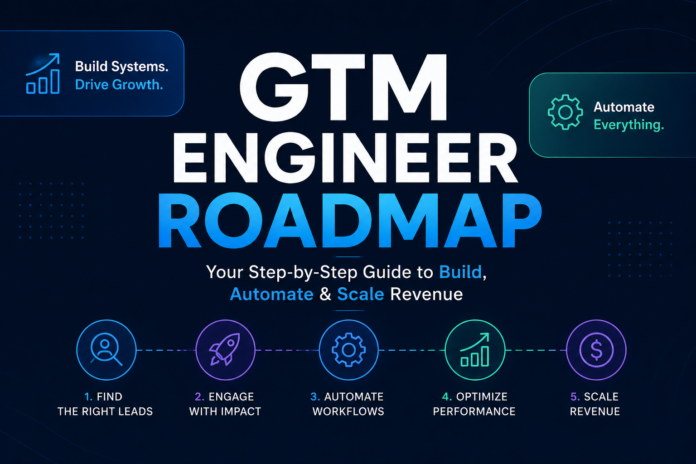
The way companies build revenue is changing rapidly.
For years, businesses followed a simple formula. Hire more sales development representatives, increase outbound activity, buy more software, and expect pipeline growth to follow. That approach worked when buyers were easier to reach and competition was lower.
Today, the reality looks very different.
Decision makers receive hundreds of sales messages every week. Marketing teams operate across dozens of platforms. Customer data is scattered across CRMs, automation tools, analytics platforms, advertising channels, and communication systems. Even companies with large sales teams often struggle to create a predictable revenue engine.
This shift has created demand for a completely new role.
Enter the GTM Engineer.
Over the last two years, GTM Engineers have become one of the fastest-growing roles across SaaS, B2B technology, and AI-driven startups. Instead of manually executing sales and marketing tasks, GTM Engineers build the systems, automations, and workflows that power revenue generation at scale.
They sit at the intersection of sales, marketing, operations, data, automation, and artificial intelligence.
If you are considering a career in GTM Engineering or want to understand why companies are hiring GTM Engineers at record pace, this roadmap will walk you through everything you need to know.
What Is a GTM Engineer?
A GTM Engineer, short for Go-To-Market Engineer, is responsible for designing, building, automating, and optimizing the systems that help companies acquire customers and generate revenue.
Think of a GTM Engineer as the architect behind a company’s growth engine.
While sales representatives focus on conversations and closing deals, GTM Engineers focus on creating the infrastructure that consistently generates those opportunities.
Their responsibilities often include:
- Building outbound prospecting systems
- Automating lead enrichment
- Connecting sales and marketing tools
- Managing CRM workflows
- Creating AI-powered outreach processes
- Improving funnel conversion rates
- Building reporting dashboards
- Optimizing customer acquisition systems
The role combines strategic thinking with technical execution.
A GTM Engineer needs to understand how businesses grow while also knowing how to build systems that make growth repeatable.
Why GTM Engineers Are Becoming Essential in 2026
Modern companies face three major challenges.
Challenge 1: Tool Overload
The average B2B company uses dozens of software products across sales, marketing, customer success, and operations.
Common tools include:
| Category | Popular Tools |
|---|---|
| CRM | HubSpot, Salesforce |
| Outreach | Instantly, Smartlead |
| Automation | Zapier, Make, n8n |
| Data Enrichment | Clay, Apollo, FullEnrich |
| Analytics | Looker, GA4, Tableau |
| Advertising | Google Ads, Meta Ads |
Most companies buy these tools but never fully integrate them.
As a result, valuable customer information remains trapped inside separate systems.
A GTM Engineer solves this problem by connecting the entire technology stack.
Challenge 2: Personalization at Scale
Modern buyers expect relevant communication.
Generic outreach campaigns no longer produce meaningful results.
Manually researching hundreds of prospects every week is impossible for most sales teams.
GTM Engineers solve this challenge through automation and AI.
For example, they can create workflows that:
- Identify ideal customers
- Gather company information
- Find recent company news
- Generate personalized messaging
- Launch outreach automatically
This allows businesses to deliver personalization without dramatically increasing headcount.
Challenge 3: Revenue Efficiency
Companies are under increasing pressure to generate more revenue without continuously expanding teams.
Hiring additional SDRs, marketers, and operations specialists can become expensive.
A skilled GTM Engineer can often create systems that allow one sales representative to perform the work previously handled by multiple people.
That efficiency is one of the biggest reasons GTM Engineering has become such a valuable career path.
What Does a GTM Engineer Actually Do?
Although responsibilities vary by company, most GTM Engineers focus on four core areas.
1. Revenue System Design
Every growth initiative starts with process design.
A GTM Engineer maps the entire customer acquisition journey.
This includes:
- Lead generation
- Lead qualification
- Outreach
- Meeting booking
- Opportunity creation
- Customer onboarding
Their goal is to remove friction throughout the funnel.
2. Workflow Automation
Automation sits at the center of modern GTM Engineering.
Common automations include:
- Automatically assigning leads
- Sending personalized emails
- Updating CRM records
- Triggering follow-up sequences
- Routing prospects to sales teams
- Creating alerts for buying signals
Tools like Zapier, Make, and n8n are commonly used to build these workflows.
3. Data Management
Revenue teams depend on accurate information.
GTM Engineers ensure customer data remains clean, organized, and actionable.
This includes:
- Lead enrichment
- Duplicate removal
- Contact validation
- CRM maintenance
- Reporting infrastructure
Without clean data, even the best sales process eventually breaks down.
4. Performance Optimization
The job does not stop once systems are built.
GTM Engineers constantly analyze metrics such as:
- Lead conversion rates
- Meeting booking rates
- Pipeline creation
- Customer acquisition cost
- Revenue generated
Based on the data, they make adjustments that improve overall performance.
GTM Engineer Skills You Need to Master
The GTM Engineer role sits at the intersection of sales, marketing, operations, automation, AI, and data. Unlike traditional sales or marketing roles that focus on a single function, GTM Engineers are responsible for building systems that generate, qualify, route, and convert opportunities automatically.
To become a successful GTM Engineer in 2026, you need a combination of business understanding, technical knowledge, automation skills, and AI expertise.
Core Skills Required for GTM Engineers
| Skill Area | Why It Matters |
|---|---|
| Sales Fundamentals | Understanding how B2B sales works |
| Customer Journey Mapping | Designing revenue workflows |
| CRM Management | Managing lead and customer data |
| Data Enrichment | Improving prospect quality |
| Automation | Eliminating manual tasks |
| AI Workflow Building | Scaling personalization |
| Prospect Research | Identifying ideal customers |
| Cold Outreach | Creating effective campaigns |
| Analytics | Measuring funnel performance |
| Revenue Operations | Connecting sales and marketing systems |
Sales Fundamentals Every GTM Engineer Must Learn
Before building automations, you must understand how revenue is generated.
Many beginners immediately start learning Clay, Zapier, and AI tools without understanding how a sales process actually works. This creates workflows that look impressive but fail to generate results.
A GTM Engineer should understand how a prospect moves from awareness to purchase.
Key Sales Concepts
Lead Qualification
Lead qualification is the process of determining whether a prospect is likely to become a customer.
A qualified lead usually has:
- A business problem
- Budget
- Decision-making authority
- Need for the solution
- Reason to buy now
Without qualification, sales teams waste time on prospects who will never purchase.
ICP Development
ICP stands for Ideal Customer Profile.
An ICP defines the type of company most likely to buy your product.
Example:
| Attribute | Example |
|---|---|
| Industry | SaaS |
| Company Size | 50–500 employees |
| Revenue | $5M–$50M |
| Geography | United States |
| Tech Stack | HubSpot + Salesforce |
A GTM Engineer uses ICP data to build targeting systems.
Sales Funnel Understanding
A typical B2B sales funnel includes:
- Awareness
- Interest
- Lead Generation
- Qualification
- Sales Meeting
- Proposal
- Negotiation
- Closed Deal
Understanding this funnel helps GTM Engineers identify bottlenecks and automate specific stages.
Understanding Customer Journey Mapping
Customer journey mapping is one of the most overlooked GTM Engineer skills.
A customer journey is the complete path a buyer takes before purchasing.
Most companies focus only on lead generation, but GTM Engineers optimize the entire journey.
Customer Journey Stages
| Stage | Buyer Action |
|---|---|
| Awareness | Learns about the company |
| Interest | Consumes content |
| Consideration | Compares options |
| Intent | Requests demo |
| Purchase | Becomes customer |
| Adoption | Starts using product |
| Expansion | Upgrades account |
For example:
A prospect discovers your LinkedIn post.
↓
Downloads a guide.
↓
Joins an email sequence.
↓
Books a demo.
↓
Signs up.
↓
Becomes a paying customer.
A GTM Engineer designs systems that move prospects smoothly through every stage.
GTM Engineer Roadmap: Step-by-Step Learning Path
Phase 1: Learn Sales and Revenue Fundamentals
Duration: 2–4 Weeks
Before touching any tools, understand:
- B2B sales process
- Sales funnels
- Customer journeys
- Pipeline management
- Lead qualification
- ICP creation
- Revenue metrics
Learn Metrics Like
- MQL
- SQL
- Conversion Rate
- CAC
- LTV
- Pipeline Value
- Win Rate
These metrics drive every GTM decision.
Phase 2: Master CRM Systems
Duration: 2–3 Weeks
CRMs are the backbone of every GTM operation.
The most common CRMs are:
- HubSpot
- Salesforce
- Pipedrive
What To Learn
- Contact management
- Lead scoring
- Deal pipelines
- Workflow automation
- Reporting dashboards
A GTM Engineer should know how data flows through a CRM from first touch to closed deal.
Phase 3: Learn Data Enrichment
Duration: 3–4 Weeks
Data enrichment means adding valuable information to prospect records.
Imagine you only have:
- Name
Enrichment tools can add:
- Job title
- Company size
- Revenue
- LinkedIn profile
- Funding information
- Technology stack
This makes outreach significantly more effective.
Top Data Enrichment Tools
Clay
Clay has become one of the most popular GTM tools.
It combines:
- Data providers
- AI workflows
- Lead research
- Prospect enrichment
Many GTM Engineers use Clay as their operating system.
Apollo
Apollo provides:
- Prospect database
- Email addresses
- Outreach functionality
- Company insights
It is widely used for prospecting.
FullEnrich
FullEnrich specializes in finding missing contact data and improving lead quality.
LinkedIn Sales Navigator
Sales Navigator helps GTM Engineers identify decision-makers and discover high-value accounts.
It is often considered one of the most important prospecting tools.
Phase 4: Learn Automation Systems
Duration: 4–6 Weeks
Automation is where GTM Engineers begin creating leverage.
Instead of manually moving data between tools, automation platforms do it automatically.
What Is Automation?
Automation connects different software tools together.
Example:
Lead fills form
↓
CRM updated
↓
Lead enriched
↓
Email sequence triggered
↓
Sales rep notified
All without human involvement.
Zapier
Zapier is one of the easiest automation tools.
Popular use cases:
- Form to CRM
- CRM to Slack
- Email notifications
- Calendar automation
Ideal for beginners.
Make
Make allows more advanced workflows.
Compared to Zapier, Make offers:
- Visual workflow building
- Better branching logic
- More customization
- Lower cost at scale
Many GTM Engineers eventually migrate to Make.
n8n
n8n has become increasingly popular among GTM Engineers.
Benefits include:
- Open source
- Self-hosted options
- Advanced automation
- AI integrations
For companies building sophisticated GTM systems, n8n is becoming a preferred choice.
Phase 5: Learn AI-Powered GTM Systems
Duration: 4–8 Weeks
AI is rapidly transforming GTM Engineering.
The role itself may not have existed without AI becoming mainstream.
Modern GTM Engineers use AI to:
- Research prospects
- Personalize emails
- Generate messaging
- Score leads
- Analyze accounts
- Automate follow-ups
AI Prospect Research
Instead of manually researching companies, AI agents can analyze:
- Websites
- LinkedIn profiles
- Funding announcements
- Job postings
- News articles
and produce account insights automatically.
AI Email Personalization
Traditional outreach often sounds generic.
AI enables personalization at scale.
For example, an AI system can:
- Read company website
- Analyze LinkedIn profiles
- Identify pain points
- Write custom opening lines
for hundreds of prospects simultaneously.
AI Lead Qualification
AI systems can analyze:
- Website activity
- CRM behavior
- Email engagement
to determine which prospects deserve sales attention.
Phase 6: Learn Prospect Research
Prospect research remains one of the highest-value GTM skills.
The goal is finding companies that closely match your ICP.
Research Sources
- Crunchbase
- Apollo
- Clay
- Company websites
- Industry reports
A GTM Engineer builds systems that automate this research process.
Phase 7: Build Outbound Systems
Now it is time to combine everything.
A complete GTM workflow might look like:
- Identify ICP
- Find prospects
- Enrich data
- Personalize messaging
- Send outreach
- Track engagement
- Route responses
- Schedule meetings
This is where GTM Engineers create the biggest business impact.
GTM Engineer Salary in India
Because the role is still emerging, compensation varies significantly.
GTM Engineer Salary in India
| Experience | Salary Range |
|---|---|
| Entry Level | ₹8–15 LPA |
| Junior | ₹15–25 LPA |
| Mid-Level | ₹25–40 LPA |
| Senior | ₹40–65 LPA |
| Lead GTM Engineer | ₹65 LPA–₹1 Cr+ |
Companies paying the highest salaries typically include:
- SaaS startups
- AI startups
- Revenue technology companies
- Global B2B software firms
GTM Engineer Salary Globally
| Experience | Annual Salary (USD) |
|---|---|
| Entry Level | $70,000–$100,000 |
| Mid-Level | $100,000–$150,000 |
| Senior | $150,000–$220,000 |
| Lead | $220,000–$300,000+ |
In major technology markets such as the United States, GTM Engineers are increasingly being compensated similarly to Growth Engineers and Revenue Operations professionals because of their direct impact on revenue generation.
AI-focused SaaS companies often pay at the higher end of these ranges.
GTM Engineer Salary Globally
| Experience Level | Annual Salary (USD) |
| Junior | $70,000 – $90,000 |
| Mid-Level | $120,000 – $180,000 |
| Senior | $200,000 – $250,000+ |
| GTM Leadership | $250,000 – $400,000+ |
Remote-first startups and AI companies frequently offer compensation packages that include equity in addition to salary.
Final Thoughts
The GTM Engineer role represents a major shift in how modern businesses approach growth.
Companies no longer need larger teams to generate more revenue. They need better systems.
The professionals who understand automation, AI, data, sales, and marketing simultaneously will be among the most valuable talent in the market over the next decade.
For anyone entering SaaS, revenue operations, growth marketing, or sales technology, GTM Engineering offers one of the strongest career opportunities available today.
The future belongs to people who can build revenue systems, not just operate inside them.
FAQs: GTM Engineer Roadmap
1. What is a GTM Engineer?
A GTM Engineer, or Go-To-Market Engineer, is a professional who combines sales, marketing, automation, data, and AI tools to build scalable revenue systems. Their goal is to automate lead generation, prospect qualification, outreach, and funnel operations so companies can grow faster without significantly increasing headcount.
2. What does a GTM Engineer do on a daily basis?
A GTM Engineer typically builds workflows, enriches prospect data, manages CRM systems, automates outreach campaigns, integrates sales tools, analyzes funnel performance, and continuously improves revenue-generating processes using AI and automation.
3. How do I become a GTM Engineer in 2026?
Start by learning sales fundamentals, customer journey mapping, CRM platforms, data enrichment tools, automation software, and AI-powered workflows. After building foundational knowledge, create real-world projects that automate lead generation and sales processes.
4. Is GTM Engineering a good career in 2026?
Yes. GTM Engineering is one of the fastest-growing roles in SaaS, AI, and B2B technology companies because businesses increasingly rely on automation, data, and AI to drive revenue growth efficiently.
5. What skills are required to become a GTM Engineer?
Key skills include sales operations, CRM management, automation workflows, data enrichment, AI tools, prospect research, revenue operations, analytics, outbound marketing, and workflow design.
6. What is the difference between a GTM Engineer and a Sales Development Representative (SDR)?
An SDR focuses on prospecting and booking meetings manually, while a GTM Engineer builds automated systems that enable SDRs to operate at a much larger scale with greater efficiency.
7. What is the difference between a GTM Engineer and a Growth Engineer?
A GTM Engineer primarily focuses on revenue generation, sales processes, lead qualification, and outbound systems. A Growth Engineer often works across acquisition, activation, retention, and product-led growth initiatives.
8. Does GTM Engineering require coding?
Not necessarily. Most GTM Engineers use low-code or no-code platforms such as Clay, Zapier, Make, HubSpot, and n8n. However, basic scripting knowledge can provide a significant advantage.
9. Which tools should a beginner GTM Engineer learn first?
Beginners should focus on HubSpot, Salesforce, Clay, Apollo, LinkedIn Sales Navigator, Zapier, Make, and AI tools such as ChatGPT and Claude.
10. How long does it take to become a GTM Engineer?
With consistent learning and practical projects, most professionals can build job-ready GTM Engineering skills within six to twelve months.
11. What is data enrichment in GTM Engineering?
Data enrichment is the process of enhancing lead records with additional information such as job titles, company size, revenue, technology stack, LinkedIn profiles, and funding data to improve targeting and personalization.
12. What role does AI play in GTM Engineering?
AI helps automate prospect research, personalize outreach, score leads, generate messaging, analyze customer data, and improve sales efficiency at scale.
13. Can marketers transition into GTM Engineering?
Yes. Many marketers already understand customer journeys, campaigns, and lead generation, making the transition into GTM Engineering relatively smooth after learning automation and CRM systems.
14. Can sales professionals become GTM Engineers?
Absolutely. Sales professionals often possess deep knowledge of customer behavior and sales processes, which gives them a strong foundation for learning automation and GTM technologies.
15. What is the average GTM Engineer salary in India?
Depending on experience, GTM Engineers in India can earn anywhere between ₹8 LPA and ₹1 crore+ annually, with senior professionals in SaaS and AI startups commanding the highest salaries.
16. What is the average GTM Engineer salary globally?
Globally, GTM Engineers typically earn between $70,000 and $300,000+ annually, depending on experience, location, industry, and company size.
17. Which industries hire GTM Engineers?
SaaS companies, AI startups, fintech firms, cybersecurity companies, cloud software businesses, and B2B technology organizations are currently among the largest employers of GTM Engineers.
18. What are some GTM Engineer interview questions?
Common interview questions include designing automated lead generation workflows, CRM optimization strategies, AI implementation in sales operations, data enrichment processes, and outbound campaign automation.
19. Will AI replace GTM Engineers?
AI is more likely to increase demand for GTM Engineers rather than replace them. Businesses still need professionals who can design, manage, optimize, and scale AI-driven revenue systems.
20. What is the future of GTM Engineering between 2026 and 2030?
The role is expected to become a core function in modern revenue teams. As AI agents, automation platforms, and revenue operations evolve, GTM Engineers will likely become one of the most valuable growth-focused roles in technology companies.

