AI agents are no longer just a concept. They are becoming the backbone of modern software systems. From autonomous workflows to intelligent copilots, AI agents are reshaping how applications are built, deployed, and scaled.
But here is the truth most people miss.
Learning AI agents is not just about tools like LangChain or AutoGen. It is about understanding systems, workflows, engineering discipline, and real-world deployment.
And the fastest way to build that foundation is through the right books.
This guide covers the top 20 AI agent books you should read, what each one teaches, and how they help you move from beginner to real-world AI builder.
Along the way, we will also align insights from practical learning paths, including programming, machine learning, and AI engineering, as emphasized in your provided transcript.
Before You Start: What You Actually Need to Learn AI Agents
Before jumping into books, understand this:
AI agents sit at the intersection of multiple disciplines.
From your transcript, the learning path is clear:
- Programming and software engineering
- Machine learning fundamentals
- Deep learning and LLMs
- AI engineering and deployment
And most importantly:
You learn by building, not just reading.
So treat these books as tools, not theory.
Category 1: Core AI Agent Books (Must Read)
1. Building Applications with AI Agents (O’Reilly, 2025)
This is one of the most relevant modern books for AI agents.
What it covers:
- Retrieval-Augmented Generation (RAG)
- Agent workflows
- Tool usage
- Multi-step reasoning systems
- Frameworks like LangGraph and AutoGen
What you will learn:
- How agents think step by step
- How to design workflows instead of single prompts
- How to connect LLMs with external tools and APIs
Why it matters:
This book moves you from “prompting” to “system building.”
2. Designing Multi-Agent Systems – Victor Dibia
This book focuses on something most people ignore.
Not just building agents. Designing systems of agents.
What it teaches:
- First principles of agents
- Interaction between multiple agents
- UX and evaluation of AI systems
- Human-in-the-loop design
What you gain:
- System-level thinking
- Ability to design scalable AI architectures
3. AI Agents in Action – Michael Lamang (Manning)
This is a hands-on builder’s book.
What it focuses on:
- Real-world agent implementations
- Practical workflows
- Application-driven learning
What you will learn:
- How to build agents that actually work
- How to iterate and improve outputs
- How to debug agent behavior
4. Principles of Building AI Agents – Sam Bhagvat
This book simplifies complex ideas.
Key topics:
- Agent architecture
- Prompt design strategies
- Task decomposition
- Execution loops
Best for:
Beginners who want clarity before complexity.
5. Agentic Artificial Intelligence – Pascal Bornet
This book is more strategic.
It focuses on:
- Business impact of AI agents
- Automation and productivity
- Enterprise adoption
What you learn:
- Why agents matter beyond coding
- How they reshape workflows and organizations
6. Building AI Agents in .NET – Daniel Costea
This is for developers in the Microsoft ecosystem.
What it teaches:
- Agent development using .NET
- Integration with enterprise systems
- Backend-heavy workflows
Best for:
Developers working in enterprise environments.
Category 2: AI Engineering & Deployment (Critical Layer)
Your transcript strongly emphasizes this:
Knowing AI is not enough. You must deploy it.
These books fill that gap.
7. AI Engineering – Chip Huyen
One of the most recommended books today.
What it covers:
- Deploying AI systems
- Scaling models
- Production pipelines
- Monitoring and evaluation
What you learn:
- How to move from prototype to production
- Real-world AI system design
8. Practical MLOps – Noah Gift
This is foundational.
Topics include:
- Docker and containerization
- Cloud deployment
- CI/CD pipelines for ML
Why it matters:
Agents are useless if they cannot be deployed.
9. Designing Machine Learning Systems – Chip Huyen
This complements AI Engineering.
Focus:
- System design for ML applications
- Trade-offs in production systems
- Reliability and scaling
10. Machine Learning Engineering – Andriy Burkov
This book connects theory to production.
You learn:
- How ML systems are built in companies
- Engineering workflows
- Model lifecycle management
Category 3: LLM & Deep Learning Foundations
Agents rely heavily on LLMs.
To truly understand them, you need this layer.
11. Hands-On Large Language Models – Jay Alammar
This is one of the most intuitive books available.
What it teaches:
- Transformers explained visually
- LLM architecture
- Prompt engineering fundamentals
Why it stands out:
Simple explanations of complex systems.
12. Deep Learning Specialization – Andrew Ng (Book + Course Combo)
Core topics:
- Neural networks
- CNNs, RNNs
- Optimization techniques
Your transcript highlights this as essential for understanding modern AI.
13. Neural Networks from Scratch – Andrej Karpathy Inspired Learning
Not a traditional book but critical learning material.
What you learn:
- Build neural networks from scratch
- Understand how GPT works internally
14. Hands-On Machine Learning with Scikit-Learn, TensorFlow, and Keras
One of the most recommended AI books ever.
What it covers:
- ML fundamentals
- Deep learning basics
- Practical coding examples
From your transcript:
This is considered one of the most complete AI books available.
Category 4: Machine Learning Fundamentals
Agents depend on ML understanding.
15. The Hundred-Page Machine Learning Book – Andriy Burkov
Short but powerful.
What it gives:
- High-level overview of ML concepts
- Quick reference guide
16. Elements of Statistical Learning
This is more advanced.
Focus:
- Deep mathematical understanding
- Statistical modeling
Best for:
Serious learners who want depth.
17. Practical Statistics for Data Science
From your transcript, this is one of the best books for applied statistics.
What you learn:
- Real-world data analysis
- Statistical thinking for AI
18. Mathematics for Machine Learning
Covers:
- Linear algebra
- Calculus
- Optimization
Essential for:
Understanding model behavior.
Category 5: Programming & System Thinking
Agents are software systems.
So programming matters.
19. Clean Code – Robert C. Martin
Why it matters:
Agents interact with codebases.
This book teaches:
- Writing maintainable code
- Structuring logic cleanly
20. Designing Data-Intensive Applications – Martin Kleppmann
One of the most important system design books.
What it covers:
- Databases
- Distributed systems
- Scalability
Why it matters:
AI agents operate inside large systems.
How to Actually Use These Books
Reading is not enough.
Your transcript makes this very clear:
Practice is the real teacher.
Here is the correct approach:
Step 1: Start with one core book
Example:
- Building Applications with AI Agents
Step 2: Build small projects
- Simple chatbot agent
- Data retrieval system
- Automation scripts
Step 3: Add engineering knowledge
- Learn deployment
- Learn APIs
- Learn workflows
Step 4: Expand into systems
- Multi-agent architecture
- Scalable design
- Production-ready pipelines
Common Mistake Most People Make
They try to learn everything at once.
Instead:
- Pick one book
- Build one project
- Learn one concept
- Repeat
As your transcript emphasizes:
Do not learn everything breadth-wise. Learn depth-wise through projects.
Final Thoughts
AI agents are not just a trend.
They represent a shift from:
- Static software → dynamic systems
- Single prompts → autonomous workflows
- Tools → intelligent systems
And the people who win in this space will not just be prompt engineers.
They will be:
- system thinkers
- builders
- engineers
These books give you that path.
But only if you use them correctly.
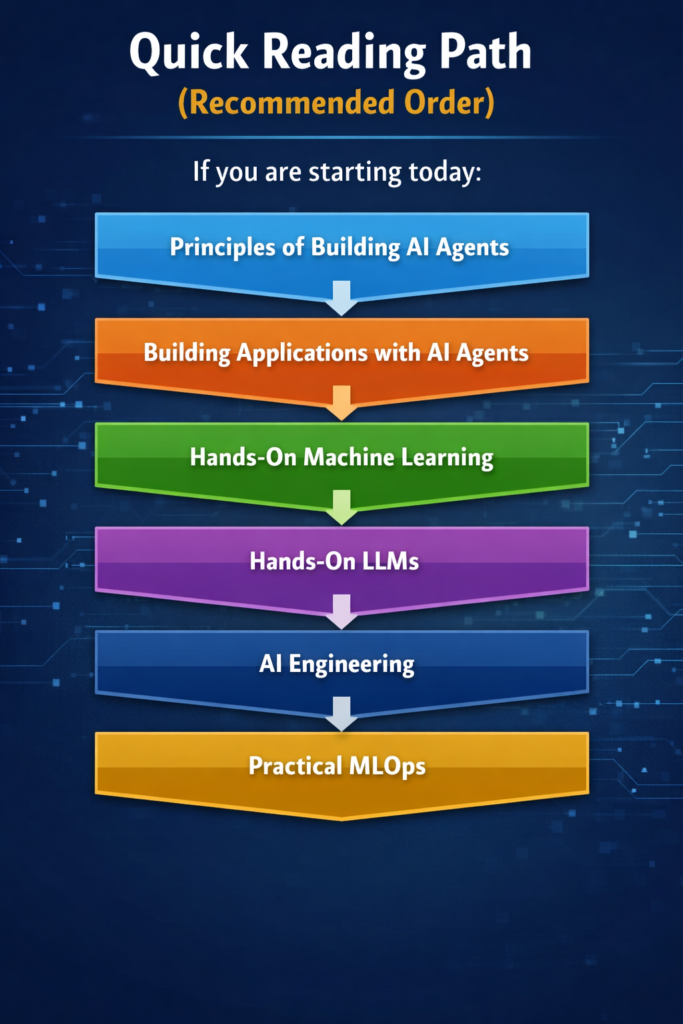
Quick Reading Path (Recommended Order)
If you are starting today:
- Principles of Building AI Agents
- Building Applications with AI Agents
- Hands-On Machine Learning
- Hands-On LLMs
- AI Engineering
- Practical MLOps
Then expand based on your goals.
🔗 Important Documentation & Learning Resources for AI Agents
🧠 Core AI Agent Frameworks & Documentation
- LangChain
https://docs.langchain.com
Full documentation for building AI agents, tools, memory systems, and RAG pipelines.
- LangGraph
https://docs.langchain.com/langgraph
Advanced framework for building multi-step, stateful AI agents.
- AutoGen
https://microsoft.github.io/autogen/
Official docs for building multi-agent systems with collaborative agents.
- CrewAI
https://docs.crewai.com
Clean and practical framework for building role-based AI agents.
- Semantic Kernel
https://learn.microsoft.com/semantic-kernel
Production-grade AI orchestration toolkit for enterprise applications.
🤖 Model Providers & AI Agent Capabilities
- OpenAI
https://platform.openai.com/docs
Official API docs covering function calling, tools, and agent-like workflows.
- Anthropic
https://docs.anthropic.com
Claude documentation including tool use, structured outputs, and agent design.
- Google DeepMind
https://ai.google.dev
Gemini API docs and agent-related workflows.
- Hugging Face
https://huggingface.co/docs
Extensive documentation on models, inference, agents, and transformers.
🧪 Research Papers & Technical Foundations
- arXiv
https://arxiv.org
Search for “AI agents”, “LLM agents”, “multi-agent systems” for cutting-edge research.
- Stanford HAI
https://hai.stanford.edu/research
Deep research insights on AI systems and agent behavior.
- DeepLearning.AI
https://www.deeplearning.ai/resources/
High-quality technical guides and resources on LLMs and AI systems.
⚙️ AI Engineering & System Design
- AWS
https://docs.aws.amazon.com/bedrock
Documentation for building AI applications using foundation models.
- Microsoft Azure
https://learn.microsoft.com/azure/ai-services
Enterprise-level AI deployment and agent-based workflows.
- Google Cloud
https://cloud.google.com/vertex-ai/docs
Vertex AI docs for building production AI systems.
🧩 RAG, Retrieval, and Data Systems
- LlamaIndex
https://docs.llamaindex.ai
Core framework for building retrieval-based AI agents.
- Weaviate
https://weaviate.io/developers/weaviate
Documentation for vector search and AI memory systems.
- Pinecone
https://docs.pinecone.io
Used for building scalable RAG and memory-based agents.
🧠 Advanced AI Concepts & Learning Paths
- Fast.ai
https://docs.fast.ai
Practical deep learning and AI system building.
- OpenAI Cookbook
https://github.com/openai/openai-cookbook
Real-world examples of AI workflows, tools, and agent-like systems.
🧭 How to Use These Resources (Important)
Do not try to read everything.
Instead:
- Start with LangChain or LlamaIndex
- Learn one agent workflow
- Use OpenAI or Claude docs to build
- Add vector databases like Pinecone
- Move into deployment using AWS or Azure
🧠 Final Insight
Books give you structured thinking.
But these documentations give you:
- real implementation
- real systems
- real workflows
If books teach you what,
these teach you how.
Frequently Asked Questions (AI Agent Books & Learning AI Agents)
Foundations
1. What are AI agents?
AI agents are systems powered by large language models that can take actions, make decisions, and execute multi-step tasks using tools, memory, and workflows.
2. How are AI agents different from chatbots?
Chatbots respond to prompts, while AI agents can:
- plan tasks
- use tools
- execute workflows
- operate autonomously
3. Do I need to know programming to build AI agents?
Yes, basic programming is important. Python is the best starting point, as it is widely used in AI development.
4. What programming language is best for AI agents?
Python is the most common, but backend languages like Java, Go, or Rust can also be useful in production systems.
5. Are AI agents only based on large language models?
Most modern agents use LLMs, but they also rely on:
- APIs
- databases
- tools
- external systems
Books & Learning
6. What is the best book to start learning AI agents?
A strong starting point is a book focused on agent workflows and real applications, such as “Building Applications with AI Agents.”
7. Do I need to read all 20 books listed?
No. Start with one or two books and apply what you learn through projects.
8. Which book is best for beginners?
Books that focus on principles and simplified explanations are best for beginners, such as “Principles of Building AI Agents.”
9. Which book focuses on real-world applications?
Books like “AI Agents in Action” focus on practical implementations and real use cases.
10. Are books enough to learn AI agents?
No. Books provide theory and structure, but practical implementation is essential.
AI Engineering & Systems
11. What is AI engineering?
AI engineering focuses on building, deploying, and maintaining AI systems in production environments.
12. Why is deployment important for AI agents?
Agents must operate in real systems to deliver value. Without deployment, they remain prototypes.
13. What is MLOps and why does it matter?
MLOps involves:
- deploying models
- monitoring performance
- managing pipelines
It is critical for production AI systems.
14. What is a multi-agent system?
A multi-agent system consists of multiple AI agents working together, each handling specific roles or tasks.
15. What is RAG in AI agents?
Retrieval-Augmented Generation combines LLMs with external data sources to improve accuracy and context.
Tools & Documentation
16. What is LangChain used for?
LangChain
LangChain helps build AI applications with tools, memory, and agent workflows.
17. What is AutoGen?
AutoGen
AutoGen enables building collaborative multi-agent systems.
18. What is LlamaIndex?
LlamaIndex
LlamaIndex helps connect LLMs to structured and unstructured data sources.
19. What is the OpenAI Cookbook?
OpenAI Cookbook
https://github.com/openai/openai-cookbook
A collection of real-world examples for building AI workflows.
20. Where can I find official AI documentation?
You can explore:
Learning Path
21. What is the best way to learn AI agents?
Follow this approach:
- learn fundamentals
- build small projects
- iterate and improve
22. Should I learn machine learning first?
Basic ML understanding helps, but you can start building AI agents alongside learning.
23. Do I need to understand deep learning?
Yes, at least at a high level, to understand how LLMs work.
24. What math is required for AI agents?
Key areas include:
- statistics
- linear algebra
- calculus
25. How long does it take to learn AI agents?
You can start building basic agents in weeks, but mastery takes months of practice.
Practical Application
26. What can I build with AI agents?
- automation tools
- chat assistants
- data analysis systems
- workflow automation platforms
27. Are AI agents used in real companies?
Yes. Companies use AI agents for:
- customer support
- internal automation
- data workflows
28. What is the biggest mistake beginners make?
Trying to learn everything at once instead of building small projects step by step.
29. How do I improve faster in AI agents?
- build projects
- read selectively
- practice consistently
- learn by doing
30. What is the future of AI agents?
AI agents are moving toward:
- autonomous systems
- multi-agent collaboration
- real-world business integration

