Most engineering roles let you pick a lane. Backend engineers build services. Solutions engineers demo products. Sales engineers answer technical questions. Forward Deployed Engineers, often shortened to FDEs, do all of it, often in the same afternoon, often inside a customer’s environment.
That is what makes the role unusual. An FDE is not a pure engineer and not a pure consultant. They are the person who lands at a customer site, builds a working solution inside a messy real-world system, and walks away having shipped something the customer can actually use. The role is most common at AI and enterprise software companies (think Palantir, Anduril, OpenAI, Anthropic, Scale AI, Databricks) where the gap between the product and the customer’s reality is large, and someone has to close it.
If you want to become an FDE, the skills you need are broader than almost any other engineering track. You need the technical depth of a senior engineer, the communication skills of a sales lead, the ownership of a founder, and enough product instinct to notice when a customer is asking for the wrong thing.
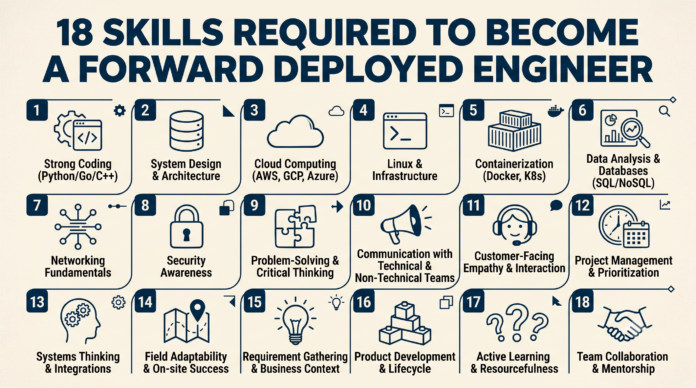
This guide breaks down the 18 skills that matter, why each one matters in practice, and how to build them on a realistic timeline.
What Is a Forward Deployed Engineer?
A Forward Deployed Engineer is a software engineer who is embedded with customers to build, customize, and deploy solutions that solve real business problems. Unlike a regular product engineer, who works on the core product from the home office, an FDE spends a significant amount of time on customer sites, in customer systems, and in customer meetings.
The role was pioneered by Palantir and has since been adopted by a wave of AI and enterprise software companies. The pattern is consistent: ship talented engineers into the field, give them deep customer context, and let them build the bridges between the product and the customer’s actual workflow.
The output of an FDE is rarely a feature in the core product. It is a working solution in the customer’s environment, a deployed integration, a data pipeline, a model in production, a tool that solves a real problem. The customer does not care that the code lives in a separate repo. They care that it works.
Why the FDE Role Is Different from a Regular Engineer
The difference comes down to three things: context, ownership, and time horizon.
Context. A regular engineer builds against a stable product spec. An FDE builds against a moving target defined by a real customer’s environment, with its legacy systems, dirty data, and competing priorities.
Ownership. A regular engineer ships to staging or production of the home product. An FDE ships to a customer’s environment, where a mistake can break a live business process.
Time horizon. A regular engineer can spend a sprint polishing a feature. An FDE often has a few weeks to deliver something usable, because the customer is paying for outcomes, not pull requests.
Those three shifts change the skill mix dramatically. The best FDEs are not necessarily the best coders in the company. They are the people who can read a room, frame a problem, build the right thing, and ship it before the customer loses patience.
The 18 Skills Required to Become a Forward Deployed Engineer
To make this readable, the 18 skills are grouped into four buckets: core engineering, systems and data, customer and communication, and AI and product. Each skill gets a short explanation, a real-world example, and a quick note on how to build it.
Bucket 1: Core Engineering Skills
These are the foundation. Without them, the rest does not work.
1. Programming fundamentals. Strong coding ability in at least one production language, usually Python, TypeScript, Java, or C++. FDEs write code that runs in customer environments, so the code has to be correct, readable, and maintainable by someone else after you leave.
A typical FDE might write a Python service that pulls data from a customer’s S3 bucket, transforms it, and pushes it into the customer’s existing data warehouse. The code does not have to be elegant. It has to work the day you leave and keep working six months later.
Build it by: writing real code on real problems. Open source contributions, side projects, and Kaggle competitions all count. Aim for fluency in one language, working knowledge of two more.
2. Data structures and algorithms. You need solid problem-solving skills for building efficient, correct solutions under pressure. FDEs do not grind LeetCode, but they do need to recognize when a problem calls for a hash map vs. a sorted set, when to use streaming vs. batch processing, and how to keep a slow pipeline from melting a customer’s database.
Build it by: reviewing the standard data structures once a year, and practicing by solving real customer-shaped problems in interviews with peers.
3. Debugging ability. When something breaks in a customer environment, you need to find the issue fast. Often the customer does not even know what their system looks like. You are reading logs, tracing requests, and forming hypotheses from scratch.
A typical FDE debugging session: a customer’s nightly batch job has been failing for three days. Their internal team cannot reproduce it. You dig into the logs, find a race condition between two of their services, write a quick fix, and ship a patch. The customer sees you as a magician. You are just methodical.
Build it by: deliberately seeking out hard debugging problems. Read open source bug threads. Volunteer for on-call rotations. The point is to build a calm, structured approach to chaos.
4. Problem framing. Great FDEs do not jump straight into coding. They first turn vague business pain into a solvable technical problem. A customer saying “we want AI” usually means “we want one specific report to take 80% less time to produce.” The first job is figuring out which problem to solve.
This is the skill that separates a strong FDE from a junior one. The junior FDE takes the request literally and builds the wrong thing. The senior FDE asks “why” three times, identifies the real constraint, and proposes a smaller, sharper solution.
Build it by: practicing on your own work. Before writing any code, write a one-paragraph problem statement. If you cannot, you have not framed the problem yet.
Bucket 2: Systems, Data, and Infrastructure Skills
Once you can write code, you need to know where that code runs and how it talks to other systems.
5. System design. FDEs design scalable systems, APIs, and workflows that work in production. Not at the level of a staff engineer at a hyperscaler, but enough to know when to use a queue, when to use a streaming pipeline, and when a simple cron job is the right answer.
A real example: a customer wants real-time alerts when certain events happen in their system. You could build a Kafka pipeline, a Lambda function, or a simple webhook receiver. The right answer depends on the customer’s existing infrastructure, their team’s ability to maintain it, and how latency-sensitive the use case is.
Build it by: studying real architectures from engineering blogs (Netflix, Uber, Stripe, Cloudflare), and trying to design systems for hypothetical problems. The skill is pattern recognition, not memorization.
6. SQL and databases. Many customer problems depend on querying, cleaning, and modeling data well. FDEs spend a surprising amount of time in psql, BigQuery, or Snowflake, writing queries that surface the truth in messy customer data.
You also need to know when SQL is not enough. Knowing when to move data into a Python script, a dbt model, or a Spark job is part of the job.
Build it by: getting comfortable with window functions, CTEs, and query optimization. Practice on real datasets. SQL is the highest-leverage technical skill for an FDE.
7. Cloud platforms. Knowledge of AWS, GCP, or Azure helps when deploying and scaling solutions. Most FDEs specialize in one cloud but have working knowledge of the others, because customers use all of them.
You do not need to know every service. You need to know the core 30 services well: compute (EC2, Lambda, Cloud Run), storage (S3, GCS), databases (RDS, BigQuery, Snowflake), networking basics, and IAM.
Build it by: getting a cloud certification if you have not already, then building a small project end to end on the platform. The certification is for the resume. The project is for the skill.
8. DevOps basics. Docker, CI/CD, monitoring, and release workflows are important because FDEs ship to production. You will write a Dockerfile, push an image, deploy it, and set up a basic monitoring dashboard. You are not expected to be a platform engineer, but you are expected to ship.
Build it by: deploying one of your side projects with proper CI/CD, observability, and a rollback plan. That single exercise teaches 80% of what you need on the job.
Bucket 3: Customer, Communication, and Ownership Skills
This is the bucket that separates an FDE from a regular engineer. Most engineers are decent at code. The bottleneck on becoming a great FDE is almost always the soft skills.
9. Client communication. You must explain technical trade-offs in simple business language. The customer does not want to hear about eventual consistency or vector embeddings. They want to know what the system will and will not do, and what they should expect.
Strong FDE communication is not about dumbing things down. It is about translating accurately. A customer who understands the trade-off is a customer who can make a good decision.
Build it by: writing things down. After every customer call, write a one-paragraph summary of what was decided and what is next. The habit of clear written communication is a huge multiplier.
10. Stakeholder management. FDEs often work with engineering, product, sales, and customer teams at the same time. Each group has different incentives, different vocabularies, and different definitions of success. Holding all those relationships at once is real work.
A common scenario: the customer’s CIO wants a strategic AI roadmap, the customer’s engineering lead wants a working integration by Friday, the customer’s account executive wants a referenceable story. The FDE has to deliver on all three without losing trust with any of them.
Build it by: paying attention to incentives. Before every meeting, ask: what does this person need to walk away happy? Then design your message around that.
11. Comfort with ambiguity. Customer problems are rarely perfectly defined. You will get brief, contradictory, or incomplete requirements, and you will be expected to make progress anyway.
Strong FDEs do not freeze when the spec is unclear. They make a reasonable assumption, communicate the assumption clearly, build the simplest thing that works, and iterate from there.
Build it by: deliberately taking on projects where the brief is fuzzy. Side projects, hackathons, or work with early-stage startups are all good training grounds.
12. Ownership mindset. The best FDEs own the outcome, not just the task list. If a deployment fails at 11pm and the customer is upset, the strong FDE is the one who fixes it, even if the bug is technically not their code.
This is the skill that turns a good FDE into the one customers ask for by name. It is also the skill that, taken too far, causes burnout. The job requires ownership of the outcome, not martyrdom.
Build it by: choosing to be the person who follows through. The next time something falls through the cracks in a team project, volunteer to own it. The habit compounds.
13. Speed with judgment. You need to move fast, but also know when a solution is “good enough” for the situation. Perfectionism is the enemy of an FDE. The customer would rather have a working 80% solution on Friday than a perfect solution in three months.
This is a learned instinct. Junior FDEs either move too slow (because they want it right) or too fast (because they do not think it through). Senior FDEs develop a calibrated sense of when to push and when to ship.
Build it by: reflecting on past projects. After every shipped project, ask: where did I over-invest, and where did I under-invest? The pattern, over time, becomes a calibrated sense of speed.
14. Presentation skills. You may need to demo solutions, explain architecture, or brief executives. The best FDEs can stand in front of a customer’s leadership team, run a clean demo, and answer hard questions without flinching.
This is a learnable skill, not a personality trait. Most people can learn to present well with practice.
Build it by: doing it. Volunteer to present at team meetings. Offer to demo your work to peers. Record yourself presenting and watch the playback. The first ten times are painful. By the twentieth, you stop dreading it.
15. Adaptability. FDE work changes quickly. You will rotate between customers, industries, and tech stacks every few months. The person who can ramp up fast on a new codebase, a new domain, or a new compliance regime is the person who thrives.
Build it by: deliberately switching contexts. Pick a side project in a stack you have never used. Read a paper outside your field. Talk to people in industries you do not know. The goal is to be comfortable being uncomfortable.
Bucket 4: AI, Product, and Compliance Skills
Modern FDE roles, especially at AI companies, expect a specific layer of modern knowledge on top of everything above.
16. Product thinking. FDEs should notice patterns across clients and feed those insights back into the product. If three customers are asking for the same missing feature, that is a product signal, not three separate tickets. The best FDEs are the ones who turn field observations into product roadmap inputs.
A strong FDE writes a quarterly memo to the product team: “I have seen this problem in four customers this quarter. Here is a pattern. Here is a proposed solution. Here is the data.”
Build it by: keeping notes on what you hear. Every customer conversation should produce a small observation. Review the observations monthly. Patterns will emerge.
17. AI and LLM knowledge. In modern FDE roles, you often need to understand prompts, embeddings, RAG, evaluation, and model trade-offs. Customers will ask you to build AI features, and they will expect you to know the difference between fine-tuning and retrieval, between Claude and GPT-4o, between a 7B and a 70B model.
This is the bucket that has changed the most in the last two years. The FDEs who thrive in 2026 are the ones who can talk fluently about evals, context windows, embedding strategies, latency/cost trade-offs, and the failure modes of generative systems.
Build it by: building a real RAG system end to end, including evaluation. Read the model release notes. Build small AI features for side projects. The technical bar here is not “I read about it once.” It is “I have shipped one.”
18. Security and privacy awareness. Customer deployments require caution around sensitive data, permissions, and compliance. A sloppy FDE who pushes customer PII into a logging system is a liability. A careful FDE who flags a security issue before it ships is a hero.
You do not need to be a security expert. You need to know the basics: how to handle PII, how to set up least-privilege IAM, what SOC 2 actually requires, how to talk to a customer’s security team without making them nervous.
Build it by: studying your own company’s security policies. Reading the OWASP top 10. Asking the security team at your company to do a 30-minute review of one of your projects. The habit of asking “is this safe?” before shipping is worth more than any specific certification.
Why These Skills Matter in 2026
The FDE role has changed more in the last 18 months than in the previous five years combined. The reason is AI.
AI products ship to customer environments that are messier than ever. Customer data is fragmented across SaaS tools, on-prem databases, file shares, and wikis. AI features that work in a clean demo often fail in production. Closing that gap is exactly what FDEs do, and the gap has gotten wider.
That shift has made some skills more important than they used to be:
- Problem framing is now the most important skill, because customers are asking for “AI” when they usually want a specific outcome.
- AI and LLM knowledge is table stakes, not a specialty.
- Speed with judgment matters more than ever, because AI features can be prototyped in hours but take weeks to make reliable.
- Comfort with ambiguity is critical, because the AI tooling landscape changes every quarter.
The FDEs who will thrive in the next few years are the ones who combine deep technical skills with strong communication and product instinct. The ones who only code will be replaced by the very AI tools they are deploying.
How to Build These Skills: A 12-Month Plan
If you are starting from a strong software engineering background, here is a realistic path to becoming FDE-ready.
Months 1 to 3: Core engineering. Sharpen programming, data structures, debugging, and problem framing. Pick one language and go deep. Practice framing problems in writing before you code them.
Months 4 to 6: Systems and data. Get comfortable with one cloud platform, one SQL dialect, and one orchestration tool. Deploy a side project end to end. Read 10 real-world system design write-ups.
Months 7 to 9: Customer and communication. This is where most engineers under-invest. Run a few mock customer calls. Volunteer to present at team meetings. Write weekly summaries of any work you do, even solo work. The writing habit is the foundation of all client communication.
Months 10 to 12: AI and product. Build one end-to-end AI feature, including evaluation. Read the recent model release notes. Write a fake “product memo” about a real customer problem you have observed.
If you do not have a strong engineering background, extend the timeline. The 12-month plan assumes you are already a competent engineer. If you are earlier in your career, give yourself 18 to 24 months.
Skills by Experience Level
The mix of skills you need changes as you grow into the role.
Junior FDE. Strong on programming, SQL, and debugging. Weak on problem framing, stakeholder management, and product thinking. Junior FDEs thrive when paired with a senior FDE who can frame the problem for them.
Mid-level FDE. Solid across the board. Can run a customer call, build a working solution, and ship it without handholding. This is the most common FDE profile, and most of the role looks like this.
Senior FDE. Strong on problem framing, ownership, product thinking, and executive communication. Spends more time on the “what to build” question than the “how to build” question. Often acts as a tech lead across multiple customers.
Principal FDE. Sets the technical strategy for entire customer engagements. Mentors other FDEs. Drives product feedback loops. Spends significant time with customer executives.
If you are interviewing for FDE roles, calibrate your story to the level you want. Junior roles are heavy on coding. Senior roles are heavy on customer scenarios and product sense.
Common Mistakes to Avoid
- Treating FDE as a stepping stone to “real” engineering. The role is a real engineering discipline. The best FDEs stay because they love the work, not because they are waiting to transfer.
- Saying yes to everything the customer asks for. The job is to solve the underlying problem, not the literal request. Frame first, then build.
- Hiding from the customer. The work is in the room with the customer, not behind a screen. If you do not like customer interaction, this is not the role for you.
- Skipping documentation. The FDE who documents well is the FDE who can hand off cleanly. The FDE who does not is the FDE who gets stuck on the same customer forever.
- Underestimating the soft skills. Coding gets you the interview. Communication gets you the job, the promotion, and the customer trust that leads to renewals.
- Neglecting AI fluency. In 2026, an FDE who cannot talk fluently about LLMs, evals, and RAG is going to be left behind.
FDE Career Path and Compensation
The FDE role is one of the better-compensated tracks in software engineering, especially at AI and frontier-tech companies.
A rough sense of base compensation at major AI and enterprise companies in 2026:
- Junior FDE: $150k to $200k base, plus equity
- Mid-level FDE: $200k to $300k base, plus equity
- Senior FDE: $300k to $450k+ base, plus meaningful equity
- Principal FDE: $400k to $600k+ base, plus senior equity
Total compensation often pushes well past $500k for senior FDEs at well-funded AI companies. The role also opens doors to several next steps: founding a company, moving into product leadership, moving into CTO or VP Engineering roles, or staying senior as a “fellow” FDE who works on the hardest customer problems.
The career path is not as defined as the standard engineering ladder, which is part of the appeal. Strong FDEs can shape their own trajectory.
Conclusion
Becoming a Forward Deployed Engineer is not about being the best coder in the company. It is about being the person who can sit in a messy customer environment, understand a real business problem, build a working solution, and ship it before the customer loses patience.
That requires a specific mix of skills: deep technical ability, comfort with systems and data, strong customer communication, and a modern understanding of AI. The 18 skills in this guide are the foundation. Build them deliberately, and the FDE role is one of the most rewarding and well-compensated paths in software.
If you are early in your career, focus on the core engineering bucket first, then add systems, then communication, then AI. If you are a senior engineer considering the switch, the gap you need to close is usually the customer and communication bucket, not the technical one.
The FDE role is not for everyone. It demands a rare combination of skills, a tolerance for ambiguity, and a willingness to own outcomes. For the people who fit, it is one of the most fun jobs in software.
Frequently Asked Questions
What is a Forward Deployed Engineer? A Forward Deployed Engineer is a software engineer who is embedded with customers to build, customize, and deploy solutions that solve real business problems. The role combines software engineering, customer communication, and product thinking. It is most common at AI and enterprise software companies.
Is FDE the same as a solutions engineer? No. A solutions engineer typically focuses on technical pre-sales: demos, scoping, and answering technical questions during the sales cycle. An FDE goes further by actually building and shipping working solutions in the customer’s environment, often staying through deployment and iteration.
What skills do you need to be a Forward Deployed Engineer? The most important skills are programming, system design, SQL, debugging, problem framing, client communication, stakeholder management, comfort with ambiguity, ownership, speed with judgment, product thinking, AI and LLM knowledge, security awareness, presentation skills, and adaptability. This guide covers all 18 in detail.
How do I become a Forward Deployed Engineer with no experience? Start with strong fundamentals in programming, data structures, SQL, and one cloud platform. Then practice customer communication through mock calls, build one end-to-end AI project, and apply to FDE or solutions engineer roles at companies with strong FDE programs. Many companies hire junior FDEs from strong engineering backgrounds.
Do FDEs code? Yes, extensively. FDEs write production code that runs in customer environments. The difference from a regular engineer is the context: FDE code ships to a customer’s stack, against a moving target, with tight deadlines. FDEs are not typically writing the core product, but they are writing real, deployed software.
What is the salary of a Forward Deployed Engineer? In 2026, FDE compensation at major AI and enterprise companies ranges from roughly $150k to $600k+ in base, with significant equity on top. Senior FDEs at well-funded AI companies often see total compensation above $500k.
Is FDE a good career path? Yes, for the right person. The role offers high compensation, exposure to many industries, strong product influence, and clear paths to senior individual contributor or leadership roles. It is especially well-suited for engineers who enjoy customer interaction and want broad exposure rather than narrow technical depth.
Which companies hire Forward Deployed Engineers? The role is most established at Palantir, which pioneered it. It has since spread to Anduril, Scale AI, OpenAI, Anthropic, Databricks, and a long tail of AI and enterprise software companies. The FDE title is also used at consulting-adjacent firms that build customer solutions.
Do you need AI experience to be an FDE in 2026? For most modern FDE roles, yes. Customers expect FDEs to understand LLMs, RAG, evals, embeddings, and model trade-offs. AI fluency is no longer a specialty; it is a baseline expectation. If you are moving into the role now, build at least one end-to-end AI project before applying.
What is the difference between an FDE and a sales engineer? A sales engineer focuses on pre-sales: technical discovery, demos, and solution architecture. An FDE focuses on post-sales: building and deploying the solution. In practice, the lines blur, but the FDE’s main output is working software, not a slide deck.

