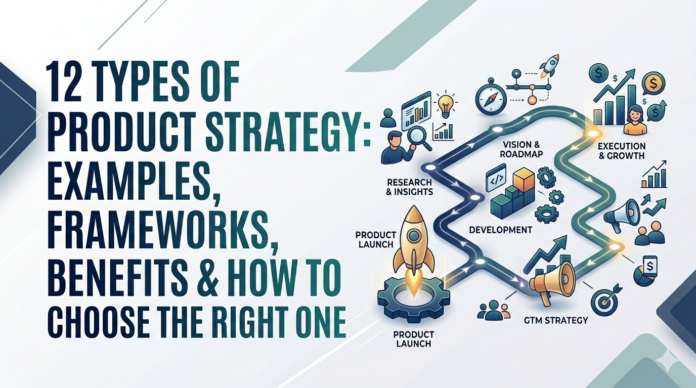
12 Types of Product Strategy: Examples, Frameworks, Benefits & How to Choose the Right One
Every successful product that dominates its market has one thing in common.
It was never built without a plan.
Whether it is Apple’s iPhone, Tesla’s electric vehicles, Netflix’s streaming platform, or Amazon’s cloud business, each product’s success can be traced back to a carefully designed product strategy.
Many businesses assume that building a great product is enough to win customers. In reality, great products fail every day because they lack a clear strategy. Some are priced incorrectly. Others target the wrong audience. Some fail because they look too similar to competitors.
A product strategy acts as the blueprint that guides every decision throughout a product’s lifecycle. It determines who the product serves, how it creates value, how it competes, and how it contributes to business growth.
The challenge is that there is no single product strategy that works for every company.
A startup entering a crowded market requires a completely different approach than a global enterprise launching a premium product line.
This is why understanding different types of product strategies is essential.
In this guide, we’ll explore the four foundational product strategy models, eight additional strategic frameworks used by modern businesses, practical examples, and how to choose the right strategy for your organization.
What Is a Product Strategy?
A product strategy is a long-term plan that defines how a product will create value for customers while helping a business achieve its goals.
It provides direction for product development, marketing, sales, and customer experience initiatives.
A strong product strategy answers several critical questions:
- Who is the target customer?
- What problem does the product solve?
- Why should customers choose it?
- How will it compete in the market?
- What business outcomes should it achieve?
Without a product strategy, teams often make decisions based on assumptions rather than evidence.
This frequently leads to wasted resources, poor product-market fit, and slow growth.
Core Elements of Product Strategy
| Element | Purpose |
|---|---|
| Product Vision | Defines the long-term destination |
| Target Audience | Identifies ideal customers |
| Value Proposition | Explains customer benefits |
| Competitive Advantage | Differentiates the product |
| Product Roadmap | Guides execution |
| Success Metrics | Measures performance |
These components work together to create a clear path from idea to market success.
Why Product Strategy Matters
Many products fail because companies focus on building features instead of solving problems.
Customers rarely buy products because they contain more functionality.
They buy products because those products make their lives easier, faster, safer, or more enjoyable.
A product strategy ensures every decision aligns with customer needs and business objectives.
Benefits of a Strong Product Strategy
| Benefit | Business Impact |
|---|---|
| Better Product-Market Fit | Higher customer adoption |
| Clear Positioning | Stronger differentiation |
| Resource Optimization | Reduced waste |
| Team Alignment | Faster execution |
| Revenue Growth | Increased profitability |
| Customer Retention | Improved loyalty |
A product strategy is not simply a planning document.
It becomes the foundation for every major product decision.
Understanding the Four Core Product Strategy Types
Most product strategies used today are built upon four classical strategic approaches.
These approaches influence pricing, positioning, customer targeting, and competitive advantage.
Comparison of the Four Core Product Strategies
| Strategy | Primary Goal | Customer Priority |
|---|---|---|
| Cost Strategy | Lowest price | Affordability |
| Differentiation Strategy | Unique value | Innovation |
| Focus Strategy | Specific niche | Specialized solutions |
| Quality Strategy | Superior performance | Premium experience |
Let’s examine each one in detail.
Cost Strategy
Cost strategy focuses on delivering products at the lowest possible price while maintaining acceptable quality.
The objective is simple.
Offer customers the best value for money.
Businesses following this strategy continuously optimize operations, streamline production, negotiate supplier costs, and improve efficiency.
The goal is to reduce expenses without compromising core customer expectations.
Characteristics of Cost Strategy
- Competitive pricing
- Operational efficiency
- High sales volume
- Standardized products
- Cost optimization
Advantages
| Benefit | Explanation |
|---|---|
| Broad Market Appeal | Affordable products attract more customers |
| Higher Sales Volume | Lower prices often increase demand |
| Competitive Protection | Difficult for competitors to undercut pricing |
Challenges
- Thin profit margins
- Intense competition
- Limited differentiation
Real-World Examples
Companies known for cost leadership include:
- Walmart
- IKEA
- Ryanair
- Costco
These organizations compete primarily through efficiency rather than premium features.
Differentiation Strategy
Differentiation strategy focuses on creating products that stand apart from competitors.
Instead of competing on price, businesses compete on uniqueness.
Customers are willing to pay more because they perceive additional value.
That value may come from innovation, design, technology, customer experience, brand reputation, or specialized functionality.
Characteristics of Differentiation Strategy
- Unique product features
- Strong branding
- Innovation-driven development
- Higher perceived value
- Premium pricing opportunities
Benefits
| Benefit | Explanation |
|---|---|
| Strong Brand Loyalty | Customers become emotionally attached |
| Higher Profit Margins | Premium pricing becomes possible |
| Reduced Price Competition | Value matters more than cost |
Challenges
- Higher development costs
- Continuous innovation requirements
- Competitive imitation risks
Real-World Examples
Several globally recognized companies excel at differentiation.
| Company | Differentiation Factor |
|---|---|
| Apple | Design and ecosystem |
| Tesla | Electric vehicle innovation |
| Dyson | Product engineering |
| Rolex | Luxury craftsmanship |
These companies sell experiences and perceptions alongside products.
Focus Strategy
Focus strategy concentrates on serving a specific market segment exceptionally well.
Rather than appealing to everyone, businesses choose a particular customer group and tailor products specifically to their needs.
This specialized approach often creates strong customer loyalty.
Characteristics of Focus Strategy
- Niche audience targeting
- Specialized solutions
- Deep customer understanding
- Limited market scope
- High customer relevance
Benefits
| Benefit | Explanation |
|---|---|
| Less Direct Competition | Niche markets are often underserved |
| Strong Customer Relationships | Businesses understand customers deeply |
| Efficient Marketing | Highly targeted campaigns |
Challenges
- Smaller market size
- Dependence on niche demand
- Growth limitations
Real-World Examples
| Company | Target Audience |
|---|---|
| ConvertKit | Content creators |
| Notion (early growth) | Productivity enthusiasts |
| Tesla (initial years) | Premium EV buyers |
Focus strategy often works particularly well for startups entering competitive markets.
Quality Strategy
Quality strategy emphasizes superior craftsmanship, reliability, and performance.
Businesses pursuing this strategy position their products as premium offerings.
Customers are willing to pay higher prices because they associate the product with excellence.
The strategy relies heavily on customer trust and brand reputation.
Characteristics of Quality Strategy
- Exceptional performance
- Premium materials
- Rigorous quality control
- Long product lifespan
- Strong customer satisfaction
Benefits
| Benefit | Explanation |
|---|---|
| Premium Pricing | Customers pay more for quality |
| Strong Reputation | Builds long-term trust |
| Higher Customer Retention | Satisfaction increases loyalty |
Challenges
- Higher production costs
- Longer development cycles
- Greater customer expectations
Real-World Examples
| Company | Quality Positioning |
|---|---|
| Mercedes-Benz | Luxury automobiles |
| Dyson | High-performance appliances |
| Samsung Flagship Devices | Premium technology |
| Bose | Audio quality |
Quality strategy succeeds when customers prioritize excellence over affordability.
How to Choose the Right Product Strategy
Many businesses struggle because they attempt to combine multiple strategies without clear priorities.
Choosing the right strategy depends on several factors.
Product Strategy Decision Framework
| Question | Strategic Consideration |
|---|---|
| Who are your customers? | Target audience needs |
| What problem are you solving? | Product value |
| Who are your competitors? | Market positioning |
| What resources are available? | Execution capability |
| How will you differentiate? | Competitive advantage |
Strategy Selection Matrix
| Business Situation | Recommended Strategy |
|---|---|
| Highly Competitive Market | Differentiation |
| Budget-Conscious Customers | Cost Strategy |
| Specialized Audience | Focus Strategy |
| Premium Market Position | Quality Strategy |
The best strategy is not necessarily the most innovative.
It is the strategy that aligns most closely with customer expectations and business capabilities.
Beyond the Core Models: Modern Product Strategy Types
While the four classical approaches remain highly relevant, modern businesses often require more specialized strategic frameworks.
The rise of SaaS, digital products, global markets, and platform businesses has expanded how organizations think about product strategy.
The next section explores eight additional product strategy models used by startups, enterprises, and technology companies worldwide.
1. B2B Product Strategy
Business-to-business product strategies focus on serving organizations rather than individual consumers.
These products prioritize efficiency, productivity, scalability, compliance, and measurable business outcomes.
Key Characteristics
- Longer sales cycles
- Enterprise relationships
- Multi-stakeholder decision-making
- ROI-driven value propositions
Examples
- Salesforce
- Microsoft Azure
- HubSpot
- Slack Enterprise
2. B2C Product Strategy
Business-to-consumer strategies target individual customers.
These products often emphasize convenience, emotional appeal, brand perception, and user experience.
Key Characteristics
- Large customer base
- Faster purchasing decisions
- Strong branding importance
- Customer-centric design
Examples
- Apple iPhone
- Coca-Cola
- Nike
- Spotify
3. Tech Product Strategy
Technology-focused product strategies emphasize innovation, scalability, and continuous improvement.
These products often operate in rapidly evolving markets where customer expectations change frequently.
Key Characteristics
- Fast development cycles
- Frequent updates
- Technology-driven differentiation
- Scalability focus
Examples
- Google Workspace
- Netflix
- AWS
- OpenAI
4. Product Line Strategy
Product line strategy involves developing multiple related products under a single brand ecosystem.
The goal is to create synergy between offerings while increasing customer lifetime value.
Examples
- Apple ecosystem
- Samsung Galaxy family
- Sony entertainment products
A successful product line strategy encourages customers to remain within the same ecosystem rather than purchasing from competitors.
Now, let’s examine the remaining product strategy types that organizations use to drive growth, expand markets, strengthen brands, and create long-term competitive advantages.
5. Product Mix Strategy
While product line strategy focuses on related products, product mix strategy involves managing multiple product categories that may not be directly connected.
The objective is diversification.
By operating across different product categories, businesses reduce dependence on a single revenue source and create multiple growth opportunities.
A broader product portfolio can also protect companies from market fluctuations and changing customer preferences.
Characteristics of Product Mix Strategy
- Multiple product categories
- Diverse customer segments
- Several revenue streams
- Risk distribution
- Portfolio management
Benefits
| Benefit | Explanation |
|---|---|
| Reduced Business Risk | Revenue comes from multiple products |
| Market Expansion | Reach broader customer groups |
| Cross-Selling Opportunities | Existing customers buy more products |
| Stronger Brand Presence | Increased visibility across industries |
Challenges
| Challenge | Explanation |
|---|---|
| Operational Complexity | Managing many products requires resources |
| Brand Dilution Risk | Too many unrelated products may confuse customers |
| Resource Allocation | Prioritization becomes difficult |
Examples
| Company | Product Mix Examples |
|---|---|
| Amazon | E-commerce, cloud computing, advertising, entertainment |
| Unilever | Food, personal care, cleaning products |
| Tata Group | Technology, automobiles, hospitality, consumer products |
A successful product mix strategy balances growth opportunities with operational efficiency.
6. New Product Development Strategy
Innovation is often the engine that drives long-term business success.
A new product development strategy focuses on creating entirely new offerings to address emerging customer needs or capture new market opportunities.
Companies adopting this approach invest heavily in research, experimentation, testing, and customer validation.
Key Objectives
- Enter new markets
- Solve emerging problems
- Create competitive advantages
- Generate new revenue streams
Product Development Process
| Stage | Purpose |
|---|---|
| Idea Generation | Identify opportunities |
| Market Research | Validate demand |
| Concept Development | Design solution |
| Prototype Creation | Build early version |
| Testing | Gather customer feedback |
| Product Launch | Enter the market |
Benefits
- Market leadership
- Increased innovation
- Long-term growth opportunities
- Competitive differentiation
Examples
- Tesla launching new vehicle platforms
- Pharmaceutical companies developing new medicines
- Apple introducing new product categories
The most successful new products are built around genuine customer problems rather than technology alone.
7. Market Penetration Strategy
Market penetration focuses on increasing sales of existing products within existing markets.
Instead of launching something new, companies aim to capture a larger share of the market they already serve.
This strategy is often less risky because businesses already understand the product and customer base.
Common Market Penetration Techniques
- Competitive pricing
- Increased advertising
- Loyalty programs
- Product bundling
- Sales promotions
Benefits
| Benefit | Explanation |
|---|---|
| Lower Risk | Existing product and market |
| Faster Results | No need for new product development |
| Improved Brand Awareness | Greater market visibility |
| Revenue Growth | Increased customer acquisition |
Examples
| Company | Strategy Example |
|---|---|
| Coca-Cola | Promotional campaigns and distribution expansion |
| Spotify | Student plans and family subscriptions |
| Netflix | Localized content and subscription offers |
Market penetration works best when there is still room for growth within an existing market.
8. Market Development Strategy
Sometimes a product has already achieved strong success in one market.
Rather than creating a new product, businesses expand into new customer segments or geographic regions.
This approach is known as market development.
Market Development Approaches
| Method | Example |
|---|---|
| Geographic Expansion | Entering new countries |
| Demographic Expansion | Serving different age groups |
| Industry Expansion | Applying product to new industries |
| Channel Expansion | New distribution methods |
Benefits
- New revenue opportunities
- Broader customer base
- Increased brand recognition
- Reduced dependence on one market
Challenges
- Cultural differences
- Regulatory requirements
- Localization costs
- Market uncertainty
Examples
- Netflix expanding globally
- McDonald’s entering international markets
- Uber launching in new cities
Market development allows businesses to extend product life cycles while maximizing existing investments.
9. Product Extension Strategy
Customers constantly seek improvements and new experiences.
Product extension strategy focuses on enhancing existing products through new features, versions, or variations.
Rather than building something entirely new, businesses improve what already works.
Common Product Extension Approaches
- New product versions
- Feature upgrades
- Premium editions
- Limited editions
- Additional functionality
Benefits
| Benefit | Explanation |
|---|---|
| Lower Development Risk | Builds on existing products |
| Customer Retention | Keeps products relevant |
| Incremental Revenue Growth | Encourages upgrades |
| Competitive Protection | Maintains market position |
Examples
| Brand | Product Extension Example |
|---|---|
| Apple | Annual iPhone releases |
| Coca-Cola | New flavors and variants |
| Microsoft | New Office features |
| Adobe | Continuous software updates |
Successful extensions improve customer value without creating unnecessary complexity.
10. Discontinued Product Strategy
Not every product deserves a permanent place in a company’s portfolio.
Some products become outdated, unprofitable, or strategically irrelevant.
Discontinued product strategy focuses on deciding when and how to retire products.
Although often overlooked, product removal can be just as important as product creation.
Reasons for Product Discontinuation
- Declining demand
- High maintenance costs
- Technological obsolescence
- Strategic repositioning
- Portfolio simplification
Benefits
| Benefit | Explanation |
|---|---|
| Resource Optimization | Focus on stronger products |
| Reduced Costs | Lower support and maintenance expenses |
| Increased Efficiency | Simplified operations |
| Better Strategic Focus | Concentrate on growth opportunities |
Examples
- Microsoft retiring legacy products
- Apple eliminating older connectors and devices
- Google discontinuing underperforming services
Successful companies regularly evaluate their product portfolios and make difficult decisions when necessary.
11. Product Positioning Strategy
Even excellent products can fail if customers do not understand why they matter.
Product positioning strategy focuses on shaping customer perception.
The goal is to establish a distinct place in the customer’s mind.
Core Positioning Components
| Component | Purpose |
|---|---|
| Target Audience | Define ideal customer |
| Category | Identify market space |
| Differentiator | Highlight unique value |
| Brand Promise | Communicate benefits |
Benefits
- Stronger brand identity
- Improved customer recognition
- Better competitive differentiation
- Increased customer loyalty
Examples
| Brand | Positioning |
|---|---|
| Volvo | Safety |
| BMW | Performance |
| Apple | Innovation |
| Nike | Athletic achievement |
Customers rarely remember features.
They remember perceptions.
Strong positioning helps create those perceptions.
12. Brand Extension Strategy
Building trust takes years.
Brand extension strategy leverages existing trust to launch new products under an established brand name.
Instead of starting from zero, businesses capitalize on brand equity already earned.
Benefits
| Benefit | Explanation |
|---|---|
| Faster Market Entry | Existing brand recognition |
| Lower Marketing Costs | Trust already established |
| Reduced Customer Risk | Familiar brand |
| Increased Revenue Opportunities | New product categories |
Challenges
| Challenge | Explanation |
|---|---|
| Brand Dilution | Poor extensions damage reputation |
| Customer Confusion | New category may not fit brand |
| Execution Risk | Expectations remain high |
Examples
| Brand | Extension Example |
|---|---|
| Virgin | Music, airlines, telecom |
| Dove | Soap, shampoo, skincare |
| Amazon | Retail, cloud, entertainment |
| Search, mobile, productivity tools |
When executed correctly, brand extension can unlock significant growth opportunities.
Product Strategy Framework Comparison
Each product strategy serves a different purpose.
Understanding when to use each one is critical.
| Strategy Type | Primary Goal | Best For |
|---|---|---|
| Cost Strategy | Affordability | Price-sensitive markets |
| Differentiation Strategy | Uniqueness | Competitive industries |
| Focus Strategy | Niche specialization | Startups and specialized businesses |
| Quality Strategy | Premium value | Luxury markets |
| B2B Strategy | Business outcomes | Enterprise products |
| B2C Strategy | Consumer appeal | Mass-market products |
| Product Line Strategy | Ecosystem growth | Established brands |
| Product Mix Strategy | Diversification | Large organizations |
| New Product Development | Innovation | Growth-focused companies |
| Market Penetration | Market share growth | Existing markets |
| Market Development | Expansion | Mature products |
| Product Extension | Product evolution | Existing customer bases |
| Product Positioning | Brand perception | Competitive categories |
| Brand Extension | Brand leverage | Trusted brands |
How to Select the Right Product Strategy
Many organizations make the mistake of choosing strategies based on trends rather than business needs.
The best strategy depends on your goals.
If Your Goal Is Growth
Consider:
- Market Development
- New Product Development
- Brand Extension
If Your Goal Is Profitability
Consider:
- Quality Strategy
- Differentiation Strategy
- Product Positioning Strategy
If Your Goal Is Market Share
Consider:
- Cost Strategy
- Market Penetration Strategy
If Your Goal Is Customer Loyalty
Consider:
- Product Line Strategy
- Product Extension Strategy
- Quality Strategy
The most successful companies often combine multiple strategies while maintaining a clear primary focus.
Common Product Strategy Mistakes
Even strong organizations can struggle with product strategy execution.
Mistake 1: Ignoring Customer Research
Assumptions rarely outperform real customer insights.
Mistake 2: Trying to Serve Everyone
Broad targeting often weakens differentiation.
Mistake 3: Competing Only on Price
Price wars usually reduce profitability.
Mistake 4: Lack of Clear Positioning
Customers must understand why a product matters.
Mistake 5: Poor Cross-Team Alignment
Strategy fails when departments move in different directions.
Mistake 6: Measuring the Wrong Metrics
Vanity metrics often hide real business problems.
Mistake 7: Failing to Adapt
Markets evolve constantly.
Product strategies must evolve as well.
Future Trends Shaping Product Strategy
Product strategy is becoming increasingly data-driven and customer-focused.
Several trends are influencing how businesses build products.
AI-Assisted Product Decision Making
Organizations increasingly use artificial intelligence to identify patterns, forecast demand, and support strategic planning.
Hyper-Personalization
Customers expect products tailored to their specific needs and preferences.
Ecosystem-Based Growth
Businesses increasingly create interconnected products rather than standalone offerings.
Faster Experimentation
Companies now validate ideas rapidly through testing and customer feedback.
Sustainability-Focused Products
Environmental responsibility is becoming a strategic differentiator across industries.
The future belongs to companies that combine innovation with deep customer understanding.
Final Thoughts
Product strategy is not simply about deciding what to build.
It is about deciding how a business will create value, compete effectively, and grow sustainably over time.
The strongest products rarely succeed because of luck.
They succeed because every decision aligns with a clear strategic direction.
Whether a company chooses cost leadership, differentiation, niche specialization, premium quality, market expansion, product innovation, or brand extension, the underlying goal remains the same.
Deliver meaningful value to customers while achieving business objectives.
Understanding these 12 types of product strategies gives organizations a practical toolkit for making smarter decisions, entering new markets, improving customer experiences, and building products that stand the test of time.
The right product strategy can transform a good product into a market leader.
The wrong strategy can leave even the most innovative product struggling for relevance.
That is why strategy remains one of the most important investments any business can make.
Helpful Resources for Learning Product Strategy
Adding trusted resources strengthens the credibility of your blog and gives readers practical places to continue learning product strategy, product management, and business growth.
1. Harvard Business Review (HBR) – Strategy & Innovation
Resource: Harvard Business Review Strategy Hub
One of the most respected sources for product strategy, competitive advantage, innovation, customer-centric growth, and business leadership.
2. Product School
Resource: Product School Resources & Guides
Offers practical frameworks, case studies, roadmaps, product strategy examples, and insights from leading product managers.
3. McKinsey & Company – Growth, Marketing & Product Insights
Resource: McKinsey Growth, Marketing & Sales Insights
Provides research-backed insights on customer behavior, product growth, innovation strategy, and market expansion.
4. Gartner Product Management Research
Resource: Gartner Product Management Research
Excellent resource for understanding product frameworks, product lifecycle management, and strategic decision-making.
5. Strategyzer
Resource: Strategyzer Business Model & Value Proposition Resources
Known for the Business Model Canvas and Value Proposition Canvas, two frameworks widely used in product strategy and innovation planning.
6. HubSpot Marketing & Product Growth Resources
Resource: HubSpot Marketing Strategy Resources
Helpful for understanding go-to-market strategy, customer acquisition, product positioning, and growth execution.
20 FAQs About Product Strategy Types
1. What are the main types of product strategy?
The four core product strategy types are Cost Strategy, Differentiation Strategy, Focus Strategy, and Quality Strategy. Modern businesses also use strategies such as Product Positioning, Product Extension, Market Development, and Brand Extension.
2. Which product strategy is best for startups?
Focus Strategy is often ideal for startups because it allows them to target a specific niche market and solve a highly specialized problem before expanding.
3. What is the difference between product strategy and product marketing strategy?
Product strategy defines what product should be built and why, while product marketing strategy focuses on how the product will be positioned, promoted, and sold.
4. What is a differentiation product strategy?
A differentiation strategy focuses on making a product unique through innovation, design, customer experience, technology, or branding.
5. What is a cost leadership strategy in product management?
Cost leadership focuses on offering products at the lowest possible price while maintaining acceptable quality and operational efficiency.
6. What is a focus strategy in product development?
A focus strategy targets a specific customer segment and develops products tailored to their unique needs and challenges.
7. What is a quality strategy?
A quality strategy prioritizes superior performance, reliability, craftsmanship, and customer satisfaction, often allowing businesses to charge premium prices.
8. What is a product line strategy?
A product line strategy involves offering multiple related products under the same brand to increase customer lifetime value and ecosystem adoption.
9. What is a product mix strategy?
Product mix strategy involves managing multiple product categories, often across different markets, to diversify revenue and reduce business risk.
10. What is a product positioning strategy?
Product positioning strategy determines how customers perceive a product compared to competitors and highlights its unique value proposition.
11. What is a market penetration strategy?
Market penetration focuses on increasing sales of existing products within existing markets through marketing, pricing, and customer acquisition initiatives.
12. What is a market development strategy?
Market development involves introducing existing products into new geographic regions, customer segments, or industries.
13. What is a product extension strategy?
A product extension strategy adds new features, versions, models, or variations to an existing product to maintain customer interest and drive growth.
14. What is a brand extension strategy?
Brand extension uses an established brand name to launch new products, helping businesses enter new markets with existing customer trust.
15. How do companies choose the right product strategy?
Companies evaluate customer needs, market conditions, competition, business goals, available resources, and growth opportunities before selecting a strategy.
16. Can a company use multiple product strategies simultaneously?
Yes. Many successful businesses combine multiple strategies. For example, Apple uses differentiation, quality, product line, and brand extension strategies together.
17. Why do some product strategies fail?
Common reasons include poor market research, weak positioning, unclear customer understanding, lack of execution, and failure to adapt to changing market conditions.
18. What is the most profitable product strategy?
There is no universal answer. However, differentiation and quality strategies often generate higher profit margins because customers are willing to pay premium prices.
19. How often should a product strategy be reviewed?
Most businesses review their product strategy quarterly and conduct major strategic evaluations annually to ensure alignment with market trends and customer needs.
20. What skills are needed to create an effective product strategy?
Important skills include market research, customer analysis, strategic thinking, competitive analysis, product management, communication, stakeholder management, and decision-making.

