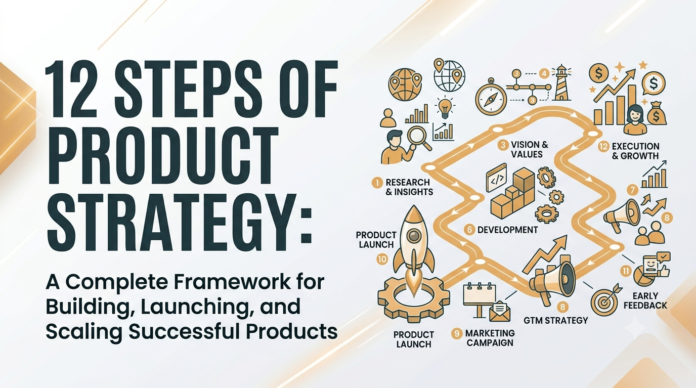
Every successful product starts long before a feature is designed, a prototype is built, or a launch campaign goes live.
Products that achieve lasting success rarely emerge from luck. Behind every successful product lies a deliberate process of research, validation, planning, execution, and continuous improvement.
This process is known as product strategy.
Many organizations focus heavily on product development while overlooking the strategic foundation that determines whether a product will succeed in the market. Teams often jump directly into building features without fully understanding customer needs, market opportunities, competitive pressures, or business objectives.
The result is often a product that works technically but struggles commercially.
A well-defined product strategy prevents this outcome. It provides a structured path that guides organizations from identifying market opportunities to delivering products that create value for customers and business stakeholders alike.
This guide explores the 12 essential steps involved in product strategy, explaining how companies move from an initial idea to a successful product that can grow, adapt, and remain competitive over time.
What Is Product Strategy?
Product strategy is a comprehensive plan that defines how a product will solve customer problems, achieve business goals, and establish a sustainable competitive advantage.
It acts as a bridge between vision and execution.
A strong product strategy helps organizations answer critical questions such as:
- What problem are we solving?
- Who are we solving it for?
- Why will customers choose our solution?
- How will we measure success?
- What path should we follow to achieve growth?
Rather than focusing on individual features, product strategy focuses on outcomes.
Why Product Strategy Matters
| Benefit | Impact |
|---|---|
| Clear Direction | Helps teams stay focused on goals |
| Better Decision Making | Prioritizes high-impact initiatives |
| Reduced Risk | Validates assumptions before investment |
| Customer Alignment | Ensures products solve real problems |
| Competitive Advantage | Differentiates products effectively |
| Business Growth | Connects product outcomes to revenue goals |
Organizations with strong product strategies typically make better decisions, use resources more efficiently, and achieve stronger product-market fit.
Overview of the 12 Product Strategy Steps
| Step | Objective |
| 1. Diagnose the Market and Business Context | Understand the environment |
| 2. Define the Problem to Solve | Identify the opportunity |
| 3. Identify the Target Audience | Determine ideal customers |
| 4. Research the Market | Gather insights and evidence |
| 5. Test the Concept | Validate assumptions |
| 6. Assess Feasibility | Evaluate viability |
| 7. Define the Product Concept | Create strategic direction |
| 8. Set Strategic Goals and KPIs | Measure success |
| 9. Build an MVP or Prototype | Validate quickly |
| 10. Brand and Position the Product | Shape perception |
| 11. Plan Launch and Go-to-Market | Reach customers effectively |
| 12. Review and Improve Continuously | Drive long-term growth |
Let’s explore the first six steps in depth.
Step 1: Diagnose the Market and Business Context
Before solving a problem, organizations must understand the environment in which the product will operate.
Market diagnosis helps teams identify opportunities, risks, customer expectations, industry trends, and competitive pressures.
Many failed products result from poor understanding of the broader market landscape.
Key Activities
Study Market Trends
Markets evolve continuously.
Consumer preferences, technologies, regulations, and competitive dynamics can change rapidly.
Organizations should analyze:
- Emerging technologies
- Industry growth trends
- Consumer behavior changes
- Economic conditions
- Regulatory developments
Identify Growth and Decline Areas
Not all markets grow at the same pace.
Some industries expand rapidly while others shrink.
Understanding where growth is occurring helps organizations invest strategically.
Review Company Goals and Constraints
Every strategy must align with business realities.
Factors include:
- Available budget
- Team capabilities
- Existing customer base
- Strategic priorities
- Operational limitations
Analyze Competitors
Understanding competitors provides valuable insight into opportunities and threats.
Market Diagnosis Framework
| Area | Questions to Ask |
| Customers | What problems exist? |
| Competitors | Who dominates the market? |
| Industry | What trends are emerging? |
| Business | What resources are available? |
| Technology | What innovations are changing the market? |
A strong diagnosis creates the foundation for every decision that follows.
Step 2: Define the Problem to Solve
The most successful products are built around meaningful problems.
Customers rarely buy products because they love features.
They buy products because they need solutions.
This step focuses on identifying a clear and valuable problem.
Collect Customer Pain Points
Organizations can gather insights through:
- Customer interviews
- Surveys
- Support tickets
- User reviews
- Community discussions
Distinguish Symptoms from Root Causes
Customers often describe symptoms rather than actual problems.
For example:
| Symptom | Root Problem |
| Slow workflow | Poor process automation |
| High employee turnover | Inefficient onboarding |
| Low productivity | Lack of collaboration tools |
Understanding root causes leads to stronger product decisions.
Prioritize the Most Valuable Problem
Not every problem deserves equal attention.
Prioritization should consider:
- Customer impact
- Business value
- Market demand
- Competitive opportunity
Problem Statement Example
A good problem statement is simple and specific:
“Remote teams struggle to track project progress across multiple communication platforms.”
Clear problem definition improves strategic focus and reduces wasted effort.
Step 3: Identify the Target Audience
Not every customer is the right customer.
One of the biggest product strategy mistakes is attempting to serve everyone.
Successful products focus on clearly defined audiences.
Segment the Market
Segmentation helps categorize customers based on:
| Segmentation Type | Example |
| Demographic | Age, income, location |
| Behavioral | Usage patterns |
| Firmographic | Company size and industry |
| Psychographic | Values and motivations |
Create Buyer Personas
A buyer persona represents an ideal customer.
A strong persona includes:
- Goals
- Challenges
- Buying motivations
- Preferred channels
- Decision-making factors
Define Primary and Secondary Audiences
Primary audiences receive the greatest attention.
Secondary audiences may benefit later as the product evolves.
Define Who the Product Is Not For
Strategic focus often comes from exclusion.
Knowing who should not use the product prevents wasted effort and confusing messaging.
Step 4: Research the Market
After identifying customers and problems, deeper market research begins.
This step validates assumptions and uncovers opportunities.
Customer Research Methods
| Method | Purpose |
| Interviews | Understand motivations |
| Surveys | Gather quantitative insights |
| Focus Groups | Explore perceptions |
| User Testing | Observe behavior |
| Analytics | Measure engagement |
Competitor Analysis
Research should include:
- Features
- Pricing
- Positioning
- Strengths
- Weaknesses
- Customer feedback
Study Communities and Reviews
Valuable insights often come from:
- Reddit discussions
- LinkedIn conversations
- Industry forums
- Product reviews
- Social media comments
These sources reveal frustrations, desires, and unmet needs.
Estimate Market Size
Understanding market size helps determine growth potential.
Organizations often evaluate:
| Metric | Purpose |
| TAM | Total Addressable Market |
| SAM | Serviceable Available Market |
| SOM | Serviceable Obtainable Market |
Market research transforms assumptions into evidence.
Step 5: Test the Concept
Many organizations invest heavily in products before validating customer interest.
Concept testing reduces this risk.
The goal is simple:
Determine whether customers actually want the proposed solution.
Methods for Testing Concepts
Customer Interviews
Present the concept and gather reactions.
Surveys
Measure interest levels across larger audiences.
Landing Pages
Gauge demand before building the product.
Mockups and Wireframes
Visual representations help customers provide meaningful feedback.
Questions to Ask During Validation
- Does this solve a real problem?
- Would you use it?
- Would you pay for it?
- Which features matter most?
- What concerns do you have?
Concept Validation Outcomes
| Outcome | Interpretation |
| Strong Interest | Continue development |
| Mixed Feedback | Refine concept |
| Low Interest | Reconsider direction |
Validation helps organizations avoid expensive mistakes.
Step 6: Assess Feasibility
An attractive opportunity is not always practical.
Feasibility analysis evaluates whether the product can realistically be built, launched, and supported.
This stage examines technical, financial, operational, and legal considerations.
Technical Feasibility
Questions include:
- Can the technology support the solution?
- Does the team possess necessary expertise?
- Are there significant development challenges?
Business Feasibility
Organizations must evaluate:
- Revenue potential
- Development costs
- Resource requirements
- Return on investment
Operational Feasibility
Consider:
- Customer support requirements
- Infrastructure needs
- Maintenance demands
- Internal processes
Risk Assessment
| Risk Category | Example |
| Technical Risk | Scalability challenges |
| Financial Risk | Budget overruns |
| Market Risk | Weak demand |
| Regulatory Risk | Compliance requirements |
Feasibility Decision Matrix
| Factor | Evaluation |
| Desirable | Do customers want it? |
| Viable | Can it generate business value? |
| Feasible | Can it be built successfully? |
Products should move forward only when all three conditions are reasonably satisfied.
Why the First Six Steps Matter
Many organizations rush into development too quickly.
However, the first half of the product strategy process focuses on understanding, validation, and risk reduction.
These steps ensure teams build products that customers actually want, businesses can support, and markets can sustain.
Without these foundational stages, even the most technically impressive products may struggle to achieve success.
Step 7: Define the Product Concept
Once research, validation, and feasibility analysis are complete, the next step is transforming insights into a clear product concept.
The product concept acts as the blueprint for the product. It defines what the product is, who it serves, why it matters, and how it differs from alternatives already available in the market.
A strong product concept creates alignment across product, engineering, marketing, sales, and leadership teams.
What Should a Product Concept Include?
| Component | Purpose |
|---|---|
| Target Audience | Defines who the product serves |
| Core Problem | Identifies the challenge being solved |
| Value Proposition | Explains the primary benefit |
| Key Features | Highlights essential functionality |
| Differentiation | Shows how the product stands apart |
| Positioning | Defines market perception |
Define the Value Proposition
A value proposition explains why customers should choose your product over competing solutions.
An effective value proposition should answer:
- What problem are we solving?
- What outcome does the customer achieve?
- Why is our solution better?
Define Product Positioning
Positioning determines how customers perceive the product in comparison to alternatives.
For example:
| Brand | Positioning |
|---|---|
| Apple | Premium innovation |
| Volvo | Safety and reliability |
| Tesla | Sustainable innovation |
| Airbnb | Unique travel experiences |
Strong positioning simplifies customer decision making and strengthens brand recognition.
Clarify Differentiation
Differentiation is one of the most important elements of product strategy.
Without meaningful differentiation, products often become commodities competing only on price.
Differentiation can come from:
- Features
- Pricing
- Customer experience
- Technology
- Support
- Community
- Brand reputation
The goal is not simply to be different.
The goal is to be meaningfully different in ways customers value.
Step 8: Set Strategic Goals and KPIs
A strategy without measurable goals becomes difficult to evaluate.
This step transforms ideas into specific outcomes that can be tracked and improved over time.
Strategic goals create accountability and help teams focus on meaningful results.
Characteristics of Effective Product Goals
Successful goals are:
- Specific
- Measurable
- Achievable
- Relevant
- Time-bound
Examples of Product Strategy Goals
| Goal Category | Example |
|---|---|
| Revenue Growth | Increase annual recurring revenue by 30% |
| Customer Acquisition | Add 20,000 new users |
| Retention | Improve retention rate from 70% to 85% |
| Market Expansion | Enter two new geographic markets |
| Product Adoption | Increase feature usage by 40% |
Define Key Performance Indicators
KPIs help measure whether the strategy is working.
Common Product Strategy KPIs
| KPI | What It Measures |
|---|---|
| Revenue Growth | Business performance |
| Customer Retention | User loyalty |
| Churn Rate | Customer loss |
| Active Users | Product engagement |
| Conversion Rate | Sales effectiveness |
| Customer Satisfaction | User experience quality |
| Net Promoter Score | Customer advocacy |
| Market Share | Competitive position |
Establish Review Cycles
Metrics become useful only when reviewed consistently.
Organizations typically review:
- Weekly operational metrics
- Monthly performance reports
- Quarterly strategic reviews
- Annual strategic planning sessions
Regular reviews ensure strategies remain aligned with changing market conditions.
Step 9: Build an MVP or Prototype
Many organizations attempt to build a perfect product before launching.
This approach often increases costs, delays feedback, and creates unnecessary risk.
Instead, successful product teams focus on building an MVP.
What Is an MVP?
MVP stands for Minimum Viable Product.
It is the simplest version of a product that delivers meaningful value while allowing teams to learn from real users.
The purpose of an MVP is learning.
It is not perfection.
MVP Development Process
| Phase | Objective |
|---|---|
| Identify Core Features | Focus on essential value |
| Remove Nonessential Features | Reduce complexity |
| Build Prototype | Create a working version |
| Launch to Early Users | Gather real-world feedback |
| Measure Results | Validate assumptions |
Benefits of Building an MVP
- Faster market entry
- Lower development costs
- Reduced risk
- Faster customer feedback
- Better prioritization decisions
Common MVP Mistakes
| Mistake | Impact |
|---|---|
| Too Many Features | Increased complexity |
| No Validation Goals | Limited learning |
| Ignoring Feedback | Missed opportunities |
| Delayed Launch | Slower learning cycle |
The best MVPs focus on solving one important problem exceptionally well.
Step 10: Brand and Position the Product
A great product can still struggle if customers do not understand its value.
Branding and positioning influence how customers perceive a product and whether they remember it.
This step shapes the product’s identity within the market.
Build a Strong Brand Identity
Brand identity includes:
- Name
- Logo
- Visual style
- Tone of voice
- Messaging
- Brand values
Together, these elements create a consistent customer experience.
Develop Core Messaging
Messaging should communicate:
- Who the product is for
- What problem it solves
- Why it matters
- What makes it unique
Positioning Statement Template
A common framework is:
“For [target audience], our product provides [primary benefit] unlike [alternative solution] because [unique differentiator].”
Branding Elements and Their Purpose
| Element | Purpose |
|---|---|
| Brand Name | Recognition |
| Messaging | Communication |
| Visual Identity | Consistency |
| Positioning | Differentiation |
| Value Proposition | Customer relevance |
Strong branding helps products stand out in crowded markets.
Step 11: Plan Launch and Go-to-Market Strategy
A successful product launch requires more than simply making a product available.
Organizations must carefully plan how customers will discover, evaluate, purchase, and adopt the product.
This process is known as go-to-market strategy.
Core Components of a Go-to-Market Strategy
| Component | Purpose |
|---|---|
| Pricing | Determines perceived value |
| Distribution | Defines how customers access the product |
| Marketing | Creates awareness |
| Sales | Converts prospects into customers |
| Customer Success | Improves adoption and retention |
Choose a Pricing Strategy
Pricing affects profitability, positioning, and customer perception.
Common pricing approaches include:
| Strategy | Description |
|---|---|
| Premium Pricing | Higher price for premium value |
| Competitive Pricing | Similar to competitors |
| Penetration Pricing | Lower price to gain market share |
| Freemium | Free basic version with paid upgrades |
| Subscription Pricing | Recurring revenue model |
Select Distribution Channels
Products can reach customers through:
- Direct sales
- Online platforms
- Marketplaces
- Partnerships
- Resellers
Prepare Marketing Assets
Launch preparation often includes:
- Website updates
- Product videos
- Case studies
- Email campaigns
- Sales materials
- Product documentation
A well-planned launch significantly increases the chances of product adoption.
Step 12: Review and Improve Continuously
Product strategy does not end after launch.
Markets evolve.
Customer expectations change.
Competitors introduce new offerings.
Technology advances.
Successful products continuously adapt.
Monitor Product Performance
Track strategic KPIs consistently.
Look for trends rather than isolated data points.
Collect Customer Feedback
Feedback sources include:
- Surveys
- Reviews
- Support tickets
- Customer interviews
- User analytics
Prioritize Improvements
Not every suggestion deserves immediate attention.
Evaluate opportunities based on:
- Customer impact
- Business value
- Strategic alignment
- Development effort
Continuous Improvement Cycle
| Phase | Objective |
|---|---|
| Measure | Gather performance data |
| Analyze | Identify patterns |
| Prioritize | Select improvements |
| Implement | Execute changes |
| Validate | Measure outcomes |
Continuous improvement transforms products from short-term launches into long-term businesses.
Complete Product Strategy Framework
The entire product strategy process can be visualized as a connected system.
| Phase | Outcome |
|---|---|
| Diagnose | Market understanding |
| Define | Clear problem statement |
| Identify | Target audience clarity |
| Research | Evidence-based insights |
| Test | Validated assumptions |
| Assess | Feasibility confirmation |
| Concept | Strategic direction |
| Measure | Success criteria |
| Build | Market-ready MVP |
| Brand | Strong positioning |
| Launch | Customer acquisition |
| Improve | Sustainable growth |
Each step builds upon the previous one.
Skipping stages often creates costly mistakes later.
Common Product Strategy Mistakes
Even experienced organizations occasionally struggle with product strategy.
Understanding common mistakes can help avoid them.
Building Before Research
Many teams become excited about an idea and begin development immediately.
Without research, products often solve the wrong problems.
Targeting Everyone
Products designed for everyone often resonate with no one.
Clear audience focus creates stronger positioning.
Ignoring Customer Feedback
Customer insights should shape strategic decisions.
Ignoring feedback can lead to poor adoption and increased churn.
Prioritizing Features Over Outcomes
Customers care about results, not feature counts.
Successful products focus on value creation.
Lack of Strategic Alignment
When leadership, product, engineering, and marketing teams operate with different priorities, execution becomes inefficient.
Alignment is essential for long-term success.
Best Practices for Product Strategy Success
Organizations with strong product strategies often follow several consistent principles.
Start With the Customer
Customer problems should drive every major decision.
Focus on Outcomes
Measure business impact rather than feature output.
Validate Before Investing
Test assumptions before committing significant resources.
Use Data and Judgment Together
Data informs decisions, but strategic thinking provides context.
Remain Adaptable
Markets evolve quickly.
Strategies should remain stable enough to provide direction while flexible enough to adapt.
Final Thoughts
Product strategy is not a document created once and forgotten.
It is an ongoing process that guides how products create value, achieve business objectives, and remain relevant in competitive markets.
The most successful products rarely emerge from luck or intuition alone.
They result from a structured process that begins with understanding customers and markets, continues through validation and execution, and evolves through continuous improvement.
The 12-step product strategy framework provides a practical roadmap for turning ideas into successful products.
By diagnosing the market, defining meaningful problems, identifying the right audience, validating concepts, assessing feasibility, creating strong positioning, launching effectively, and continuously improving, organizations dramatically increase their chances of building products that customers genuinely value.
In a world where markets evolve rapidly and competition grows stronger every year, a thoughtful product strategy is no longer optional. It is one of the most important competitive advantages a business can possess.

